Showing posts with label study guides. Show all posts

31 December 2012

ASC Education in 2013

As we wrap up another great year at the American Shakespeare Center, we're gearing up to offer even bigger and better programming in 2013 (and beyond). Here's a sneak peek at what we'll be bringing you over the next twelve months:
  • The No Kidding Shakespeare Camp: London Edition: This adventure is something we've been wanting to do for several years now. Dr. Ralph Alan Cohen, drawing on his experience founding JMU's Studies Abroad program and leading overseas trips for many years. This program will focus on Shakespeare's London and the theatrical joys of the modern city. Highlights will include the Globe Theatre, the Museum of London, the British Museum, the Victoria and Albert Museum, Regent's Park, walking tours of important neighborhoods, a day trip to Oxford, and visits to some of London's finest pubs. Registration is now open, and we would love for you to join us next summer.
  • From Class to Cast: 2013 Summer Teacher Seminar: With NKSC heading overseas, we're expanding our Summer Teacher Seminar to a three-day adventure in the mechanics of putting together a play in your classroom. From cutting, doubling, and casting to costume considerations to the language work that forms the basis of all of the ASC's productions, we will walk teachers through some techniques to get Shakespeare's plays up on their feet and into their students' bodies.
  • The 7th Blackfriars Conference: Our biennial celebration of Shakespeare, his contemporaries, and the early modern theatrical world will take place 23-27 October 2013. The gathering will honor George Walton Williams IV and will include keynote addresses from Russ McDonald, Ann Thompson, and Peter Holland, among others. Registration and Abstract Submission are now open.
  • Conferences: Members of ASC Education will make appearances at the Shakespeare Theatre Association conference and at Shakespeare Works When Shakespeare Plays at UC-Davis in January, at the Shakespeare Association of America conference in April.
  • Even more new and improved ASC Study Guides: In 2013, our Lulu offerings will expand to include Othello and The Merry Wives of Windsor, with mini-guides on All's Well That Ends Well and Henry IV, Part 1. I'll also be updating As You Like It and Romeo and Juliet with some fresh new activities.
  • More Education Artists -- meaning more programming for you: Sarah and I spent a week in December training and auditioning new Education Artists, and once they are settled in, they'll be helping us out with workshops, Little Academes, Educational Residencies, Leadership Programming, and much more. Together, we will welcome colleges from all over the country to the Blackfriars Playhouse, including old friends from James Madison University, the Federal Executive Institute, Grove City College, the University of South Dakota, Indiana Wesleyan, and International Paper. Remember, we also take this show on the road with Leadership Programming in Germany and more residencies on the books in 2013.
  • A plethora of pre-show entertainment: Our Dr. Ralph Presents Lectures and Inside Plays Workshops will begin again in just a few weeks with insights into the plays of the Actors' Renaissance Season. Join us select Wednesdays and Thursdays throughout the year at 5:30pm to brush up your knowledge of old favorites or to get an introduction to unfamiliar works. Podcasts of these lectures and our Actor-Scholar Councils will also be available to further enhance your play-viewing pleasure.
  • Slightly Skewed Shakespeare: The 2013-2014 Staged Reading series will feature works that are familiar yet off-kilter, almost-but-not-quite the Shakespearean plays you love and recognize. Join us for the First Quarto of Romeo and Juliet, the forgery Vortigern and Rowena, Nahum Tate's infamous adjustment of King Lear, and the anonymous history The Famous Victories of Henry the Fifth.
  • ASC Theatre Camp: This year's campers will explore Pericles, As You Like It, Richard II, The Taming of the Shrew, John Fletcher's The Wild Goose Chase, and Ben Jonson's Volpone. Registration is now open.
  • Student Matinees: In 2013, we'll be offering nine titles: Julius Caesar and Henry VIII in the Actors' Renaissance Season, Twelfth Night and Love's Labour's Lost in the Spring Season, Romeo and Juliet, All's Well That Ends Well, and Troilus and Cressida in the Fall Season, and A Christmas Carol in the Holiday Season, with a special preview of Spring 2014's Othello.
A very happy New Year to you all -- we look forward to seeing you at the Blackfriars Playhouse in 2013!

27 August 2012

Study Guides for TWELFTH NIGHT and ROMEO AND JULIET now available

I'm pleased to announce that the ASC now has Study Guides available for Twelfth Night and Romeo and Juliet. Thanks to the excellent feedback that we get from teachers who use these materials, ASC Education is able to tailor our resources to the activities that are best-suited for active classroom exploration. Here's a sneak peek at what is included in these brand-new Study Guides:

Twelfth Night
  • Staging Directions: Twinning: In putting twins into several of his plays, Shakespeare breaks all the rules of verisimilitude and classical drama -- but how important is it that stage twins actually look alike? In this activity, your students will uncover how much Viola and Sebastian reflect the theatre of the imagination that Shakespeare so loves to play with.
  • Perspectives: Gender and Behavior: Twelfth Night is famously full of gender-bending and confused sexuality -- issues which are not just politically "hot", but which may be crucial to some of your students as they explore their own identities. The activities in this section will help you navigate these considerations in your classroom by looking at ideas of gender presentation on stage.
  • Rhetoric: Corrupter of Words: Feste the Clown is a famous fool -- but what is it that puts him into that category? Your students will explore Feste's wit and wordplay, discovering how he twists words to show off his quick and clever mind.
  • Textual Variants: Embedded Stage Directions: Modern editors frequently move or insert stage directions, based on what they think readers need to know about the scene. But how necessary are these editions? Shakespeare gives clues for action within the dialogue of his plays. Changing an entrance, exit, or action may make a world of difference to the story that a scene tells.
  • Staging Challenges: Gulling Malvolio: The "box-tree scene," where Maria, Toby, Andrew, and Fabian team up to deceive Malvolio, is frequently one of the funniest scenes in a production of Twelfth Night -- but, it has a lot of moving pieces. Your students will actively explore the potential for comedy in this scene, while wrestling with the requirements imposed by the text and Shakespeare's staging conditions.
  • Perspectives: Music: Twelfth Night is one of Shakespeare's most musical plays. In his own time, the tunes played during or before the performance would have resonated with his audiences -- they would have been popular and familiar. In this activity, your students will explore ways to recover that touchstone in the modern day.
Romeo and Juliet
  • Metrical Exploration: The Conversational Sonnet: Throughout Romeo and Juliet, Shakespeare plays with the familiar form of the sonnet, working it into his prologues as well as into the lovers' conversation. This activity provides an introduction to the poetic form as well as an exploration of its function in Romeo and Juliet's first meeting.
  • Staging Challenges: Stage Combat: From the first scene to the last, Romeo and Juliet is full of opportunities for violence. How do fight choreographers determine how to stage these fights based on information in the text? Your students will examine Mercutio and Tybalt's combat to find out.
  • Rhetoric: Emotional Highs and Lows: Romeo's wild mood swings and hyperbolic emotions may be familiar to your teenaged students -- but how does Shakespeare construct that hormonal rollercoaster? Explore his rhetorical structure to find out.
  • Staging Challenges: Parts and Cues: Theatrical companies in early modern England used "cue scripts" when producing their plays, rolls on which an actor would receive his own lines and only a few cuing words, not the full script of the play. Your students will explore what performance clues may be hidden in those cues.
  • Textual Variants: Quarto and Folio: Romeo and Juliet is one of Shakespeare's plays that exists in multiple early modern forms, including an early and much-altered quarto. In this activity, your students will explore the differences between the First Quarto and the play as they probably know it, looking at key differences in speech length, speech prefixes, stage directions, and more.
  • Perspectives: Comedy and Tragedy: Though one of the world's most famous tragedies, Romeo and Juliet is a play with a surprising amount of comedy in it. Where does that thin line between the genres live, and how does Shakespeare challenge and subvert audience expectations? Your students will find out in this thought-provoking activity.
Additionally, both guides include:
  • The Basics: Getting your students on their feet, working with iambic pentameter, paraphrasing, exploring rhetoric, and turning your classroom into an early modern stage.
  • Line Assignments: A way to give your students ownership over a small section of text, which they will use in further language-based activities and staging explorations.
  • Advice for how to use film in the classroom judiciously and effectively.
  • A guide to producing a 1-hour version of the play in your classroom.
  • Guidelines matching these activities to Virginia SOLs and U.S. Core Curriculum Standards.
  • Full bibliographies for further reading.
Both of these Study Guides are available for purchase at Lulu, along with guides for ten other plays. You can also view 15-page previews of the guides on that site. Coming soon: The Merchant of Venice and The Two Gentlemen of Verona.

06 June 2012

"I am not what I am": Shakespeare and Gender Fluidity

The thing about being active in social media, in fandoms, on the Internet in general is that it exposes you to a broader spectrum of humanity than most people encounter on a day-to-day basis -- and it means that a lot of minority groups get greater exposure on the Internet than they do elsewhere. A lifelong citizen of the web, I'm always learning new things from new groups of people. Because I'm politically interested and active, a lot of the things I learn have to do with civil rights, and because of the nature of current politics, a lot of those rights have to do with sexual attraction and gender equality, in some way or another. I've noticed a trend, in the past few years, of increasing awareness of people who do not conform to the socially projected binary system: people who are neither male nor female, but somewhere in between; people who are not cisgendered, whose mental, emotional, psychological identities don't match with their biological organs; people who are neither heterosexual nor homosexual, but bi-, or pan-, or asexual, or who are still figuring that out. It's a big wide world out there, and there are all kinds of people in it -- but just because we didn't hear as much about these people before doesn't mean they suddenly started existing in the past few years. These ideas have been around for centuries, even millennia -- and Shakespeare had something to say about them, albeit in a different language than we use today.

Five years ago, I don't know that it would ever have occurred to me to use the terms "gender fluidity" or "sliding scale of human sexuality" (and I hadn't even heard the term "cisgendered," which is still new enough that it has yet to make it into the OED) -- particularly not in a Study Guide aimed for teachers of high school and college students. And yet, in an activity I've been preparing for the Twelfth Night Study Guide, I've done just that. Viola gives me a great in -- and so does Antonio, and so does Olivia, so do Orsino and Sebastian. In "Perspectives: Gender and Behavior," I ask teachers to lead their students through an exploration of the gender dynamics in the play. The activities involve looking at the stereotypical presentations of male and female, both in appearance and behavior, examining how Shakespeare invokes these markers in the plays with cross-dressing heroines, and then exploring how the gender confusion creates emotional conflict . As with all our Study Guides, the main focus of the activity is practical -- how do we stage this? How do costumes affect the presentation? How can an actor play against his or her biological gender or usual presentation of gender? But, as this is the Perspectives section, I also take a moment to broaden the scope -- to explore the social issues the play raises, particularly in modern performance, and how those issues may resonate in students' lives. And so part of the activity looks like this:
  • Give your students Handout #5A: Suit Me Like a Man. This handout provides the text of the scenes from five Shakespeare plays where the heroine makes the decision to dress as a man:
  • Discuss:
    • What do Shakespeare's cross-dressing heroines point to as the markers of masculinity versus femininity?
    • What information does Shakespeare convey about how his (male) actors playing female characters will present masculinity?
    • All of these heroines have help in assuming their disguises. Julia and Portia ask their waiting-women; Rosalind has Celia for a comrade; Viola asks the sea captain; Imogen takes the suggestion from Pisanio. How do these relationships pertain to the social anxiety surrounding cross-dressing? Is it different for Viola, who asks a man for help? For Imogen, the only one among the five who does not have the idea herself, and cross-dresses at a man’s suggestion?
    • Further Exploration: Look at Shakespeare's sonnets for more commentary on the comparison and confusion of gender (particularly Sonnet #20). What continuing relevance do these poems and the gender-bending heroines in the plays have in the modern world, as we begin to consider more frequently ideas of gender identity, gender fluidity, and the sliding scale of human sexuality? How is the social anxiety expressed in the plays and poems like or unlike modern social anxiety around the same topics?

It would be easy to write about Twelfth Night without directly addressing these issues -- to keep it locked safely in a very narrow interpretation of historical context, to ignore the potential homoerotic implications, to pass over what attention the play can draw to the fluidity of gender assignation and the possible impermeability of identity. I could skip over that. I could avoid what is still, in this country and across the world, a highly controversial topic.

But I don't want to do that. Because I don't know who's in the classrooms that will be using these materials. I don't know if there will be a girl studying Twelfth Night who has just figured out that she likes girls, or a boy who's discovering that he likes boys, or boys and girls, or neither. I don't know if there might be a student of either gender who has never felt right in his or her body, has never identified with what biology provided. I don't know if there's someone who, like Viola for much of the play, feels stuck somewhere in the middle. I don't know who they are. I don't know if they get support at home or from their friends, or if they're dealing with it all in silence and isolation. I don't know how often they hear that they're sinful, or sick, or monstrous. And so I don't want to close doors for them. I want to give teachers the tools explore these ideas where they live in Shakespeare's works, rather than skimming past them.

Being a teenager is hard enough. Being a teenager who feels profoundly different from his or her peers is even harder -- particularly when that difference, in so much of our country, can make you a target for prejudice, ridicule, and abuse. I like the idea that Shakespeare might be able to help, in some small way -- to let those teenagers know that, even four hundred years ago, someone was questioning the stability of gender identity. More than one someone, really -- Kit Marlowe's homoerotic themes are hardly subtextual, women writers were challenging society's gendered expectations of them, and Italian artists frequently explored androgyny and blurred gender lines in paintings and sculptures. The topic was out there in the early modern world, and students should get to know that. Even that long ago, in a world we often perceive as so much more rigid than ours, some people were pushing the boundaries of what it meant to be a boy or a girl, and some were interrogating the nature of sexual attraction. Real people, not so unlike the modern readers, were exploring alternatives to the prescribed norm, questioning their own emotions and desires, and expressing that through art. So this is why I include the discussion topic in the Twelfth Night Study Guide. If Shakespeare can reach across the centuries and help just one student struggling with these issues of identity, then that makes it worth raising the issue.

30 April 2012

Wandering through Wordles, Part the Second

When I began building last year's set of Study Guides, I devoted a post to the Wordles which we include as part of the Basics unit. ASC Education uses Wordles as a device to introduce students to the idea that Shakespeare's language is their language, that the vocabulary is familiar, not alien. Handing students who are new to Shakespeare a block of uninterrupted text can be intimidating, and the so-called "line of terror" at the bottom of many editions only augments the students' assumptions that they won't understand without explanation. Breaking the words down through a Wordle, however, demonstrates the accessibility of the language. In most instances, the only completely unfamiliar words will be proper nouns -- place names and character names. When students find a challenging word that is not a proper noun, we tell teachers to move back to the text itself; usually, the word's meaning is apparent in context. This method is an easy introduction to Shakespeare's language and can help remove some of the fear that many students experience when first engaging with the text.

Last year, I discovered that Wordles of the first 100 lines can also illuminate something about the plays themselves, as well as what Shakespeare seems to be calling attention to in the first five minutes of a show. As I begin working on the 2012-2013 set -- Twelfth Night, Romeo and Juliet, The Merchant of Venice, and The Two Gentlemen of Verona -- I've started constructing a new series of Wordles. So, as a bit of a teaser for these upcoming Study Guides, I thought I would share the discoveries I've made in these new examples.

To begin, here's Twelfth Night:

The first 100 lines of Twelfth Night stretch over almost two full scenes: Orsino lamenting to his court about Olivia's persistent rejection, and Viola the Illyrian shore, mourning her supposedly drowned brother. The biggest words here are "love" and "brother", and those clues wrap up the relationship dynamics of the play pretty succinctly. Both have a focus in both of the opening scenes; Olivia has recently lost her brother, and uses that as the basis for rejecting Orsino's suit, and Viola thinks her brother Sebastian has drowned. The other words that stand out to me are "may" and "perchance." There's an emphasis on the subjunctive mood, which, in a strange way, sort of highlights the impermeability and the uncertainty that dominates this play. The subjunctive mood is one of desire and doubt, wishes and maybes. Everything is "perchance;" everything exists on unstable ground when we start, and the lines of certainty only become more blurred as the play goes on.

Next up, Romeo and Juliet:
I think, from this Wordle, you get a sense of the challenging atmosphere in the first 100 lines of this play. We see a lot of address happening -- "sir," "thou," "thee" -- so we know, right off, that characters are speaking to each other and that they are, judging by the pronouns, being informal. We also see a lot of active verbs, such as "bite," "draw," "stand," and "strike," as well as other words indicative of a fight -- "sword," "quarrel," "hate." The first 100 lines of Romeo and Juliet set a mood of combat and aggression, and that much is evident in the vocabulary Shakespeare uses. We also get the names of the factions involved, the Capulets and Montagues.

Next, The Merchant of Venice, and I'll confess, this one cracked me up:
Why did this crack me up? Well, as I'd been looking over these first 100 lines, I turned to Sarah and said, "It feels like all anyone does in the first scene of this play is walk up to Antonio and say, 'Hey, man, you look terrible, what's wrong?' Seriously, it just keeps happening." And then I did this Wordle, and lo and behold, our largest words? "Sad" and "Antonio." The Wordle verifies my perception of what's going on in this opening scene. Apart from that, we see a lot of other words related to emotions -- "laugh," "merry," "love," "like," "wearies," "melancholy," -- as well as some words introducing the mercantile aspect of the play: "worth," "ventures," "merchandise," "fortune." It's interesting to me that Shakespeare foregrounds both of those spheres in these first five minutes, demonstrating the complicated links between love and fortune (and between personal merit and financial worth) right from the start.

Finally, the Wordle for the first 100 lines of The Two Gentlemen of Verona, which is interesting in a rather different way from the others:
At first glance, this one is rather weird, and might have you thinking that Two Gents is some kind of pastoral comedy. Why on earth would "sheep" and "shepherd" appear so large? I love this example, because the Wordle actually points at the rhetoric. Those words appear in repetition in the following exchange:
SPEED
Sir Proteus, save you! Saw you my master?

PROTEUS
But now he parted hence, to embark for Milan.

SPEED
Twenty to one then he is shipp'd already,
And I have play'd the sheep in losing him.

PROTEUS
Indeed, a sheep doth very often stray,
An if the shepherd be a while away.

SPEED
You conclude that my master is a shepherd, then,
and I a sheep?

PROTEUS
I do.

SPEED
Why then, my horns are his horns, whether I wake or sleep.

PROTEUS
A silly answer and fitting well a sheep.

SPEED
This proves me still a sheep.

PROTEUS
True; and thy master a shepherd.

SPEED
Nay, that I can deny by a circumstance.

PROTEUS
It shall go hard but I'll prove it by another.

SPEED
The shepherd seeks the sheep, and not the sheep the
shepherd; but I seek my master, and my master seeks
not me: therefore I am no sheep.

PROTEUS
The sheep for fodder follow the shepherd; the
shepherd for food follows not the sheep: thou for
wages followest thy master; thy master for wages
follows not thee: therefore thou art a sheep.

SPEED
Such another proof will make me cry 'baa.'

Proteus and Speed engage in stichomythia, the rapid exchange of lines (as do Sampson and Gregory in the beginning of Romeo and Juliet), and they layer this with punning and repetitions, including antimetabole, the repetition of words in inverted (A-B-B-A) order. The prominence of those terms in the Wordle, then, doesn't introduce us to a large overarching concept of the play, but it does hint at what the tenor of the play will be. This sort of bantering humor continues throughout the text, between many different characters.

The biggest word in this example, though, is "love" -- right from the beginning, that's what Valentine and Proteus are talking about, and that's what they'll keep talking about throughout the entire play. The tensions between romantic love, friendly love, and self-love are what drive this play, and Shakespeare opens by having his two male protagonists discuss when love is real and when it isn't, during which they repeat the word "love" seventeen times.

Since ASC Education began using Wordles as a tool in our Study Guides, we've had great responses to them. These are a great way for a teacher to begin the class discussion of the play on an accessible level, easing students away from their fear and into a discussion of the text. For more information, check out our Study Guides, available as PDF downloads or print-on-demand hard copies through lulu.com.

15 March 2012

"Let each man render me his bloody hand": Blood on the Ides

On the Ides of March last year, I explored the rhetoric of what is possibly my favorite speech in all of Shakespeare: Antony's funeral eulogy for Caesar, in which he whips the plebeians into a murderous frenzy. As I was last year, I remain a little in awe of the strange cultural phenomenon surrounding this day. Quotes from Plutarch and Shakespeare are everywhere -- and I wonder how many people are consciously aware of whom they're quoting, or if those phrases have so permeated our world that they've detached entirely from their original context.

I make my living now with my head in the early modern era, but I've always kept one foot trailing in the classics, particularly in this fascinating period where the Republic crashed and metamorphosed into the Empire. Fortunately, Shakespeare gives me fertile territory on which to indulge both of my historical obsessions. And I'm not alone -- those of us in the Shakespeare world seize on the opportunity that this cultural awareness provides (carpe occasionem?). Twitter is full of our enthusiasm today, and a video on Pursued by a Bear explores the play's place in the common consciousness as well as providing an interesting analysis the dearth of really good productions of the show.


This year, I thought I'd take a look at a particularly interesting staging moment which precedes the great speech I explored last year: when Antony greets the conspirators just after Caesar's murder. Two of the most visually striking moments in Julius Caesar are Caesar's assassination and the subsequent decision of the conspirators to wash their hands in the corpse's blood. This scene can pack quite a bit of power -- especially in a theatre like the Blackfriars Playhouse, where the actors share light with the audience -- but it also lends itself to quite a bit of mess. Blood is something that actors and production companies have to negotiate with, deciding how much to use, what kind to use, where to hide blood packets, whether or not it can get on clothing (and if so, how to get it out; if not, how to keep that from happening). Often, productions choose to stylize the blood in this scene, for those very practical reasons. I will always champion the use of live blood, however, because of what happens later in the scene.
CASSIUS
Where is Antony?

TREBONIUS
Fled to his house amaz'd:
Men, wives, and children stare, cry out, and run,
As it were doomsday.

BRUTUS
Fates, we will know your pleasures:
That we shall die, we know; 'tis but the time
And drawing days out, that men stand upon.

CASSIUS
Why, he that cuts off twenty years of life,
Cuts off so many years of fearing death.

BRUTUS
Grant that, and then is death a benefit:
So are we Caesar's friends, that have abridged
His time of fearing death. Stoop, Romans, stoop,
And let us bathe our hands in Caesar's blood
Up to the elbows, and besmear our swords:
Then walk we forth, even to the marketplace,
And, waving our red weapons o'er our heads,
Let's all cry 'Peace, freedom and liberty.'

CASSIUS
Stoop, then, and wash. How many ages hence
Shall this our lofty scene be acted over
In states unborn and accents yet unknown?

BRUTUS
How many times shall Caesar bleed in sport,
That now on Pompey's basis lies along,
No worthier than the dust?

CASSIUS
So oft as that shall be,
So often shall the knot of us be call'd
The men that gave their country liberty.
First of all, this is weird. There is just no getting around that this is a really strange thing to do with someone you've just killed. This is not a bit of a historical culture, not something Romans just did when they killed someone. To me, it reads as Brutus coming a little unhinged. Then, think about how deep you would have to plunge your hands into a dagger wound -- likely a puncture far more than a rending gash -- to get up to the elbow in blood. It's pretty gruesome, and I think that the more real and visceral the blood appears, the more the audience is going to feel the grotesque aspect of the scene, rather than dismissing it as, "Oh, a thing people just did back then." Live blood also gives the other actors a lot to work with -- physically as well as figuratively -- in terms of how much they are on board with Brutus or not. If at least a couple of the conspirators are visibly uncomfortable with smearing themselves up to the elbow in blood, that also transmits some important information to the audience.

Secondly, it's ambiguous whether or not Trebonius washes his hands in blood along with the rest of the conspirators. He's on stage at this point, but as someone who did not actually take part in the stabbing, I think there's justification for not having him join in the literal bloodbath. You could certainly choose to have him wash in blood at this point, but I think there's more money in having him hold back, because of what happens when Antony -- whom Trebonius detained outside the Senate, whom he kept from coming to Caesar's aid -- enters.
Enter ANTONY

BRUTUS
But here comes Antony:
Welcome, Mark Antony.

ANTONY
O mighty Caesar! Dost thou lie so low?
Are all thy conquests, glories, triumphs, spoils,
Shrunk to this little measure? Fare thee well.
I know not, gentlemen, what you intend,
Who else must be let blood, who else is rank:
If I myself, there is no hour so fit
As Caesar's death hour, nor no instrument
Of half that worth as those your swords, made rich
With the most noble blood of all this world.
I do beseech ye, if you bear me hard,
Now, whilst your purpled hands do reek and smoke,
Fulfil your pleasure. Live a thousand years,
I shall not find myself so apt to die:
No place will please me so, no mean of death,
As here by Caesar, and by you cut off,
The choice and master spirits of this age.

BRUTUS
O Antony! Beg not your death of us.
Though now we must appear bloody and cruel,
As by our hands, and this our present act
You see we do: yet see you but our hands
And this the bleeding business they have done:
Our hearts you see not; they are pitiful:
And pity to the general wrong of Rome,
As fire drives out fire, so pity, pity
Hath done this deed on Caesar. For your part,
To you our swords have leaden points, Mark Antony:
Our arms in strength of malice, and our hearts
Of brothers' temper, do receive you in,
With all kind love, good thoughts, and reverence.

CASSIUS
Your voice shall be as strong as any man's
In the disposing of new dignities.

BRUTUS
Only be patient till we have appeased
The multitude, beside themselves with fear,
And then, we will deliver you the cause,
Why I, that did love Caesar when I struck him,
Have thus proceeded.

ANTONY
I doubt not of your wisdom:
Let each man render me his bloody hand:
First, Marcus Brutus, will I shake with you;
Next, Caius Cassius, do I take your hand;
Now Decius Brutus, yours: now yours, Metellus;
Yours, Cinna; and my valiant Casca, yours;
Though last, not least in love, yours, good Trebonius.
Gentlemen all: Alas, what shall I say?
Antony comes in and shakes each man's bloody hand, one by one, and as he names them, it's hard to feel that he's doing anything other than marking them down for retribution. And then, at last, he comes to Trebonius, who did not stab Caesar himself, but who was nonetheless instrumental to the plot, the means by which Antony was not there to defend his friend. So if Antony has just shaken six other bloody hands, his own would be quite smeared with blood by this point -- which he then transfers to Trebonius. If his hands have been clean till that point, Antony's gesture makes a powerful statement: Trebonius is, in his eyes, every bit as guilty, every bit as culpable, and Antony is every bit as determined to take him down. So, while you could have Trebonius engage in the blood-smearing earlier on, I think you get greater payoff from saving it for this moment.

An exploration of this and other staging challenges in Julius Caesar can be found in our Study Guide -- and the play will be part of the 2013 Actors' Renaissance Season. I'm going to be serving as dramaturg for that production, so I'm sure next March 15th, I'll have something new to share. Until then, cavite idus Martii, everyone!

24 February 2012

Imprimis: Links and Tidbits, 24 February 2012

A few notes and points of interest from the world of Shakespeare studies this week:
  • London's Globe Theatre has awarded its first PhDs to Sarah Dustagheer and Penelope Woods. These women are both friends of the ASC: Woods presented on audience studies at our 2009 Blackfriars Conference, and Dustagheer observed an Actors' Renaissance Season, giving presentations to the MBC MLitt/MFA program on the differences between playing the Globe and playing the Blackfriars Playhouse. Congratulations to them both, and to the Globe for enacting this joint degree-awarding venture with Queen Mary, University of London, and King's College London.
  • The new "Shakespeare's Sisters: Voices of English and European Women Writers, 1500-1700" exhibit at the Folger Library challenges the notion that early modern women didn't write (or, as Virginia Woolf famously asserted, that, if they did, they must have been driven mad by the frustrations of it). The exhibit celebrates such notable female authors as Veronica Franco, Lady Anne Clifford, Lady Mary Wroth, the Mancini sisters, Aemilia Lanyer, Aphra Behn, Susanna Centlivre, and (my personal favorite early modern woman) Lady Mary Herbert. If you can't make it to DC to see the exhibit in person, selections from it are also available online.
  • This week, the ASC welcomes alumni from Dartmouth College for a weekend of entertainment and scholarship. Peter Saccio, the Leon D. Black Professor of Shakespearean Studies at Dartmouth College, was the editor of A Mad World, My Masters for the Middleton Complete Works. Saccio gave a public lecture last night, detailing some of the textual oddities of the script and what that can mean for the stage, and will give several private lectures to the Dartmouth group throughout the weekend.
  • Education Week featured an article on the challenge educators face when attempting to tie their lesson plans to Core Curriculum Standards. "Their current materials fall short, and there is a dearth of good new ones to fill the void." ASC Study Guides (now available on lulu.com!) feature not only guidelines for fulfilling Virginia's Standards of Learning, but also the U.S. Core Curriculum Standards.

As a final note, remember that you still have a few days to get in your nominations for the 2012 Shakespearean March Madness. I've already heard support for Hotspur, Cassius, the Duke of Cornwall, and Richard II. Pitch your pick for this no-holds-barred brawl here.

22 February 2012

ASC Study Guides now available on Lulu.com

The Education Department is pleased to announce the transfer of 10 full-length Study Guides to Lulu.com, a site which allows both for PDF downloads and for print-on-demand hard copies of the text. This is a vast improvement over our old system, and will increase both the visibility and the accessibility of ASC educator resources.

Much of the credit for this transfer goes to ASC Senior Graphic Artist Lauren Rogers, who not only helped get us onto the website, but also redesigned our covers into this far-more-attractive format. The idea comes from Wordles, which we advocate as a way into the text for some of your particularly Shakespeare-skittish students, since they demonstrate how few words in a play or in a given speech are actually unfamiliar. Lauren found the visuals of the Wordles appealing, and she took it from there, giving us these fabulous new covers:


Yesterday, we received our own hard copies, which Sarah will be taking down to Orlando and displaying at the Shakespeare Theatre Association Conference. They've been the source of much delight and merriment in the office:

All of next year's Study Guides -- Twelfth Night, Romeo and Juliet, The Merchant of Venice, and The Two Gentlemen of Verona, along with any mini-guides -- will go directly to Lulu. I'm so looking forward to the opportunities this new integration will present for us.

10 February 2012

Exploration and Revelation: The Winter 2012 Teacher Seminar

This past weekend, we held our Winter Teacher Seminar, a two-day event where participants attend workshops and lectures and see two of the plays of the Actors' Renaissance Season. Thanks in part to a generous grant from the Richard and Caroline T. Gwathmey Memorial Trust, more educators than ever were able to join us – and we had a group from diverse teaching backgrounds: middle schools, high schools, and universities, public and private, military and religious, as well as some professional acting companies and arts organizations. We also had participants join us from as far away as Florida and Pennsylvania, as well as representing 16 cities and counties within Virginia. It was so exciting to have such a full, enthusiastic group with us for the weekend. I always feel so energized after these events, so full of joy for the work that we do together and for the new avenues of insight these educators feed back to me.

Saturday's workshops focused on Much Ado about Nothing, Sunday's on Richard III. Ralph drew connections between the two plays, and how each has its moments of invited and inappropriate laughter, and each its moments inviting or castigating silence. He drew a correlation between these moments on stage and in the classroom – after all, there are times teachers desperately hope that their students laugh at a joke, and there are times teachers abhor hearing laughter. He also encouraged the teachers to find their own personal hook within the play, something that calls to them and energizes them, and to teach those moments. Teaching requires no small part of vulnerability, to lay out the things you care for to what may often seem an unruly mob of the disaffected and cynical.

Saturday morning, we also modeled one of the activities out of the Much Ado about Nothing Study Guide. This one was my baby, and I'd been looking forward to working through it with our seminar attendees ever since I wrote it back in November – so I was actually fairly nervous heading in. Like any teacher, I have had, on occasion, something I'm really excited about flop rather pathetically when brought to the table. I always learn something from that experience – how I might need to tweak the activity, toss out elements that aren't working, or graft a new idea on – but failure isn't exactly pleasant to go through, however constructive it may ultimately be. So, heart in my hands, I stepped up to lead this workshop. And it went wonderfully(!).

The exploration is an active one, examining how language can inform character choices in the various sparring matches between Beatrice and Benedick. Participants – with the help of the rest of the class – look for moments when one character repeats the other, builds on a metaphor the other started, or arranges contrast of some kind. What the seminar attendees discovered – as I'd hoped they would – is that while Beatrice and Benedick use the same rhetorical devices with each other in three different scenes, the way they use them creates three very different moods, from the aggressive sparring of 1.1 to the tender hesitation of 4.1 to the playful equilibrium achieved in 5.2. We make these devices visual and kinetic – to appeal to different kinds of learners – by having our Beatrice and Benedick peg nerf balls at each other each time, highlighting the verbal tennis match they engage in. It was great to see at what moments one of them (usually Beatrice) was able to score more points.

I love this activity for how it demonstrates several different advantages of performance-based learning: first, how Shakespeare creates these characters as so right for each other. No one else in the play – even in a play as full of quick wits as Much Ado is – can quite match their verbal dexterity. Second, the activity highlights that "infinite variety" of performance choices Sarah and I are always talking about. The rhetoric gives actors – and students – not an answer, but the grounds on which to make a decision. Our avatar Beatrices and Benedicks were able to offer so many alternatives on even the smallest moment – it really drives home that idea of performance-based learning. Finally, this activity appeals to many different kinds of learners, as it involves verbal, textual, visual, and kinetic elements. Everyone from the class clown to the shiest member of the class has a place in this activity. I think all of those elements came across for our seminar attendees, and I'm so pleased I got to share this workshop with them.

You can view a sample of this workshop in-progress on YouTube:


The Gwathmey grant also allowed us to bring two guest speakers to Staunton, giving our participants the chance to interact with scholars whose research bears a direct emphasis on the plays they saw and their classroom activities. Chelsea Phillips, a veteran of MBC's MLitt/MFA program and now a third-year Ph.D. student at Ohio State University, came down to share thoughts related to her dissertation: the presence of pregnant bodies on stage. This discussion is particularly relevant this year, as Miriam Donald, who plays Beatrice in Much Ado about Nothing and the Duchess of York, among other roles, in Richard III, is visibly pregnant. We wanted to offer teachers – especially those bringing their students to see one of those two productions this year – the benefit of Chelsea's research into the historical precedent of pregnant actresses playing non-pregnant roles, in order to give them a solid grounding on which to base classroom discussion. Chelsea also works on Ohio State’s partnership with the Royal Shakespeare Company implementing the RSC’s Stand Up for Shakespeare program in local schools, making her a valuable resource on Shakespeare in the classroom. On Sunday, Carter Hailey joined us for a lecture-demo on textual variants. Carter has taught Medieval and Renaissance literature, Shakespeare, and textual studies at Washington and Lee University, the College of William and Mary (where yours truly was one of his students), Sweet Briar College, and Georgetown University, and he publishes on matters bibliographical, lexical, and editorial. In addition to discussing the textual histories of Much Ado about Nothing and Richard III, he shared Hailey’s COMET, a portable optical collator of his own design and construction, which provides critical editors with a new way of examining variants between texts. We synthesized Carter's lecture with an exploration of how to use textual variants in the classroom as a way to give students greater ownership of the text, allowing them to realize that there is no One Shakespeare to Rule Them All – rather, that the text as they see it has already passed through the hands of many compositors and editors, and that they may make choices based on this awareness.

So, that was the weekend. As ever, I wished I had more time. There's always so much more to say, more staging moments to discuss, more of Shakespeare's word- and stagecraft to explore. I'm already looking forward to our spring seminar, in April, when we'll be leaping into A Midsummer Night's Dream and The Winter's Tale. I'm also going to be releasing a survey soon, both to our seminar participants and to anyone who's purchased a Study Guide from us, asking for feedback on the information and activities we provide. It's interesting to have to examine what it is I need to know from our teachers – a sort of backwards self-evaluation. I'll be putting their feedback into practice when I start – very soon – building the Study Guides for next year. My first endeavor will be Twelfth Night, as we already have folks booking the touring company asking for it. I love seeing so much advance enthusiasm for the ASC's synthesis of education and performance. I extend my heartfelt thanks to everyone who joined us this past weekend, and I sincerely hope we'll see you all again soon.

13 January 2012

ASC Education in 2012-2013

The announcement is officially out, the Facebook Jeopardy game is complete, and that means I can share ASC Education's plans for the upcoming year. If you've missed the information elsewhere, here's the American Shakespeare Center artistic line-up for 2012-2013:

Summer
The Merchant of Venice
The Lion in Winter, by James Goldman
The Two Gentlemen of Verona

Fall
Cymbeline
King John
The Merchant of Venice
The Lion in Winter, by James Goldman
The Two Gentlemen of Verona

Holiday
A Christmas Carol
Santaland Diaries
, by David Sedaris
The 12 Dates of Christmas, by Ginna Hoben

Actors' Renaissance
Julius Caesar
The Country Wife
, by William Wycherly
Henry VIII
The Custom of the Country
, by Francis Beaumont & Philip Massinger
Two Noble Kinsmen

Spring/Tempt Me Further Tour
Twelfth Night
Love's Labour's Lost
The Duchess of Malfi
, John Webster

What does this mean for Shakespeare Education at the ASC? For a start, throughout the year, we'll be offering Student Matinees of The Merchant of Venice, The Two Gentlemen of Verona, Cymbeline, A Christmas Carol, Julius Caesar, Henry VIII, Twelfth Night, and Love's Labour's Lost. To complement these opportunities to bring your students to the Playhouse, I'll be preparing brand-new full-length Study Guides for The Merchant of Venice, The Two Gentlemen of Verona, and Twelfth Night, as well as revising (and, quite possibly, adding to) last year's Julius Caesar guide. I will also produce mini-guides for Cymbeline, Love's Labour's Lost, and Henry VIII.

We will, again, have four Teacher Seminars in the 2012-2013 season. On August 10th, we'll be looking at that perennial curriculum favorite, Romeo and Juliet (for which I will also be producing a full-length Study Guide), where both the construction of the language and the complex interplay of comedy and tragedy provide many opportunities for exploration. Our Fall Seminar, September 14th-16th, will focus on The Merchant of Venice and The Two Gentlemen of Verona. I'm excited to tackle the challenge of these two off-kilter comedies, from the racial tensions in Merchant to the troubled ending of Two Gents. Both plays are full of emotionally charged moments, opportunities for audience contact, and clever, fast-paced language, all of which make wonderful fodder for teachers. As we did in 2011 with The Comedy of Errors, we will be linking these non-curriculum plays with their more-frequently-assigned cousins, in order to provide teachers with the greatest opportunity to incorporate staging with study. We also champion these plays as ideal for teachers who are tired of always retreading the same material. The Merchant of Venice and The Two Gentlemen of Verona will provide intrepid educators with a new, invigorating approach to Shakespeare's word- and stagecraft.

Our Winter Seminar, February 2nd-3rd 2013, will focus on Julius Caesar, a play I can never get enough of and can't wait to return to. That play features so prominently two of my favorite things to talk about: rhetoric and audience contact. Those two elements define Caesar for me, more than anything else, and they provide wonderful avenues for making the play exciting for students. Our Spring Seminar, April 12th-14th 2013, will focus on Twelfth Night: frothy fun with some dark undercurrents. I look forward to reawakening some of the same topics I've looked at in As You Like It, The Comedy of Errors, and Much Ado about Nothing -- twins, gender-bending, gulling, etc -- as well as exploring the role of music on the early modern stage.

Throughout the year, we'll continue to hold our lecture series, on select Wednesday and Thursday nights, prior to the evening shows. We've moved the timing of these events to 5:30pm, which will allow attendees enough time to go get a quick bite or a drink at one of downtown Staunton's fabulous eateries before the show begins. I'm pleased to announce that this year, we will have both a Dr. Ralph Presents lecture and an Inside Plays workshop for every play in the Fall, Actors' Renaissance, and Spring Seasons. We're especially pleased that this will allow us to offer audiences some more insight into the shows which are enjoying their Blackfriars Playhouse premieres in 2012 and 2013. See the schedule on our website for more information.

Our Staged Reading series also continues in 2012-2013, with four dynamic titles: the anonymous Edward Ironside (October 28th), an early English chronicle play full of patriotic glory, violent energy, and inventive language; George Chapman's An Humorous Day's Mirth (November 4th), where jealous husbands, absurd courtiers, lapsed Puritans, and lustful monarchs collide; Aphra Behn's Restoration hit The Rover (March 24th, 2013), a quick-witted and wickedly wanton comedy where a group of amorous English exiles revel their way through Naples; and The Insatiate Countess (April 28th, 2013), by John Marston and collaborators, a play of merry widows, virtuous wives, and subverted theatrical conventions. We're in the process of making some exciting changes to how the Staged Readings operate, and we'll have more information on that for you as the year progresses.

And, of course, summer 2012 will be full to the brim with camps for Shakespeare enthusiasts of all ages. ASCTC Session 1, June 17th-July 8th, tackles Twelfth Night, Romeo and Juliet, and John Lyly's Gallathea, while Session 2, July 15th-August 5th, takes on Much Ado about Nothing, 1 Henry VI, and Francis Beaumont & John Fletcher's A King and No King. Our Midsummer Day Camp for ages 9-12, July 9th-13th, moves from the light-hearted comedies of the past few years to the high-octane thriller, Macbeth. Finally, the No Kidding Shakespeare Camp for adults, June 25th-29th, will explore Movement -- both the movement of the actor on stage and the movement of plays from one playhouse to another and out on the road.

It's almost hard to believe that here we are in January 2012, already planning for April 2013, but that's the way of it. The whole education team is looking forward to a full and fabulous year -- we hope you'll be joining us for these explorations into early modern staging.

06 January 2012

'Richard III' Study Guide Now Available!

I am tremendously pleased to announce that the ASC Study Guide for Richard III is now available for purchase online! We've got lots of juicy information for you in this one, stuffed as this play is with amazing language, fascinating characters, and active staging requirements.

As usual, I have a ten-page preview for your preliminary enjoyment. This Study Guide includes the following:
  • The Basics: Getting your students on their feet, working with iambic pentameter, paraphrasing, exploring rhetoric, and turning your classroom into an early modern stage.
  • Line Assignments: A way to give your students ownership over a small section of text, which they will use in further language-based activities and staging explorations.
  • Rhetoric: Stichomythia. Quick, back-and-forth dialogue characterizes some of the play's most memorable scenes. How does Shakespeare use this device to engage the audience's affections?
  • Perspectives: Cursing -- No, not that kind of cursing. This activity goes to the heart of what power a play can invest in words. Does Margaret really bring down the House of York with her invective language, or does she merely prophesy what was already destined to occur? Your students will explore some of Shakespeare's most inventive insults and deliciously antagonistic vitriol to determine the relationship between language and fate.
  • Staging Directions: Richard III has some of Shakespeare's most explicit and detailed stage directions, uncommon for the early modern stage. Your students will explore what information those directions offer versus the information embedded in the text of the play itself.
  • Perspectives: Richard's Reputation. What was the historical reality of Richard III's reign, where did Shakespeare get his ideas about crookbacked Dick from, and how can an actor use this information in performance?
  • Staging Challenges: Haunting Richard and Helping Richmond. Your students will explore ways of bringing Richard III's supernatural elements to life.
  • Textual Variants: While the 1623 Folio is the longer text and the version more closely related to Shakespeare's sources, the earlier quartos may reflect changes made for the stage or while the company was touring the provinces. Your students will explore the transmission of text and how those alterations can change the overall impression of the play.
  • Rhetoric: Richard and the Audience. In Richard III, Shakespeare created one of his most enduringly memorable characters, and Richard's relationship with the audience is critical to his legacy. But how does Shakespeare craft that relationship?
  • A guide to producing a 1-hour version of the play in your classroom
And that completes the set! All of the Study Guides for our 2011-2012 artistic year are now complete, and you can preview any of them before purchasing your downloadable PDF. We also provide hard copies to educators who attend our Teacher Seminars -- join us next month for Much Ado about Nothing and Richard III. Teachers who bring students to matinees can receive download access by contacting Ben Ratkowski.

My next task (already in-progress) is to update last year's guides for Macbeth, The Taming of the Shrew, The Comedy of Errors, and As You Like It with the newly expanded Basics section. Once I've completed the upgrade, I'll move on to the Study Guides for the 2012-2013 artistic year. What will those be? I can tell you... next week! Artistic Director and Co-Founder Jim Warren will be announcing the 2012-2013 lineup tomorrow night, before the opening of Much Ado about Nothing, and after that, I'll be able to detail which of them will be our school matinee and Study Guide shows. Stay tuned next week for that information -- or, join us at 7pm Saturday night and hear it from Jim!

14 December 2011

'Much Ado About Nothing' Study Guide Now Available!

At last! I get to share the Study Guide for my very favorite play, Much Ado about Nothing. As I noted in a previous post, I've enjoyed this one tremendously, and I'm already super-excited about getting to work through these activities with attendees at our Winter Teacher Seminar.

Shakespeare Education: Much Ado about Nothing Study GuideHere is a ten-page preview for your enjoyment. This Study Guide includes the following activities:
  • The Basics: Getting your students on their feet, working with iambic pentameter, paraphrasing, exploring rhetoric, and turning your classroom into an early modern stage.
  • Line Assignments: A way to give your students ownership over a small section of text, which they will use in further language-based activities and staging explorations.
  • Too Wise to Woo Peaceably: Benedick and Beatrice are one of Shakespeare's finest couples, witty and brilliant and endearing. Better than all of that, however, they're both fantastically smart -- and in this activity, your students will explore the rhetoric of their scenes and discover how Shakespeare uses their language to show the audience that they deserve each other and belong together.
  • Perspectives: Slanderous Tongues. Much Ado about Nothing's plot revolves around an issue that your students experience every day in high school life: rumors. Your students will examine the language of slander in Much Ado and will relate Hero's unfortunate situation to their own lives. What words hurt the most? On what basis can a girl's reputation become ruined? How is reputation different from a male perspective?
  • Dogberry: Before malapropism was malapropism, it was something else entirely. From everlasting redemptions to odorous comparisons, your students will discover the comic gold that is Dogberry's creatively mistaken vocabulary.
  • The Gulling of Benedick and Beatrice: Your students will explore the staging requirements of two of the play's best comic scenes, when Benedick and Beatrice each hear their friends conspiring against them. Where can you hide the eavesdroppers so that the audience can see their reactions -- critical to the success of the scene -- without breaking the imaginative fiction that allows Benedick and Beatrice to believe that their gullers are unaware of their presence? These scenes take advantage of early modern staging conditions in creative ways, and working through them will get your students thinking actively about thrust staging, universal lighting, and audience contact.
  • Staging Challenges: Kill Claudio. Shakespeare's plays rarely fit neatly into the categories of comedy and tragedy that we've created for them, and a key example of this in Much Ado about Nothing is the moment when Beatrice challenges Benedick to prove his worth to her by killing the man who dishonored her cousin. Through active staging, your students will explore different potential interpretations of this scene and will determine which version they feel tells the best story.
  • Textual Variants: The earliest printed versions of Much Ado about Nothing have several textual oddities -- oddities which reveal that this play may be more closely related to Shakespeare's original manuscript than any other in the canon. Activities on speech prefixes and stage directions will walk your students through an examination of the transmission of text in early modern London.
  • Production Choices: A guide to producing a 1-hour version of the play in your classroom.

If you would like to purchase a downloadable PDF of this or any other ASC Study Guide, just visit our website. I'm already well into work on the Study Guide for Richard III -- the last for this artistic year! After which, my plan is to bring the 2010 set up-to-date with the modifications we introduced for the 2011s, and then I will start work on 2012.

02 December 2011

Too Wise to Woo Peaceably

The Much Ado about Nothing Study Guide should be ready soon (and I hope I'll have a 10-page preview for you on Monday), and I just have to say, I'm enjoying this one more than probably ought to be allowed. I'm enjoying it so much, in fact, that I couldn't wait until the release to tell you what a good time I'm having.

Much Ado about Nothing is my favorite play, and this has never been a secret to anyone who knows me. It was not the first Shakespeare play I read, but it was the first one I saw in performance, at the age of 12, in the little theatre in the basement of the Virginia Museum of Fine Arts. From that night on, it was all over for me. Much Ado had won my heart, and nothing since has had any power to tempt it away.

There's a lot that's good in this play -- the satire of courtship between Claudio and Hero, the insidious villainy of Don John, the overconfident antics of Constable Dogberry -- but for my money (and I suspect for many others' as well), this show is all about Beatrice and Benedick. They are both the head and the heart of the story, the greatest wits and also the characters who demonstrate the most tremendous emotional depth. I think theirs is the most emotionally real of all of Shakespeare's love stories, not least because it's a more mature affair than many others. Benedick and Beatrice have loved and lost and hurt before; Beatrice tells us this flat-out, though Shakespeare tantalizingly never elucidates the circumstances of their shared past:
DON PEDRO
Come, lady, come; you have lost the heart of

Signior Benedick.


BEATRICE
Indeed, my lord, he lent it me awhile; and I gave
him use for it, a double heart for his single one:
marry, once before he won it of me with false dice,
therefore your grace may well say I have lost it.
I like this glimpse of backstory not only for the magnificent potential for emotional nuance that it gives performers, but also because it provides Beatrice and Benedick with a more solid foundation on which to build a relationship. If they only fall in love with each other because their friends trick them into it, that would make them fairly shallow people, and it would not inspire a lot of hope for a successful future -- but if the love is already there and just needs to be rekindled, that paints a much brighter picture.

I've been working on an activity that I just can't wait to test out with the participants of our Teacher Seminar in February, examining the progression of their relationship through an analysis of how they use language. Shakespeare shows the audience, so clearly, that these two are meant for each other. No one else in the play uses language quite the way they do. For all the banter, quips, and Beatrice and Benedick are the only two who so consistently take each others' words, fire them back across, and set up for the next volley.

The rhetoric shows us not only how smart they are -- and these two characters are some of Shakespeare's most verbally intelligent creations -- but how well they work together. At the beginning of the play, those shared words and mimicked rhetoric are part of the battle, a game of one-up-manship they play with each other. By the end of the play, however, Beatrice and Benedick are using those same figures in a completely different way; instead of combating each other, they're working together, building off of each others' words instead of trying to tear each other down. There's still an element of challenge there -- essential, I think, to their relationship -- but it's no longer with the end goal of destruction. Beatrice and Benedick prove themselves a delightfully matched pair. From the "gay couples" of Restoration comedy to the comedies of manners in the eighteenth and nineteenth centuries, the "screwball" comedies of the 1930s and 40s, and the sitcoms of today, their legacy is certainly a magnificent one.

15 November 2011

'Henry V' Study Guide Now Available

The ASC Study Guide for Henry V is now available. I got to stretch my historical muscles and revisit my medieval studies roots for this one, which was a real treat for me.
Here is a ten-page preview for your perusing enjoyment. Activities in this guide include the following:
  • The Basics: Getting your students on their feet, working with iambic pentameter, paraphrasing, exploring rhetoric, and turning your classroom into an early modern stage.
  • Line Assignments: A way to give your students ownership over a small section of text, which they will use in further language-based activities and staging explorations.
  • Staging Challenges: Dealing with Canterbury's seemingly interminable Salic Law speech -- and turning it into an exciting exploration of language and performance opportunities. The Salic Law speech may, at first, seem to represent everything your students fear most about Shakespeare: an enormous block of text, spoken by a high-ranking official, which doesn't appear to say anything of importance. This activity will help you show your students that there is humor for the mining in Canterbury's digressions, and that the entire speech is a set-up for a grand punchline.
  • Perspectives: How does Henry craft his language in order to motivate his men? And is he really such a glorious leader, or is there some disconnect between the Henry that the Chorus celebrates and the Henry that Shakespeare shows us in action? This activity examines the examples of leadership, both positive and negative, presented in Henry V: heroic Henry, not-so-heroic Henry, the flippant Dauphin, the aging Charles VI, the brusque Fluellen, and others. Your students will relate Shakespeare's various portrayals of leadership to modern politics, and will examine Henry's methods of motivation as compared to modern military recruiting techniques.
  • Perspectives: The Battle of Agincourt stands as one of England's most famous victories, but what were the historical realities? Were the English outnumbered 6-to-1? 10-to-1? Or just 4-to-3? Your students will explore contemporary accounts, secondary sources, and modern research to cast new light on the version of events Shakespeare portrays. They will also discuss the place that Agincourt holds in the English narrative of national identity and will explore what similar moments in American history hold that same position for us.
  • Rhetoric: Henry V is one of Shakespeare's very best speakers. He fits his speech to the occasion and his listeners remarkably well, changing his tenor, his vocabulary, and his rhythms for greatest appeal. Your students will examine those conditions throughout their exploration of Henry V, but how does Henry speak when he is alone with the audience? In this activity, your students will explore how Henry uses devices of repetition and substitution in order to build a rapport with the audience.
  • A variety of scenes for alternative stagings.
  • Production Choices: A guide to producing a 1-hour version of the play in your classroom
If you would like to purchase a downloadable PDF of the Henry V Study Guide, or of any of our other Study Guides, please visit our website. I've already begun work on the next offering: Much Ado about Nothing -- It's my all-time favorite play, so I'm quite excited about it.

07 October 2011

'A Midsummer Night's Dream' Study Guide Now Available

The ASC Study Guide for A Midsummer Night's Dream is now available on our website. And, I promise you, this one's a lot of fun. Midsummer has so much potential for playing, and I think we've found some ways to really bring that to life in classrooms.

Here is a ten-page preview. The Study Guide contains the following activities:
  • The Basics: Getting your students on their feet, working with iambic pentameter, paraphrasing, exploring rhetoric, and turning your classroom into an early modern stage. These sections include, for your benefit, the first 100 lines of text, already marked-up, to use as a model in the classroom.
  • Line Assignments: A way to give your students ownership over a small section of text, which they will use in further language-based activities and staging explorations.
  • Metrical Magic: Examines the performance clues provided by the shifts between normal iambic pentameter and the unusual trochaic tetrameter, the rhythm of spellcasting. The moments when a speaker transitions from one form to the other provide the basis for performance choices. Does the unusual meter call for music? A different physicality? How can actors emphasize the mysticism of what's going on in those moments?
  • Staging Challenges: Titania's Bower explores the opportunities presented by the early modern stage. When Titania falls asleep on stage, where can she be placed? She can't be too much in the way of what's going on, but she also needs to be close enough for Oberon to ensorcel her and for Bottom to wake her. Students will experiment with different options and determine which they think is most effective.
  • Perspectives: Courtship Rituals examines the social context of the romantic troubles in the play. How would Shakespeare's audience have perceived Egeus's ruthless inflexibility and Hermia's defiance? What implications of pre-contracted betrothals are in the play?
  • Staging Challenges: Actors Playing Actors. The well-meant shenanigans of the Mechanicals can illuminate some potential clues about Shakespeare's own theatrical world. In this activity, your students will first explore the rehearsal process that Quince, Bottom, and the rest display, and then will prepare their own production of 'Pyramus and Thisbe'. We expect the result to be far more mirthful than tragical.
  • Perspectives: Fairies explores the changing nature of the fae in literature, from its darker origins in English folklore to the benign transformation effected by the Victorians and Disney. Students will choose a source as inspiration for costume design in their vision of A Midsummer Night's Dream.
  • Textual Variants: Examines a curious difference in speech prefixes between the Quarto and Folio versions of A Midsummer Night's Dream (which I discussed in my last post).
  • Creative writing exercises based on the play, involving imitating Pyramus's questionable poetry or giving relationship advice to one of the lovers
  • A guide to producing a 1-hour version of the play in your classroom
If you would like to purchase a downloadable copy of the study guide for A Midsummer Night's Dream, or any of our other available titles, please visit our website. Next up on the slate: Henry V.

27 September 2011

Call Philostrate and/or Egeus

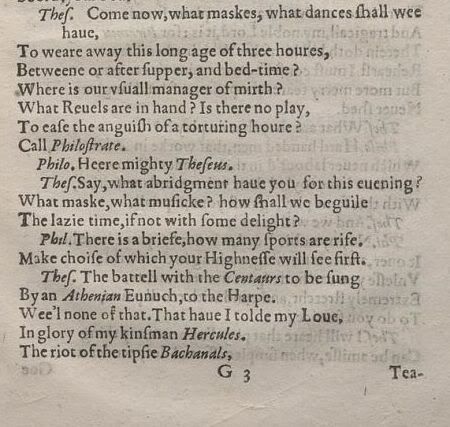
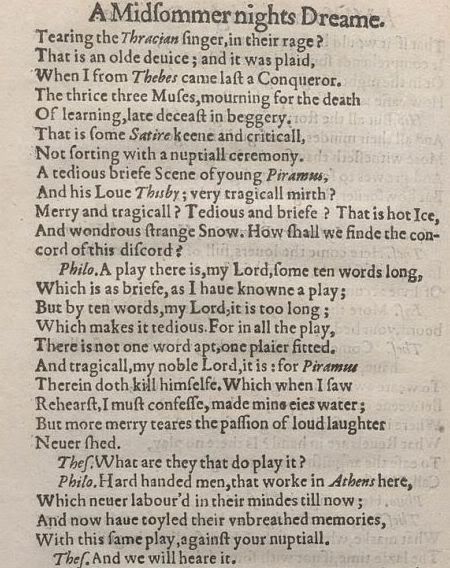
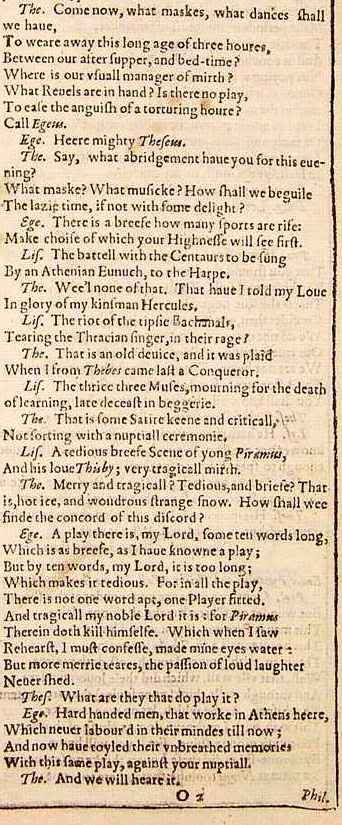
Working on the ASC Study Guide for A Midsummer Night's Dream, I've had my first chance in a while to examine differences between Quarto and Folio versions of a text. Intern Kim Lenz prepared the Textual Variants section for the Hamlet study guide, and everything else I've worked on since the end of last season has been a text which only exists in the Folio. I knew that, looking at Midsummer, I wanted to find a Quarto/Folio variation, rather than looking at a choice made by modern editors. I found a great opportunity for exploration in 5.1, when Duke Theseus is debating who to select for the post-nuptial entertainment. In the Quarto edition of the text, Theseus reads off the list of potential entertainments and responds to himself. His servant Philostrate responds to the idea of watching the Mechanicals' version of 'Pyramus and Thisbe.' In the Folio version of the text, however, Lysander reads off the list to Theseus, and Egeus attempts to dissuade him.

Quarto Version


Folio Version


What interested me about this isn't just that the speech prefixes get reassigned -- what I find particularly intriguing is that almost nothing else changes between the two versions. Throughout the conversation and the itemization of theatrical endeavors, most of the spellings and puncutation remain consistent between the editions. Even the least-orthodox of the spelling variations -- "muſicke", "Wee'l", "tipſie", "vſuall" -- remain the same between the Quarto and the Folio. At Philostrate's/Egeus's speech beginning "A play there is," inconsistencies begin to appear, but until that point, it looks as though whoever did the typesetting for the Folio copied the Quarto nearly identically -- except for the prefixes.

The striking similarities in typesetting, despite the considerable change to the speech prefixes, really makes me wonder what the cause for that change was. Could this be an example of the Folio text reflecting a change to the play-as-produced? Somewhere between 1600 and 1623, did Shakespeare the author, or the King's Men as a company, decide that the scene worked better as a dialogue between Lysander and Theseus? Did a new doubling mean that whoever played Philostrate in 1.1 could not be available for this section of text? This change seems too large and too deliberate to have been an error, since it involves not only reassigning speech prefixes but also breaking a monologue into a dialogue. There must have been a reason -- but we're not ever likely to find out what that reason was. This textual variant offers a tantalizing opportunity for speculation -- just the sort of intellectual and imaginative experiment that makes working with early modern texts so intriguing.

22 September 2011

Hamlet Study Guide now available

I am pleased and proud to announce that the Hamlet ASC Study Guide is now available for purchase online!Here is a ten-page preview, for your viewing enjoyment. This Study Guide covers the following:
  • Our Basics: getting students on their feet, giving them ownership of specific sections of text, exploring iambic pentameter and the rhythms of prose, discovering acting choices, paraphrasing, introductory level rhetoric, how to turn your classroom into an early modern stage, and the hidden guidance of embedded stage directions and audience contact
  • 15 questions your students will ask (Did Ophelia kill herself? Is Hamlet in love with his mother?) and how to deal with them.
  • Staging Challenges: Darkness -- The opening scene of Hamlet is one of the best examples of how Shakespeare uses his staging conditions and the talents of his actors in order to set a mood. Your students will explore the information Shakespeare provides about how to "act darkness."
  • Perspectives: Catching Consciences -- Did early modern theatre improve the moral judgment of its audiences, or did it lead them into lives of sin? How did this viewpoint influence Hamlet's attempt to learn Claudius's guilt through The Mouse-trap? And how does media continue to influence behavior -- or does it?
  • Staging Challenges: Heard and Overheard -- Hamlet's most famous monologue, "To be or not to be," is not, as it often gets portrayed in media, a soliloquy. Ophelia, Claudius, and Polonius are all listening -- but is Hamlet aware of that? Your students will explore the different opportunities presented by this scene and how those choices can affect the audience's perception of Hamlet's "antic disposition."
  • Staging Challenges: Placed to the View -- Hamlet ends in a bloodbath, so what do you do with all of those bodies left on stage? Your students will explore the staging of the play's final moments, working through both the technical requirements and the emotional potential.
  • Rhetoric: Matter and Art -- Polonius talks a lot, and how he says something is often as important as what he says. Your students will look in-depth at his use of two different rhetorical figures to examine what that can tell an actor about his character.
  • Textual Variants -- Hamlet exists in several early modern editions, with notable variations between them. In this activity, your students will examine some differences between Quarto 1, the supposedly "bad" quarto, and the Folio-standard text.
  • Perspectives: Revenge Tragedies -- Hamlet fits in with the popular early modern genre of the revenge tragedy, a tradition which gave the stage a number of bloody spectacles and philosophical quandries. Your students will explore Hamlet's similarities and differences to two other early modern revenge tragedies, The Spanish Tragedy and The Revenger's Tragedy, looking at ghosts, poisoned skulls, and the on-stage presence of death.
  • Production Choices -- How did Shakespeare's company actually go through the process of putting on a play? How does the ASC negotiate those same challenges today? Your students will explore cutting a script, doubling, casting, and other technical aspects of production. This activity also includes instructions for producing a 1-hour version of the play in your classroom.
If you would like to purchase a downloadable PDF of the Hamlet Study Guide (or any of the others currently available), please visit our website. I'm plugging away at the guide for A Midsummer Night's Dream, which I hope to have available soon!