Good morning, scholars -- We're back again, bright and early, for Session 2 of the MLitt/MFA Thesis Festival. This session runs from 9:30am to 12:00pm.
Clara Giebel: "Playing Paper"
Giebel's presentation begins with an interesting tableau: Katy Mulvaney, Linden Kueck, and Amanda Noel Allen on-stage, crafting -- rather than, as we might expect, sitting on the gallant stools holding scripts. Giebel explains that sometimes a tradition should be broken "just because there's something we'd rather do," and that she hopes their presence will provide a meaningful counterpoint to her ideas.
She moves into discussing the typical structure and tropes of fairy tales, and she shares illustrations from some classic fairy tales via a Powerpoint presentation. She explains that these images are not only beautiful but "look right to our eyes", with conventional tropes reminiscent of illuminated manuscripts. She expands the idea further, referring to how Disney's fairy tale movies often open with the frame narrative of books, giving images of pages turning before the animation begins. Giebel explains these frame devices as important because of the "time of textual transmission" we currently exist in. The movement of page to screen, first scene from books to movies, is now prominent in the idea of moving from books to e-readers. She demonstrates various "skins" and covers for e-readers which attempt to recover the tangible and visual elements that are lost in the transmission to digital text. She posits that the two most important elements lost are the paper itself and the "codex", or non-textual visual information, which she demonstrates through a reading of "The Monster at the End of This Book" and through a consideration of pop-up books, which "glory in the paper-ness of paper". Giebel talks about the importance of sound, smell, and texture to the experience of reading, and relates those concepts to ideas of crafting.
Giebel then brings her ideas around to the early modern period, looking at the history of textile handwork, particularly with regards to gender assignations of various tasks such as embroidery and knitting, seen as female tasks both in the early modern period and in the 21st century. She notes, however, that these tasks no longer have the same cultural significance, thanks to mass marketing -- similar to the fading essentialism of paper in books.
Teachers, parents, and the media, as Giebel points out, teach fairy tales to children, but particularly to girls, emphasizing the female character "as the object of other characters' acts and desires", not as the agent. She notes that Shakespeare's All's Well That Ends Well both draws on and inverts these fairy tale tropes, featuring not just one, but several active women. Helena has to mangle her own sentences to try and fit herself into the expected passive role. All's Well is "a fairy tale, but a problematic one... a deliciously messy one" in contrast to the neat, happy endings of Disney's fairy tales. Giebel has worked with Linden Kueck to design a paper-based set for All's Well That Ends Well based on these concepts, particularly as an exploration of the gender issues at play. She ends by foregrounding the need to examine, in this concept of textual transmission and shifting gender roles, what we want to keep from the past and what we want to move on to -- a world where we can both read blogs on our cellphones, but also enjoy the texture and physical reality of paper, "where boys can learn embroidery and girls can be the king".
Brian Maxwell: "The First Generation: The Dawn of American Shakespeare"
Maxwell's presentation begins by interrogating our awareness, in the American Shakespeare Center, of the history of Shakespeare in America. Actors Jarom Brown, Brian Falbo, Rebecca Hodder, and Zach Brown assist by taking on the personas of various 19th-century American Shakespearean actors. Maxwell contrasts the various acting styles of these historical actors: Forrest, Cushman, Booth (Edwin, not his infamous brother), and Jefferson. Forrest represents the emotional style, requiring the actor to give himself over entirely to the affect of the character. Maxwell notes that this style was incredibly popular in the first half of the nineteenth century in America and drew in the working-classes to the theatre. By contrast, Booth and Jefferson display the style which became popular in the second half of the century. This style was a "launching point for Stanislavski's method", praised for its naturalism, but less popular with those of the working classes seated in the galleries and a bit too far from the gaslit stage to appreciate the nuances.
Maxwell then encourages Forrest and Booth to dueling monologues. The contrast, with Forrest's bombastic style and Booth's understated delivery, makes plain the differences between the early and late methods. Maxwell credits both styles as important to American theatrical heritage. He also posits that these actors, others like them, and their companies gave America cultural credit on the world stage. He shares a 1902 video of Jefferson as Rip Van Winkle and an 1890 wax cylinder audio recording by Edwin Booth.
Daniel Kennedy: "From Place to Space: The Abstraction and Diminution of Hell on the Renaissance Stage"
Kennedy begins by coaxing us all into singing "Happy Birthday" to Christopher Marlowe. He then discusses the ASC Actors' Renaissance Season production of Marlowe's Doctor Faustus, and the dismay of the actors when, each time they revealed the painted-plywood hellmouth, the audience chuckled. Kennedy sketches out the history of the hellmouth, with its roots in medieval representations of Biblical stories. Early illustrations envisioned "an open pit" to invoke Hell; later a volcano, initially considered appropriate for its fiery and sulpherous nature, but later rejected as too passive; later the heads of beasts, particularly dragons. He positions the evolution in relation to attempts to convert the Danish pagans of north England: "Now, if I know Vikings, at least one of those bad motherf*ckers has walked out of a volcano. I don't think any have walked out of a dragon's mouth." Clearly, this imagery would have had a resonance for the England-occupying Danes.
The hellmouth became a convention of the morality plays, an intricate construction, but one which, Kennedy notes with some dejection, audiences found "amusingly wonderful" rather than terrifying or awe-inspiring. He shows an illustration of the stage mansions of Valenciennes, the elaborate decorated carts used for these plays. He notes that, while the hellmouth itself disappeared, the opposition of Heaven and Hell remained prominent. While the structure of the medieval stage mansions positioned Heaven and Hell in horizontal opposition, the early modern audience was conditioned to think of up, the balcony or "heavens", as good and down, through the trap, as bad. The stage pictures became less religious spectacle, less a stylistic presentation, and more an interpretation of inner struggle.
Kennedy moves on to a discussion of the various texts of Doctor Faustus, noting that the A text, earlier published, lacks elements present in the later B text, considered the version closer to Marlowe's intended play. The stage direction "Hell is discovered" indicates that, reminiscent of the medieval morality plays, Hell must be visibly represented on the stage. Where, however, remains ambiguous. Kennedy presents it first as revealed in the discovery space, drawing on the image of a dragon's head gaping open to consume Faustus; then a second time, using the trap. In the second version, the Bad Angel's description becomes more critical to feeding the audience's imagination as the means for invoking Hell, rather than an actual stage depiction. Kennedy notes that while Shakespeare never directly calls for a hellmouth as Marlowe does, he still visually invokes the concepts of Hell, demons, and the afterlife in several plays (Hamlet, Macbeth, 1 and 2 Henry VI). He suggests that the accepted convention of the trap as Hell can inform the interpretation of the ghost of Hamlet's father; if he enters from the trap, the audience may assume him as a demonic figure. He also relates the concept to certain resonances in Macbeth to the idea of the Harrowing of Hell, particularly as relevant in the Porter scene.
Elizabeth Rentfro: "For I Am She: The Development of Margaret of Anjou in Performance"
Rentfro's presentation opens with a presentation from Richard III, with most of the cast (Liz Lodato, Brian Falbo, Mel Johnson, Dane Leasure, Deb Streusand, Jessica Schiermeister, Stephanie Tschetter, Kelly Elliot, and Rachel Ratkowski) on-stage, and Rentfro, as Margaret, moving in from the audience. Following Margaret's intrusion into the body of the scene, Rentfro details her experience having played Margaret in both full productions and staged readings across the "Margaret canon" of Henry VI, Parts 1-3 and Richard III. She prefaces that the presentation will work through the scene with a few breaks for her to explain her exploration as a self-evaluating performance study.
As they progress through the scene, Rentfro notes that while Margaret harbors special hate for Richard III and is the first person to see him for what he is, she also feels a kinship with him due to some of their inherent similarities. Likewise, she sees a reflection of herself in Elizabeth, the "poor painted queen" she mocks. Rentfro moves on through Margaret's exit, leaving the Yorkists behind to "muse why she's at liberty". She then relates her experience to that of Sarah Fallon, someone else who has seen Margaret all the way through her arc. She notes the experience as fairly rare, since so few companies perform the full tetralogy.
Jared Fair: "The Grieving Parent in Shakespeare and the Early Modern English Children's Epitaph"
Fair begins by positing the opinions of Laurence Stone as to the emotional distance between parents and children in the early modern period, which he views as necessary due to the high child mortality, depicting these parents as detached and unemotional even upon the death of a child. Fair juxtaposes this with the ideas of David Cressy, who claims that early modern people were deeply emotional and loving, with a great capacity for tenderness both in their families and their communities. Cressy uses diaries and letters as examples that early modern people experienced intense emotions upon the death of a loved one.
Fair presents (through actors Jarom Brown and Dr. Julie Fox) epitaphs from the early modern period, which demonstrate the emotions felt by parents upon the death of a child. These epitaphs imagine sleep as a death, which Fair suggests as a coping mechanism to soften the blow. They also suggest that "death is not the end, that life continues for the child." He presents an epitaph written by Ben Jonson on the death of a child actor, the first epitaph to so commemorate an actor. Jonson also wrote an epitaph when his own daughter died at 6 months and when his son died in the plague of 1603. Fair points out that Jonson describes himself as possessed by his own emotions; the epitaph serves as method to "loose" the bonds that hold him in thrall to grief. Fair then moves to considering Shakespeare's experience with a child's death, particularly in the proximity of the composition of King John to the death of his son Hamnet. Constance's grief "is anticipatory", upon Arthur's disappearance. Fair argues that if Hamnet suffered an illness rather than a sudden death, Shakespeare's own emotions may have informed this sense of anticipatory dread. He notes that Constance sinks into a suicidal depression, haunted by her son's image, reminded of him everywhere. She later dies "in a frenzy", inconsolable. Fair links this depiction of dramatic pain to Shakespeare's personal experience as a parent.
--
For the rest of the Festival, see these posts:
Session 1
Session 3
Session 4

06 February 2012
05 February 2012
2012 MLitt/MFA Thesis Festival: Session 1
Good evening, all. Tonight and tomorrow at the Blackfriars Playhouse, twenty-three students from Mary Baldwin College will give presentations on their MLitt and MFA projects. These presentations are a required portion of the thesis project for all candidates. The ASC education team will be live-blogging throughout the both days of the event. The first session runs this evening from 6:30pm-9:30pm.
With his characteristic wit, Dr. Paul Menzer opens by apologizing for scheduling this event during that great Sunday ritual, but reminds us that Downton Abbey re-airs on Thursdays. He also notes the infeasibility of sharing chicken wings and airing misogynistic commercials between presentations.
Amy Bolis: "Color-Conscious Shakespeare: A Dramaturgical Investigation of 'Othello' and Its Legacy
Bolis begins by noting that, in Othello, the word "Moor" appears more times than Othello's actual name; she then moves on to a list of the "contradictory characterizations" of the title character contained within the play. She then probes the "problematic construction of blackness" within the play, questioning what role Othello should hold in modern theatre. The problem, as she notes, is further complicated by the divergent opinions of those in the field; her actors Brittany Fauzer and Katy Mulvaney read from such opinions throughout the presentation. She uses the example of Patrick Stewart's photo-negative production, but notes that such a production encourages white audiences still to sympathize with the white man, experiencing only the fear of losing their own privilege. She notes that, for the remainder of the presentation, she will focus on Harlem Duet by Djanet Sears.
Harlem Duet is an Americanized prelude to Othello, set in Harlem during the 1990s, with flashbacks linking different moments of black experience in American history. She foregrounds four questions: 1) What is the relationship between non-white theatre practitioners and the Shakespeare canon? 2) Given lack of roles for non-white characters, how can modern companies approach these plays? 3) Where do actors of colours reside within the realm of Shakespeare performance? 4) Given Harlem Duet's critique, what is the legacy of Othello?
Fauzer presents a monologue from Harlem Duet by Billie, Othello's first wife, where she discusses her decision to poison his handkerchief. Through this story, Sears gives the handkerchief a tangible history, positioning it as an heirloom that "holds the ancestry of generations" through slavery and emancipation, rather than as a magical object of ambiguous origin. Fauzer also presents a statement from Sears on the need to integrate the black narrative into the theatrical world. Bolis concludes with the thought that, "Adaptation has allowed for a different dream of Othello," one that allows for a shifting of the play's legacy.
David Ashton: "Staging the Censored Text"
Ashton's presentation explores the question of "How do you stage a censored text?", focusing on the most obviously altered sections of George Chapman's 1608 The Conspiracy and Tragedy of Charles Duke of Byron. Actors Amanda Noel Allen and Brian Falbo present an altered scene, where characters report on a conversation involving Queen Elizabeth and French politics. The alternations make the scene noticeably awkward. Ashton suggests that, while theories exist as to the reason for the alteration, none seem plausible. He looked to production history for possible illumination.
Ashton relates his methodology to that of Genevieve Love, exploring the theatrical impact of absences and voids for those early modern plays which have no strong performance record. He posits the notion of "fantasy performances" suggested by those absences, which may be a means of recovering the pre-censored version. Ashton claims that Act Four allows for at least three "fantasy performances" using the extant text as sole source, a fourth informed by historical context, and a fifth from textual criticism. Actors Maxim Overton, Melissa Tolner, Allen, and Falbo present Ashton's various possibilities.
The fourth version draws from the historical context of the play's censorship, which Ashton details; Chapman apparently wanted his plays printed and fought for their restoration. Chapman's history suggests that he was likely involved in the printing of the plays, often overlooking proofs before they went to print, and that he thus authorized leaving the 1625 reprint unchanged from the 1608. Moreover, Ashton posits that statements from Chapman suggest that he believed readers could fill in the gaps on their own, that "a reader's mind is capable of imagining moments of theatrical effect." This fourth version of the scene, then, is a conflation of the extant texts with what Chapman assumed his readers could fill in, the shade of an original performance. Ashton's suggested fifth version takes critical context into account, a methodology he believes most likely as a way to "stage the censored text", an exercise both in edition and creation.
Elizabeth Lodato: "From Alehouse to Household: Women in Service in Early Modern Drama"
Lodato begins by having the audience close their eyes and imagine being in a 16th-century alehouse; she suggests that we, as she would have months earlier, probably conjured a romanticized vision of a warm, happy tavern populated with cheerful folk. The reality, she notes, was somewhat darker, as alehouses were often dens of criminal behavior, including prostitution, money-lending, thievery, and fugitive-harboring. She then posits that alewives suffered more complaints and condemnation because of the economic threat they posed to working men, suggesting considerably anxiety about a female-dominated trade.
Lodato's presentation examines depictions of alewives in both dramatic and non-dramatic literature, with the aid of actors Stephanie Tschetter, Angelina LaBarre, and Elizabeth Rentfro. The popular depictions, Lodato argues, grossly dominated over the actual faults of the trade, often along themes of uncleanliness. She notes the odd juxtaposition of positive statements on an alewife's congeniality and sociability with the insults regarding unsanitary brewing conditions and dishonesty of practice. She then moves to noting the difference in depiction of alewives in early modern plays, where the women are less often gross caricatures of slovenliness, and more amiable comedic characters, "full of malaprops and earnest". She suggests that the plays present male hosts as far more dishonest characters than their female counterparts. Lodato pulls examples from the anonymous Every Woman in Her Humour and Heywood's Fair Maid of the West. The latter particularly displays a virtuous woman defending her reputation against bullies and cheats. Lodato finished by summarizing the sexist depiction of alewives in popular literature and its connection to male anxiety over female independence, and her desire to further investigate the evolved role those characters hold in early modern theatre.
Kimberly Lenz: "'What's in a Name?': Proper Name as Performance Clue"
Lenz opens by commenting on the attraction of the idea of demonic possession in the entertainment industry. She relates the idea of the power of a proper name to expel a demon to the notion of characters in a play using a proper name to exercise power over another character. She uses The Maid's Tragedy as her example, noticing the frequency with which other characters use Amintor's name, particularly by those characters who are manipulating his fate. Lenz notes that there seemed to be an epidemic of demonic possession and exorcism in England in the 16th and 17th century. Some men won great fame as exorcists, though often fell from grace and were exposed as frauds; popular awareness of the phenomenon found its way into plays such as The Devil is an Ass (scenes presented by James Byers, Mel Johnson, Joshua Brown, and Justine Mackey).
Lenz describes that her project aims to explore the applicability of the idea of the power exercised through use of proper names. She admits that the results are in no way quantifiable, but that they are nonetheless valuable. Her actors present an exploration of a scene from King Lear. Lenz notes that she is developing rehearsal techniques based around this idea and intends to explore the idea further.
AJ Sclafani: "Distancing Techniques in Modern Early Modern Playhouses"
The presentation opens with the inimitable Dane Leasure giving a version of the traditional pre-show Playhouse-opening speech, Maria Hart giving out tickets for a raffle, and Dan Stott giving the actor's pre-show speech on our staging conditions. Jessica Schiermeister then enters in an approximation of Sclafani's sartorial style and takes the podium. Sclafani eventually reclaims the stage and notes that his project looks at the paratextual material of the Blackfriars Playhouse.
He discusses how some of the paratextual material, such as the posters for the shows, emphasizes to the audience that they are about to see actors in a play. He suggests that posters containing the actors' faces, actors' names, photographer's name, and title of the play, but not the name of character portrayed, leads the audience to focus on matters other than the actor's representation of the role. He moves on to the pre-show speech, which he states positions the audience as an observer of the customs of the Playhouse. He notes that some aspects of the pre-show have become vestigial, while others (asking for donations and asking audience members to turn off cell phones) has reversed the effect of the speech, originally designed to integrate unfamiliar audiences into the unique conditions of ASC productions. He argues that, especially in the context of "problem" plays, distancing techniques transfer the creation of synthesis onto the audience.
Monica Cross: "Modern Adaptations of 'Hamlet'"
Cross begins by noting the proliferation of adaptations in the MLitt/MFA program within the past few years, and declares her intent to examine how adaptations comment on their source material. She looks at several adaptations of Hamlet from the 1990s and 2000s: Fortinbras, by Lee Blessing (1992), Claudius, by Ken Gass (1993), Something's Rotten, by Michael Burdick (2003), and 12 Ophelias (a play with brokensongs), by Caridad Svich (2004). She focuses in this presentation on Fortinbras and Something's Rotten (with scenes presented by Clara Giebel, Linden Kueck, Celi Oliveto, Stephan Pietrowski, and Shane Sczepankowski), the latter of which was presented in a one-act version at the 2011 Blackfriars Conference.
Something's Rotten follows the reactions of the the gravediggers to the play and its aftermath, taking fragments from Hamlet's language. Shifting the focus from court life to commoners "breaks the Aristotelian model", particularly with such prominent speeches as "To be or not to be". Burdick's reimagining breaks the concept down into ideas of being an aggressor or being a victim, as represented by the two gravediggers' divergent opinions. It also examines the concept of different kinds of death. Fortinbras, by contrast, features the titular character trying "to manipulate the story of Hamlet to suit his own purposes". This play breaks traditional modes and the fourth wall equally, having characters comment on their own situations. One character actually gets a hold of Shakespeare's Hamlet and becomes engrossed, suggesting, as Cross notes, that even the characters in the play find the original superior to the adaptation. Cross positions her interest in these plays in particular for what they have to say about the role of adaptation as a form of commentary.
--
And that's it for tonight -- We're back at 9:30am tomorrow (Monday, February 6th) for a full day of presentations.
For the rest of the Festival, see further posts:
Session 2
Session 3
Session 4
With his characteristic wit, Dr. Paul Menzer opens by apologizing for scheduling this event during that great Sunday ritual, but reminds us that Downton Abbey re-airs on Thursdays. He also notes the infeasibility of sharing chicken wings and airing misogynistic commercials between presentations.
Amy Bolis: "Color-Conscious Shakespeare: A Dramaturgical Investigation of 'Othello' and Its Legacy
Bolis begins by noting that, in Othello, the word "Moor" appears more times than Othello's actual name; she then moves on to a list of the "contradictory characterizations" of the title character contained within the play. She then probes the "problematic construction of blackness" within the play, questioning what role Othello should hold in modern theatre. The problem, as she notes, is further complicated by the divergent opinions of those in the field; her actors Brittany Fauzer and Katy Mulvaney read from such opinions throughout the presentation. She uses the example of Patrick Stewart's photo-negative production, but notes that such a production encourages white audiences still to sympathize with the white man, experiencing only the fear of losing their own privilege. She notes that, for the remainder of the presentation, she will focus on Harlem Duet by Djanet Sears.
Harlem Duet is an Americanized prelude to Othello, set in Harlem during the 1990s, with flashbacks linking different moments of black experience in American history. She foregrounds four questions: 1) What is the relationship between non-white theatre practitioners and the Shakespeare canon? 2) Given lack of roles for non-white characters, how can modern companies approach these plays? 3) Where do actors of colours reside within the realm of Shakespeare performance? 4) Given Harlem Duet's critique, what is the legacy of Othello?
Fauzer presents a monologue from Harlem Duet by Billie, Othello's first wife, where she discusses her decision to poison his handkerchief. Through this story, Sears gives the handkerchief a tangible history, positioning it as an heirloom that "holds the ancestry of generations" through slavery and emancipation, rather than as a magical object of ambiguous origin. Fauzer also presents a statement from Sears on the need to integrate the black narrative into the theatrical world. Bolis concludes with the thought that, "Adaptation has allowed for a different dream of Othello," one that allows for a shifting of the play's legacy.
David Ashton: "Staging the Censored Text"
Ashton's presentation explores the question of "How do you stage a censored text?", focusing on the most obviously altered sections of George Chapman's 1608 The Conspiracy and Tragedy of Charles Duke of Byron. Actors Amanda Noel Allen and Brian Falbo present an altered scene, where characters report on a conversation involving Queen Elizabeth and French politics. The alternations make the scene noticeably awkward. Ashton suggests that, while theories exist as to the reason for the alteration, none seem plausible. He looked to production history for possible illumination.
Ashton relates his methodology to that of Genevieve Love, exploring the theatrical impact of absences and voids for those early modern plays which have no strong performance record. He posits the notion of "fantasy performances" suggested by those absences, which may be a means of recovering the pre-censored version. Ashton claims that Act Four allows for at least three "fantasy performances" using the extant text as sole source, a fourth informed by historical context, and a fifth from textual criticism. Actors Maxim Overton, Melissa Tolner, Allen, and Falbo present Ashton's various possibilities.
The fourth version draws from the historical context of the play's censorship, which Ashton details; Chapman apparently wanted his plays printed and fought for their restoration. Chapman's history suggests that he was likely involved in the printing of the plays, often overlooking proofs before they went to print, and that he thus authorized leaving the 1625 reprint unchanged from the 1608. Moreover, Ashton posits that statements from Chapman suggest that he believed readers could fill in the gaps on their own, that "a reader's mind is capable of imagining moments of theatrical effect." This fourth version of the scene, then, is a conflation of the extant texts with what Chapman assumed his readers could fill in, the shade of an original performance. Ashton's suggested fifth version takes critical context into account, a methodology he believes most likely as a way to "stage the censored text", an exercise both in edition and creation.
Elizabeth Lodato: "From Alehouse to Household: Women in Service in Early Modern Drama"
Lodato begins by having the audience close their eyes and imagine being in a 16th-century alehouse; she suggests that we, as she would have months earlier, probably conjured a romanticized vision of a warm, happy tavern populated with cheerful folk. The reality, she notes, was somewhat darker, as alehouses were often dens of criminal behavior, including prostitution, money-lending, thievery, and fugitive-harboring. She then posits that alewives suffered more complaints and condemnation because of the economic threat they posed to working men, suggesting considerably anxiety about a female-dominated trade.
Lodato's presentation examines depictions of alewives in both dramatic and non-dramatic literature, with the aid of actors Stephanie Tschetter, Angelina LaBarre, and Elizabeth Rentfro. The popular depictions, Lodato argues, grossly dominated over the actual faults of the trade, often along themes of uncleanliness. She notes the odd juxtaposition of positive statements on an alewife's congeniality and sociability with the insults regarding unsanitary brewing conditions and dishonesty of practice. She then moves to noting the difference in depiction of alewives in early modern plays, where the women are less often gross caricatures of slovenliness, and more amiable comedic characters, "full of malaprops and earnest". She suggests that the plays present male hosts as far more dishonest characters than their female counterparts. Lodato pulls examples from the anonymous Every Woman in Her Humour and Heywood's Fair Maid of the West. The latter particularly displays a virtuous woman defending her reputation against bullies and cheats. Lodato finished by summarizing the sexist depiction of alewives in popular literature and its connection to male anxiety over female independence, and her desire to further investigate the evolved role those characters hold in early modern theatre.
Kimberly Lenz: "'What's in a Name?': Proper Name as Performance Clue"
Lenz opens by commenting on the attraction of the idea of demonic possession in the entertainment industry. She relates the idea of the power of a proper name to expel a demon to the notion of characters in a play using a proper name to exercise power over another character. She uses The Maid's Tragedy as her example, noticing the frequency with which other characters use Amintor's name, particularly by those characters who are manipulating his fate. Lenz notes that there seemed to be an epidemic of demonic possession and exorcism in England in the 16th and 17th century. Some men won great fame as exorcists, though often fell from grace and were exposed as frauds; popular awareness of the phenomenon found its way into plays such as The Devil is an Ass (scenes presented by James Byers, Mel Johnson, Joshua Brown, and Justine Mackey).
Lenz describes that her project aims to explore the applicability of the idea of the power exercised through use of proper names. She admits that the results are in no way quantifiable, but that they are nonetheless valuable. Her actors present an exploration of a scene from King Lear. Lenz notes that she is developing rehearsal techniques based around this idea and intends to explore the idea further.
AJ Sclafani: "Distancing Techniques in Modern Early Modern Playhouses"
The presentation opens with the inimitable Dane Leasure giving a version of the traditional pre-show Playhouse-opening speech, Maria Hart giving out tickets for a raffle, and Dan Stott giving the actor's pre-show speech on our staging conditions. Jessica Schiermeister then enters in an approximation of Sclafani's sartorial style and takes the podium. Sclafani eventually reclaims the stage and notes that his project looks at the paratextual material of the Blackfriars Playhouse.
He discusses how some of the paratextual material, such as the posters for the shows, emphasizes to the audience that they are about to see actors in a play. He suggests that posters containing the actors' faces, actors' names, photographer's name, and title of the play, but not the name of character portrayed, leads the audience to focus on matters other than the actor's representation of the role. He moves on to the pre-show speech, which he states positions the audience as an observer of the customs of the Playhouse. He notes that some aspects of the pre-show have become vestigial, while others (asking for donations and asking audience members to turn off cell phones) has reversed the effect of the speech, originally designed to integrate unfamiliar audiences into the unique conditions of ASC productions. He argues that, especially in the context of "problem" plays, distancing techniques transfer the creation of synthesis onto the audience.
Monica Cross: "Modern Adaptations of 'Hamlet'"
Cross begins by noting the proliferation of adaptations in the MLitt/MFA program within the past few years, and declares her intent to examine how adaptations comment on their source material. She looks at several adaptations of Hamlet from the 1990s and 2000s: Fortinbras, by Lee Blessing (1992), Claudius, by Ken Gass (1993), Something's Rotten, by Michael Burdick (2003), and 12 Ophelias (a play with brokensongs), by Caridad Svich (2004). She focuses in this presentation on Fortinbras and Something's Rotten (with scenes presented by Clara Giebel, Linden Kueck, Celi Oliveto, Stephan Pietrowski, and Shane Sczepankowski), the latter of which was presented in a one-act version at the 2011 Blackfriars Conference.
Something's Rotten follows the reactions of the the gravediggers to the play and its aftermath, taking fragments from Hamlet's language. Shifting the focus from court life to commoners "breaks the Aristotelian model", particularly with such prominent speeches as "To be or not to be". Burdick's reimagining breaks the concept down into ideas of being an aggressor or being a victim, as represented by the two gravediggers' divergent opinions. It also examines the concept of different kinds of death. Fortinbras, by contrast, features the titular character trying "to manipulate the story of Hamlet to suit his own purposes". This play breaks traditional modes and the fourth wall equally, having characters comment on their own situations. One character actually gets a hold of Shakespeare's Hamlet and becomes engrossed, suggesting, as Cross notes, that even the characters in the play find the original superior to the adaptation. Cross positions her interest in these plays in particular for what they have to say about the role of adaptation as a form of commentary.
--
And that's it for tonight -- We're back at 9:30am tomorrow (Monday, February 6th) for a full day of presentations.
For the rest of the Festival, see further posts:
Session 2
Session 3
Session 4
18 January 2012
I play for Shakespeare
I am among the fortunate group of people who can claim “I work for Shakespeare.” Strangely, that statement is often used, almost, defensively--as in “We all work for the same guy, let’s stop competing.” This past week, however, at UC Davis outside of Sacramento, California, I had the pleasure of celebrating with my fellows from other Shakespeare companies the fact that we all engage with the plays for a living (or, we play for work). This meeting of minds and practice, called Shakespeare Works when Shakespeare Plays (and the brain-child of Patrick Spottiswoode at Shakespeare's Globe in London), renewed me in ways I will continue to use for as long as the memory lives.
Memory is a funny thing. Though I work for Shakespeare, a writer whom many people can quote with ready abandon at the slightest provocation, I have never been one to hold onto his exact words for long. I have played a few parts in my time. I have directed several productions. And I talk all the time about our ASC actors’ portrayals of specific moments in the plays. Yet, the sentence “I’m paraphrasing here” is probably the most frequently used in my collection. This weekend, however, I re-discovered what physicalization can do for memorization. I was reminded what playing--really playing--can do to help your brain hold onto a line. Kevin Coleman, from Shakespeare & Company, based in Lenox, MA,took the 80 teachers at the conference through a workshop titled “Air Broadswords.” After we all learned the defensive moves, the aggressive moves, the killing blow, and the dying, we put the action together with lines from Macbeth,
Not surprisingly, iambic pentameter figured heavily into Ralph’s plenary presentation called “Bill’s Advice to Dick: Clues for Actors (and Students) in the Text.” Teachers were delighted to hear the methods our actors engage with in their preparation for a role at ASC, and to discover ways to engage those practices in their classrooms. The teachers split up for workshops: mine, Asides and Audience Contact, built on Ralph’s ideas, while Kevin Costa, from the Folger Shakespeare Library, worked with teachers on pre-reading activities next door. Across the courtyard, our friends from LA Shakes, Oregon Shakespeare, and Shakespeare’s Globe engaged teachers by helping them learn to find tactics for differentiation, to do instead of to read, and to work with archetypes, respectively. Rebecca Ennals, from San Francisco Shakes, opened the conference with a plenary session which asked students to engage with visual elements in the exploration of the text . The teachers enthusiastically responded to the workshops, but I think if pressed, they would concur that the most enjoyable part of the weekend was the jig taught to them by Sian Williams of Shakespeare’s Globe.
Like the ASC presenters, Sian drew on contemporary (and historical) Globe practices to engage the teachers in a concert of movement. Teaching anyone to move to music is a challenge unto itself, but putting together two dances with 80 participants in less than 2 hours is an amazing feat. As I watched the rehearsals and talked to my colleagues about the glowing joy exuding from the participants’ faces, I tried to suss out what makes us so responsive to dancing. I don’t think it was about taking it back to the classroom--I think it was a very “in the moment” experience--much like the joy an actor would find in a discovery onstage. It seemed like the teachers weren’t thinking about anything but their motion, about the movement to get from the step they were on to the next one--and so they let go of all of the crowdings of life for that moment. Rather than being concerned about themselves singly, they were engaging with the collaboration of the other bodies onstage--helping their dance partners to look good by doing their own jobs. I think they were relishing the music telling them what to do (instead of their bosses), the grace and beauty every body can express (with just a little nudge), the gift of power imbued by appreciating audience eyes.
These feelings, linked to the performance of dance, are transferable to performance of many kinds, including performance in a classroom. When we give our teachers tools to create safe performance explorations in their classrooms, we give students a chance at the gift of grace, beauty, discovery, a glow of joy, power, appreciation, and collaboration. Are these traits useful only in the arts? Only with Shakespeare? No. We need our students, our future leaders, to learn the traits of humanity Shakespeare painted for his actors in rich and lasting characters. And performance is the surest way to unlock them all. Shakespeare works when Shakespeare plays could easily be called People work when People play. So, I’m going to change my mantra to “I play for Shakespeare” and see where that takes me.
 P.S. Speaking of playing, some of the best times during the weekend were just being silly with people who love Shakespeare as much as I do, quoting the plays at one another, singing Sondheim (the Broadway Musical’s Shakespeare) and The Fantasticks, pulling up Edna St Vincent Millay on our iPads, and reading poetry aloud. Nothing better than playing with your workmates.
-Sarah Enloe
Memory is a funny thing. Though I work for Shakespeare, a writer whom many people can quote with ready abandon at the slightest provocation, I have never been one to hold onto his exact words for long. I have played a few parts in my time. I have directed several productions. And I talk all the time about our ASC actors’ portrayals of specific moments in the plays. Yet, the sentence “I’m paraphrasing here” is probably the most frequently used in my collection. This weekend, however, I re-discovered what physicalization can do for memorization. I was reminded what playing--really playing--can do to help your brain hold onto a line. Kevin Coleman, from Shakespeare & Company,
based in Lenox, MA,took the 80 teachers at the conference through a workshop titled “Air Broadswords.” After we all learned the defensive moves, the aggressive moves, the killing blow, and the dying, we put the action together with lines from Macbeth,MACDUFF Turn, Hell-hound, turn.I have been repeating that last line to myself all weekend, and thinking of all of the lovely metaphors and connections Shakespeare concocts with 10 beats of iambic pentameter.
MACBETH Of all men else, I have avoided thee.
But get thee back! My soul is too much charg’d
with blood of thine already.
MACDUFF I have no words, my voice is in my sword.
Not surprisingly, iambic pentameter figured heavily into Ralph’s plenary presentation called “Bill’s Advice to Dick: Clues for Actors (and Students) in the Text.” Teachers were delighted to hear the methods our actors engage with in their preparation for a role at ASC, and to discover ways to engage those practices in their classrooms. The teachers split up for workshops: mine, Asides and Audience Contact,
built on Ralph’s ideas, while Kevin Costa, from the Folger Shakespeare Library, worked with teachers on pre-reading activities next door. Across the courtyard, our friends from LA Shakes, Oregon Shakespeare, and Shakespeare’s Globe engaged teachers by helping them learn to find tactics for differentiation, to do instead of to read, and to work with archetypes, respectively. Rebecca Ennals, from San Francisco Shakes, opened the conference with a plenary session which asked students to engage with visual elements in the exploration of the text . The teachers enthusiastically responded to the workshops, but I think if pressed, they would concur that the most enjoyable part of the weekend was the jig taught to them by Sian Williams of Shakespeare’s Globe.Like the ASC presenters, Sian drew on contemporary (and historical) Globe practices to engage the teachers in a concert of movement. Teaching anyone to move to music is a challenge unto itself, but putting together two dances with 80 participants in less than 2 hours is an amazing feat. As I watched the rehearsals and talked to my colleagues about the glowing joy exuding from the participants’ faces, I tried to suss out what makes us so responsive to dancing. I don’t think it was about taking it back to the classroom--I think it was a very “in the moment” experience--much like the joy an actor would find in a discovery onstage. It seemed like the teachers weren’t thinking about anything but their motion, about the movement to get from the step they were on to the next one--and so they let go of all of the crowdings of life for that moment. Rather than being concerned about themselves singly, they were engaging with the collaboration of the other bodies onstage--helping their dance partners to look good by doing their own jobs. I think they were relishing the music telling them what to do (instead of their bosses), the grace and beauty every body can express (with just a little nudge), the gift of power imbued by appreciating audience eyes.
These feelings, linked to the performance of dance, are transferable to performance of many kinds, including performance in a classroom. When we give our teachers tools to create safe performance explorations in their classrooms, we give students a chance at the gift of grace, beauty, discovery, a glow of joy, power, appreciation, and collaboration. Are these traits useful only in the arts? Only with Shakespeare? No. We need our students, our future leaders, to learn the traits of humanity Shakespeare painted for his actors in rich and lasting characters. And performance is the surest way to unlock them all. Shakespeare works when Shakespeare plays could easily be called People work when People play. So, I’m going to change my mantra to “I play for Shakespeare” and see where that takes me.
P.S. Speaking of playing, some of the best times during the weekend were just being silly with people who love Shakespeare as much as I do, quoting the plays at one another, singing Sondheim (the Broadway Musical’s Shakespeare) and The Fantasticks, pulling up Edna St Vincent Millay on our iPads, and reading poetry aloud. Nothing better than playing with your workmates.-Sarah Enloe

13 January 2012
ASC Education in 2012-2013
The announcement is officially out, the Facebook Jeopardy game is complete, and that means I can share ASC Education's plans for the upcoming year. If you've missed the information elsewhere, here's the American Shakespeare Center artistic line-up for 2012-2013:
Summer
The Merchant of Venice
The Lion in Winter, by James Goldman
The Two Gentlemen of Verona
Fall
Cymbeline
King John
The Merchant of Venice
The Lion in Winter, by James Goldman
The Two Gentlemen of Verona
Holiday
A Christmas Carol
Santaland Diaries, by David Sedaris
The 12 Dates of Christmas, by Ginna Hoben
Actors' Renaissance
Julius Caesar
The Country Wife, by William Wycherly
Henry VIII
The Custom of the Country, by Francis Beaumont & Philip Massinger
Two Noble Kinsmen
Spring/Tempt Me Further Tour
Twelfth Night
Love's Labour's Lost
The Duchess of Malfi, John Webster
What does this mean for Shakespeare Education at the ASC? For a start, throughout the year, we'll be offering Student Matinees of The Merchant of Venice, The Two Gentlemen of Verona, Cymbeline, A Christmas Carol, Julius Caesar, Henry VIII, Twelfth Night, and Love's Labour's Lost. To complement these opportunities to bring your students to the Playhouse, I'll be preparing brand-new full-length Study Guides for The Merchant of Venice, The Two Gentlemen of Verona, and Twelfth Night, as well as revising (and, quite possibly, adding to) last year's Julius Caesar guide. I will also produce mini-guides for Cymbeline, Love's Labour's Lost, and Henry VIII.
We will, again, have four Teacher Seminars in the 2012-2013 season. On August 10th, we'll be looking at that perennial curriculum favorite, Romeo and Juliet (for which I will also be producing a full-length Study Guide), where both the construction of the language and the complex interplay of comedy and tragedy provide many opportunities for exploration. Our Fall Seminar, September 14th-16th, will focus on The Merchant of Venice and The Two Gentlemen of Verona. I'm excited to tackle the challenge of these two off-kilter comedies, from the racial tensions in Merchant to the troubled ending of Two Gents. Both plays are full of emotionally charged moments, opportunities for audience contact, and clever, fast-paced language, all of which make wonderful fodder for teachers. As we did in 2011 with The Comedy of Errors, we will be linking these non-curriculum plays with their more-frequently-assigned cousins, in order to provide teachers with the greatest opportunity to incorporate staging with study. We also champion these plays as ideal for teachers who are tired of always retreading the same material. The Merchant of Venice and The Two Gentlemen of Verona will provide intrepid educators with a new, invigorating approach to Shakespeare's word- and stagecraft.
Our Winter Seminar, February 2nd-3rd 2013, will focus on Julius Caesar, a play I can never get enough of and can't wait to return to. That play features so prominently two of my favorite things to talk about: rhetoric and audience contact. Those two elements define Caesar for me, more than anything else, and they provide wonderful avenues for making the play exciting for students. Our Spring Seminar, April 12th-14th 2013, will focus on Twelfth Night: frothy fun with some dark undercurrents. I look forward to reawakening some of the same topics I've looked at in As You Like It, The Comedy of Errors, and Much Ado about Nothing -- twins, gender-bending, gulling, etc -- as well as exploring the role of music on the early modern stage.
Throughout the year, we'll continue to hold our lecture series, on select Wednesday and Thursday nights, prior to the evening shows. We've moved the timing of these events to 5:30pm, which will allow attendees enough time to go get a quick bite or a drink at one of downtown Staunton's fabulous eateries before the show begins. I'm pleased to announce that this year, we will have both a Dr. Ralph Presents lecture and an Inside Plays workshop for every play in the Fall, Actors' Renaissance, and Spring Seasons. We're especially pleased that this will allow us to offer audiences some more insight into the shows which are enjoying their Blackfriars Playhouse premieres in 2012 and 2013. See the schedule on our website for more information.
Our Staged Reading series also continues in 2012-2013, with four dynamic titles: the anonymous Edward Ironside (October 28th), an early English chronicle play full of patriotic glory, violent energy, and inventive language; George Chapman's An Humorous Day's Mirth (November 4th), where jealous husbands, absurd courtiers, lapsed Puritans, and lustful monarchs collide; Aphra Behn's Restoration hit The Rover (March 24th, 2013), a quick-witted and wickedly wanton comedy where a group of amorous English exiles revel their way through Naples; and The Insatiate Countess (April 28th, 2013), by John Marston and collaborators, a play of merry widows, virtuous wives, and subverted theatrical conventions. We're in the process of making some exciting changes to how the Staged Readings operate, and we'll have more information on that for you as the year progresses.
And, of course, summer 2012 will be full to the brim with camps for Shakespeare enthusiasts of all ages. ASCTC Session 1, June 17th-July 8th, tackles Twelfth Night, Romeo and Juliet, and John Lyly's Gallathea, while Session 2, July 15th-August 5th, takes on Much Ado about Nothing, 1 Henry VI, and Francis Beaumont & John Fletcher's A King and No King. Our Midsummer Day Camp for ages 9-12, July 9th-13th, moves from the light-hearted comedies of the past few years to the high-octane thriller, Macbeth. Finally, the No Kidding Shakespeare Camp for adults, June 25th-29th, will explore Movement -- both the movement of the actor on stage and the movement of plays from one playhouse to another and out on the road.
It's almost hard to believe that here we are in January 2012, already planning for April 2013, but that's the way of it. The whole education team is looking forward to a full and fabulous year -- we hope you'll be joining us for these explorations into early modern staging.
Summer
The Merchant of Venice
The Lion in Winter, by James Goldman
The Two Gentlemen of Verona
Fall
Cymbeline
King John
The Merchant of Venice
The Lion in Winter, by James Goldman
The Two Gentlemen of Verona
Holiday
A Christmas Carol
Santaland Diaries, by David Sedaris
The 12 Dates of Christmas, by Ginna Hoben
Actors' Renaissance
Julius Caesar
The Country Wife, by William Wycherly
Henry VIII
The Custom of the Country, by Francis Beaumont & Philip Massinger
Two Noble Kinsmen
Spring/Tempt Me Further Tour
Twelfth Night
Love's Labour's Lost
The Duchess of Malfi, John Webster
What does this mean for Shakespeare Education at the ASC? For a start, throughout the year, we'll be offering Student Matinees of The Merchant of Venice, The Two Gentlemen of Verona, Cymbeline, A Christmas Carol, Julius Caesar, Henry VIII, Twelfth Night, and Love's Labour's Lost. To complement these opportunities to bring your students to the Playhouse, I'll be preparing brand-new full-length Study Guides for The Merchant of Venice, The Two Gentlemen of Verona, and Twelfth Night, as well as revising (and, quite possibly, adding to) last year's Julius Caesar guide. I will also produce mini-guides for Cymbeline, Love's Labour's Lost, and Henry VIII.
We will, again, have four Teacher Seminars in the 2012-2013 season. On August 10th, we'll be looking at that perennial curriculum favorite, Romeo and Juliet (for which I will also be producing a full-length Study Guide), where both the construction of the language and the complex interplay of comedy and tragedy provide many opportunities for exploration. Our Fall Seminar, September 14th-16th, will focus on The Merchant of Venice and The Two Gentlemen of Verona. I'm excited to tackle the challenge of these two off-kilter comedies, from the racial tensions in Merchant to the troubled ending of Two Gents. Both plays are full of emotionally charged moments, opportunities for audience contact, and clever, fast-paced language, all of which make wonderful fodder for teachers. As we did in 2011 with The Comedy of Errors, we will be linking these non-curriculum plays with their more-frequently-assigned cousins, in order to provide teachers with the greatest opportunity to incorporate staging with study. We also champion these plays as ideal for teachers who are tired of always retreading the same material. The Merchant of Venice and The Two Gentlemen of Verona will provide intrepid educators with a new, invigorating approach to Shakespeare's word- and stagecraft.
Our Winter Seminar, February 2nd-3rd 2013, will focus on Julius Caesar, a play I can never get enough of and can't wait to return to. That play features so prominently two of my favorite things to talk about: rhetoric and audience contact. Those two elements define Caesar for me, more than anything else, and they provide wonderful avenues for making the play exciting for students. Our Spring Seminar, April 12th-14th 2013, will focus on Twelfth Night: frothy fun with some dark undercurrents. I look forward to reawakening some of the same topics I've looked at in As You Like It, The Comedy of Errors, and Much Ado about Nothing -- twins, gender-bending, gulling, etc -- as well as exploring the role of music on the early modern stage.
Throughout the year, we'll continue to hold our lecture series, on select Wednesday and Thursday nights, prior to the evening shows. We've moved the timing of these events to 5:30pm, which will allow attendees enough time to go get a quick bite or a drink at one of downtown Staunton's fabulous eateries before the show begins. I'm pleased to announce that this year, we will have both a Dr. Ralph Presents lecture and an Inside Plays workshop for every play in the Fall, Actors' Renaissance, and Spring Seasons. We're especially pleased that this will allow us to offer audiences some more insight into the shows which are enjoying their Blackfriars Playhouse premieres in 2012 and 2013. See the schedule on our website for more information.
Our Staged Reading series also continues in 2012-2013, with four dynamic titles: the anonymous Edward Ironside (October 28th), an early English chronicle play full of patriotic glory, violent energy, and inventive language; George Chapman's An Humorous Day's Mirth (November 4th), where jealous husbands, absurd courtiers, lapsed Puritans, and lustful monarchs collide; Aphra Behn's Restoration hit The Rover (March 24th, 2013), a quick-witted and wickedly wanton comedy where a group of amorous English exiles revel their way through Naples; and The Insatiate Countess (April 28th, 2013), by John Marston and collaborators, a play of merry widows, virtuous wives, and subverted theatrical conventions. We're in the process of making some exciting changes to how the Staged Readings operate, and we'll have more information on that for you as the year progresses.
And, of course, summer 2012 will be full to the brim with camps for Shakespeare enthusiasts of all ages. ASCTC Session 1, June 17th-July 8th, tackles Twelfth Night, Romeo and Juliet, and John Lyly's Gallathea, while Session 2, July 15th-August 5th, takes on Much Ado about Nothing, 1 Henry VI, and Francis Beaumont & John Fletcher's A King and No King. Our Midsummer Day Camp for ages 9-12, July 9th-13th, moves from the light-hearted comedies of the past few years to the high-octane thriller, Macbeth. Finally, the No Kidding Shakespeare Camp for adults, June 25th-29th, will explore Movement -- both the movement of the actor on stage and the movement of plays from one playhouse to another and out on the road.
It's almost hard to believe that here we are in January 2012, already planning for April 2013, but that's the way of it. The whole education team is looking forward to a full and fabulous year -- we hope you'll be joining us for these explorations into early modern staging.
06 January 2012
'Richard III' Study Guide Now Available!
I am tremendously pleased to announce that the ASC Study Guide for Richard III is now available for purchase online! We've got lots of juicy information for you in this one, stuffed as this play is with amazing language, fascinating characters, and active staging requirements.

As usual, I have a ten-page preview for your preliminary enjoyment. This Study Guide includes the following:
My next task (already in-progress) is to update last year's guides for Macbeth, The Taming of the Shrew, The Comedy of Errors, and As You Like It with the newly expanded Basics section. Once I've completed the upgrade, I'll move on to the Study Guides for the 2012-2013 artistic year. What will those be? I can tell you... next week! Artistic Director and Co-Founder Jim Warren will be announcing the 2012-2013 lineup tomorrow night, before the opening of Much Ado about Nothing, and after that, I'll be able to detail which of them will be our school matinee and Study Guide shows. Stay tuned next week for that information -- or, join us at 7pm Saturday night and hear it from Jim!
As usual, I have a ten-page preview for your preliminary enjoyment. This Study Guide includes the following:
- The Basics: Getting your students on their feet, working with iambic pentameter, paraphrasing, exploring rhetoric, and turning your classroom into an early modern stage.
- Line Assignments: A way to give your students ownership over a small section of text, which they will use in further language-based activities and staging explorations.
- Rhetoric: Stichomythia. Quick, back-and-forth dialogue characterizes some of the play's most memorable scenes. How does Shakespeare use this device to engage the audience's affections?
- Perspectives: Cursing -- No, not that kind of cursing. This activity goes to the heart of what power a play can invest in words. Does Margaret really bring down the House of York with her invective language, or does she merely prophesy what was already destined to occur? Your students will explore some of Shakespeare's most inventive insults and deliciously antagonistic vitriol to determine the relationship between language and fate.
- Staging Directions: Richard III has some of Shakespeare's most explicit and detailed stage directions, uncommon for the early modern stage. Your students will explore what information those directions offer versus the information embedded in the text of the play itself.
- Perspectives: Richard's Reputation. What was the historical reality of Richard III's reign, where did Shakespeare get his ideas about crookbacked Dick from, and how can an actor use this information in performance?
- Staging Challenges: Haunting Richard and Helping Richmond. Your students will explore ways of bringing Richard III's supernatural elements to life.
- Textual Variants: While the 1623 Folio is the longer text and the version more closely related to Shakespeare's sources, the earlier quartos may reflect changes made for the stage or while the company was touring the provinces. Your students will explore the transmission of text and how those alterations can change the overall impression of the play.
- Rhetoric: Richard and the Audience. In Richard III, Shakespeare created one of his most enduringly memorable characters, and Richard's relationship with the audience is critical to his legacy. But how does Shakespeare craft that relationship?
- A guide to producing a 1-hour version of the play in your classroom
My next task (already in-progress) is to update last year's guides for Macbeth, The Taming of the Shrew, The Comedy of Errors, and As You Like It with the newly expanded Basics section. Once I've completed the upgrade, I'll move on to the Study Guides for the 2012-2013 artistic year. What will those be? I can tell you... next week! Artistic Director and Co-Founder Jim Warren will be announcing the 2012-2013 lineup tomorrow night, before the opening of Much Ado about Nothing, and after that, I'll be able to detail which of them will be our school matinee and Study Guide shows. Stay tuned next week for that information -- or, join us at 7pm Saturday night and hear it from Jim!
30 December 2011
2011 in Review
We're wrapping up another year in ASC Education, and 2011 has been full of excitement and surprises.
So what’s ahead for ASC Education in 2012? More access to more people. We hope to reach more students and educators than ever -- that means more classes coming to matinees, more young adults at ASCTC, more pre-teens at Midsummer Day Camp, more grown folks at No Kidding Shakespeare Camp, more attendees at our Teacher Seminars, more educators downloading Study Guides, more groups coming in for leadership seminars and other professional training opportunities, more podcasts featuring our actors and education artists -- more of you getting to do more with us.
I hope everyone has had a lovely and safe holiday season, and that we’ll be seeing you in the coming months. The Actors’ Renaissance Season ramps up in just a few days, providing a wonderful opportunity to witness firsthand the marriage of research and scholarship with theatrical practice -- so come see us soon!
- Our biggest event of the year was the 6th Blackfriars Conference, held in late October. With over 150 presenters in both plenary and colloquy sessions; keynotes from George T. Wright, Scott Kaiser, Tiffany Stern, and honoree Stephen Booth; ASC productions and special late-night performances; banquets; parties; and after-parties, this year’s conference was a rousing success.
- Our summer camps were more successful than ever. At the American Shakespeare Center Theatre Camp, six troupes across two sessions performed in an hour-long version of early modern plays (in a “Greek to me Summer”, the plays were all set in Greece); participated in master classes including stage combat, dance, music, acrobatics, and maskwork; attended academic classes in theatre history, scansion/rhetoric, classics, and source study; and visited the Blackfriars Playhouse to watch the professional Resident and Touring Troupe actors rehearse and perform in our summer season of plays. This was the first summer we offered college credit for the camp. Our Midsummer Day Camp welcomed students ages 9-12 for an adventurous week of creative play, imagination, and fantasy, culminating in a final performance of Twelfth Night. Enthusiasts of all ages came to Staunton for the second year of the No Kidding Shakespeare Camp for Adults. We’re already looking forward to the 2012 camps; applications and registrations are now open: ASCTC; MSDC; NKSC.
- We introduced a new program in 2011: ASC Family. An ASC Family membership has many benefits, including discounted tickets, free Playhouse tours, and free admission to ASC Family events, where we bring the community into the Playhouse. In September, we welcomed musicians and artists; our next ASC Family event, “Taste of Staunton” is on January 21st and will feature local restaurateurs.
- The ASC also hosted recitation competitions for Poetry Out Loud and the English Speaking Union. At the ESU Nationals in New York in May, Ralph Alan Cohen served as a judge, and the ASC awarded a full ASCTC scholarship to second-place winner Claire Hilton.
- Our Study Guides, already improved in 2010, underwent another round of revisions. The new guides for Julius Caesar, Hamlet, Henry V, A Midsummer Night's Dream, Much Ado about Nothing, and Richard III feature an expanded Basics section, introducing teachers to methods of classroom performance and engagement with the text, including scansion, paraphrasing, acting interpretation, rhetoric, and audience interaction. I'm currently working on bringing the Basics from last year's guides up to those standards, and then I'll start work on the 2012-2013 guides.
- Those Study Guides form the basis for our Teacher Seminars. This year, we added a fourth seminar, a special one-day event in August. Winter, Spring, Summer, and Fall, dozens of new attendees and old friends joined us to explore methods of performance-based learning. For the second year in a row, we’ve welcomed pre-service teachers from JMU to a mini-seminar in December, we look forward to seeing them return next year.
- We welcomed 15 Little Academes to the Playhouse over the course of the year: 2 in February, 6 in March, 2 in April, 3 in May, 1 in August, and 1 in September. That's up from 11 in 2010, and we hope that even more teachers will choose to bring their students to us for week-long intensives in 2012.
- If the students can’t come to us, we’ll come to them! In October, we held our first On-Site Educational Residency in Shaker Heights, Ohio. I traveled with former ASC actors Kelley McKinnon and Chad Bradford for a week with the amazing young women of the Hathaway Brown School. We presented in both English and theatre classes, and Kelley and Chad provided rehearsal coaching for the school’s production of Macbeth.
- Our educational opportunities aren’t just limited to students; this year, we expanded our professional training programs farther than ever. We continue our long relationship with the Federal Executive Institute, providing leadership seminars, and we’ve begun to develop programs focusing on law and finance as well.
- Apart from bringing scholars to visit us during the Blackfriars Conference, we also attended a number of other conferences in 2011. We presented to teachers and students at the Texas Educational Theatre Association in January, and that month, representatives from the Education, Marketing, and Managing departments of the ASC attended the Shakespeare Theatre Association conference in Boulder, Colorado. In February, Sarah and I presented on Shakespeare as a Primary Source at the Arizona Center for Medieval and Renaissance Studies’s conference in Phoenix. And in April, Ralph traveled with ASC actors James Keegan, Rene Thornton Jr., and John Harrell to the Shakespeare Association of American conference in Seattle, where Ralph presented on Falstaff and our actors presented at a workshop on Playing Shakespeare. 2012 is shaping up to be just as full of travel for the whole team, with visits planned to Sacramento, Orlando, and Boston.
- We’re also expanding our relationships with friends across the world. Sarah and I visited the Folger Shakespeare Library in May to discuss how both companies are expanding our online resources for students and teachers. Ryan Nelson from Shakespeare’s Globe visited us to present for the MBC MLitt/MFA program and to talk about digital opportunities for education, and the conference in October further expanded that relationship with a presentation given by new Globe Managing Director Neil Constable, and Director of Research Farah Karim-Cooper on their upcoming Indoor Theatre.
- We moved the bulk of our archives to Washington and Lee University, where our materials can enjoy greater storage space and management than our facilities could offer (So for anyone who’s visited our archives in the past, that means no more cramming yourselves into that tiny, overstuffed closet). We retain the last five years’ worth of material in the offices, but we shipped everything about shows from 1987 to 2005 down to Lexington; more sections (from Education, Marketing, Development, the Board of Trustees, and on the building of the Blackfriars) will go down in Summer 2012.
- The MBC MLitt/MFA Shakespeare in Performance program also had a full year: an all-male production of Romeo and Juliet, dueling versions of The Two Gentlemen of Verona, a spring thesis festival, and many other events and productions.
- We also work with the MBC Program for the Exceptionally Gifted and Honors program each fall semester. This year’s focus word was “wisdom”, and the students explored variations of that word’s meaning through scenes from As You Like It.
- We partnered with the Virginia School for the Deaf and Blind to bring workshops to their students, as well as arranging two sign-language interpreted nights of Macbeth in April -- one matinee, for their students, and one evening performance open to the public, thanks to the generosity of the interpreters, Kate O’Varanese and Laurie Shaffer, from UVA who gave us the gift of their services at no cost.
- We said goodbye to Christina Sayer Grey and welcomed Ben Ratkowski to the team. Christina didn't leave the ASC, but shuffled over into Marketing; if you follow the ASC on Facebook or Twitter, she's responsible for most of that content now, as well as numerous contributions to our other promotional materials. Ben took over her job as Group Sales and Academic Relations Manager, in addition to his responsibilities as ASC Family Coordinator.
- Education Interns always provide a bitter-sweet Hello and Goodbye. Good-bye to Natalie and Liz and David. Hello to Jane, Kyle, Brenna, Kimberly, Jennifer, Angelinne, and John. We’re so grateful for the time each of you can spend with us, and we wish you all the luck in 2012 and beyond.
So what’s ahead for ASC Education in 2012? More access to more people. We hope to reach more students and educators than ever -- that means more classes coming to matinees, more young adults at ASCTC, more pre-teens at Midsummer Day Camp, more grown folks at No Kidding Shakespeare Camp, more attendees at our Teacher Seminars, more educators downloading Study Guides, more groups coming in for leadership seminars and other professional training opportunities, more podcasts featuring our actors and education artists -- more of you getting to do more with us.
I hope everyone has had a lovely and safe holiday season, and that we’ll be seeing you in the coming months. The Actors’ Renaissance Season ramps up in just a few days, providing a wonderful opportunity to witness firsthand the marriage of research and scholarship with theatrical practice -- so come see us soon!
15 December 2011
Remembering Bernice Kliman and H. Gordon Smyth -- A Special Message from Ralph Alan Cohen
Bernice Kliman and H. Gordon Smyth, two important friends to the ASC, died last week. They didn’t know each other, and they would be surprised to find themselves being remembered together in this piece. In truth, they were about as different as two good people can be. Gordon, a retired executive with Dupont, was a quiet and reserved man, the kind of upright citizen you expect to meet at the Rotary Club and have as a deacon of your church. Bernice was a retired professor from Nassau Community College, and the kind of gleefully uninhibited New Yorker you’d expect to see at a protest march with Bella Abzug.
Bernice first raised a family of four sons with her husband Merwin on Long Island and then began a remarkable career as a Shakespearean. At the Folger Shakespeare Library, she was the first reader at her desk when the library opened at 8:45 and the last one there when it closed at 4:45. After hours, she was the ringleader in getting the other scholars together for plays, concerts, lectures, and – especially – parties where there was dancing. She was a wonderful dancer and my memory of parties at the Folger Guest House and at Tom Berger’s Malone Society Dances at the Shakespeare Association of America always feature Bernice tearing up the dance floor in her colorfully patterned stockings – imagine Ruth Gordon doing a damned good Tina Turner imitation and you’ll be pretty close to what I remember.
Bernice didn’t like snobs and she was suspicious of the establishment, but she loved upstarts and underdogs – she was one – so she was immediately drawn to the work of the Shenandoah Shakespeare Express. A good show was all the credentials she needed in a Shakespeare company. At the Folger she became a vocal proponent of the SSE, and, when we offered our first teacher seminars (at the Dayton Learning Center), she was our featured visiting scholar (thanks to the Virginia Foundation for the Humanities and our first ever grant). Later she brought us up to Long Island to do shows and workshops at at her college. She was one of those people’s whose high regard for our work made me know we were on the right track, and her remarkable enthusiasm put a favoring wind in our sails. Her great work, The Three-Text Hamlet, gives a side-by-side-by-side look at the three versions of the play, and is one of the indispensible books for a Shakespearean scholar. She did me the honor of letting me use an advanced manuscript for my production of the play in 1995.
By contrast, Gordon’s support was not so much moral as financial – generously so. At his funeral, the minister talked about the story in Luke of the Good Samaritan, and pointed out that loving your neighbor meant extending the idea of “neighbor” even to strangers. In a way, that’s what Gordon did with us. I don't think he cared that much about Shakespeare, but he and Mary Beth wanted to support young minds – their foundation sends deserving young people to college – and he cared about Mary Baldwin College and knew we were important to Cynthia Tyson and then to Pamela Fox.
I remember, during board meetings, his quiet dismay at our first attempts to be a sound business. I remember his dry comments and his pointed questions. I fancy, too, that he had a glint of amusement in his eyes, the kind of glint your father had while you were explaining to him why you needed a larger allowance. Whatever his misgivings may have been about our start-up, upstart Shakespeare company, it was Gordon who agreed to assure the mortgage our late, great Bruce Campbell had arranged for the Blackfriars.
Gordon and Bernice – the businessman-philanthropist and the scholar-teacher – so unlike one another except in their devotion to the idea that learning enriches, were part of our foundation. We are saddened at losing them. We celebrate their friendship and we owe their memories the best work we can do.
Bernice first raised a family of four sons with her husband Merwin on Long Island and then began a remarkable career as a Shakespearean. At the Folger Shakespeare Library, she was the first reader at her desk when the library opened at 8:45 and the last one there when it closed at 4:45. After hours, she was the ringleader in getting the other scholars together for plays, concerts, lectures, and – especially – parties where there was dancing. She was a wonderful dancer and my memory of parties at the Folger Guest House and at Tom Berger’s Malone Society Dances at the Shakespeare Association of America always feature Bernice tearing up the dance floor in her colorfully patterned stockings – imagine Ruth Gordon doing a damned good Tina Turner imitation and you’ll be pretty close to what I remember.
Bernice didn’t like snobs and she was suspicious of the establishment, but she loved upstarts and underdogs – she was one – so she was immediately drawn to the work of the Shenandoah Shakespeare Express. A good show was all the credentials she needed in a Shakespeare company. At the Folger she became a vocal proponent of the SSE, and, when we offered our first teacher seminars (at the Dayton Learning Center), she was our featured visiting scholar (thanks to the Virginia Foundation for the Humanities and our first ever grant). Later she brought us up to Long Island to do shows and workshops at at her college. She was one of those people’s whose high regard for our work made me know we were on the right track, and her remarkable enthusiasm put a favoring wind in our sails. Her great work, The Three-Text Hamlet, gives a side-by-side-by-side look at the three versions of the play, and is one of the indispensible books for a Shakespearean scholar. She did me the honor of letting me use an advanced manuscript for my production of the play in 1995.
By contrast, Gordon’s support was not so much moral as financial – generously so. At his funeral, the minister talked about the story in Luke of the Good Samaritan, and pointed out that loving your neighbor meant extending the idea of “neighbor” even to strangers. In a way, that’s what Gordon did with us. I don't think he cared that much about Shakespeare, but he and Mary Beth wanted to support young minds – their foundation sends deserving young people to college – and he cared about Mary Baldwin College and knew we were important to Cynthia Tyson and then to Pamela Fox.
I remember, during board meetings, his quiet dismay at our first attempts to be a sound business. I remember his dry comments and his pointed questions. I fancy, too, that he had a glint of amusement in his eyes, the kind of glint your father had while you were explaining to him why you needed a larger allowance. Whatever his misgivings may have been about our start-up, upstart Shakespeare company, it was Gordon who agreed to assure the mortgage our late, great Bruce Campbell had arranged for the Blackfriars.
Gordon and Bernice – the businessman-philanthropist and the scholar-teacher – so unlike one another except in their devotion to the idea that learning enriches, were part of our foundation. We are saddened at losing them. We celebrate their friendship and we owe their memories the best work we can do.
Tags:
asc history,
ralph has thoughts
14 December 2011
'Much Ado About Nothing' Study Guide Now Available!
At last! I get to share the Study Guide for my very favorite play, Much Ado about Nothing. As I noted in a previous post, I've enjoyed this one tremendously, and I'm already super-excited about getting to work through these activities with attendees at our Winter Teacher Seminar.
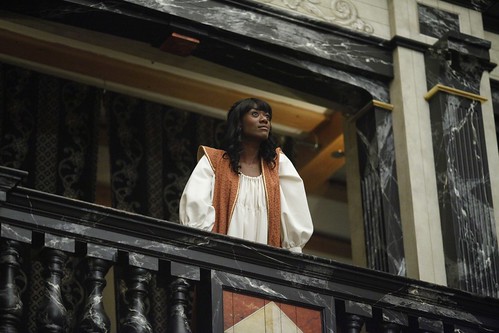 Here is a ten-page preview for your enjoyment. This Study Guide includes the following activities:
Here is a ten-page preview for your enjoyment. This Study Guide includes the following activities:- The Basics: Getting your students on their feet, working with iambic pentameter, paraphrasing, exploring rhetoric, and turning your classroom into an early modern stage.
- Line Assignments: A way to give your students ownership over a small section of text, which they will use in further language-based activities and staging explorations.
- Too Wise to Woo Peaceably: Benedick and Beatrice are one of Shakespeare's finest couples, witty and brilliant and endearing. Better than all of that, however, they're both fantastically smart -- and in this activity, your students will explore the rhetoric of their scenes and discover how Shakespeare uses their language to show the audience that they deserve each other and belong together.
- Perspectives: Slanderous Tongues. Much Ado about Nothing's plot revolves around an issue that your students experience every day in high school life: rumors. Your students will examine the language of slander in Much Ado and will relate Hero's unfortunate situation to their own lives. What words hurt the most? On what basis can a girl's reputation become ruined? How is reputation different from a male perspective?
- Dogberry: Before malapropism was malapropism, it was something else entirely. From everlasting redemptions to odorous comparisons, your students will discover the comic gold that is Dogberry's creatively mistaken vocabulary.
- The Gulling of Benedick and Beatrice: Your students will explore the staging requirements of two of the play's best comic scenes, when Benedick and Beatrice each hear their friends conspiring against them. Where can you hide the eavesdroppers so that the audience can see their reactions -- critical to the success of the scene -- without breaking the imaginative fiction that allows Benedick and Beatrice to believe that their gullers are unaware of their presence? These scenes take advantage of early modern staging conditions in creative ways, and working through them will get your students thinking actively about thrust staging, universal lighting, and audience contact.
- Staging Challenges: Kill Claudio. Shakespeare's plays rarely fit neatly into the categories of comedy and tragedy that we've created for them, and a key example of this in Much Ado about Nothing is the moment when Beatrice challenges Benedick to prove his worth to her by killing the man who dishonored her cousin. Through active staging, your students will explore different potential interpretations of this scene and will determine which version they feel tells the best story.
- Textual Variants: The earliest printed versions of Much Ado about Nothing have several textual oddities -- oddities which reveal that this play may be more closely related to Shakespeare's original manuscript than any other in the canon. Activities on speech prefixes and stage directions will walk your students through an examination of the transmission of text in early modern London.
- Production Choices: A guide to producing a 1-hour version of the play in your classroom.
If you would like to purchase a downloadable PDF of this or any other ASC Study Guide, just visit our website. I'm already well into work on the Study Guide for Richard III -- the last for this artistic year! After which, my plan is to bring the 2010 set up-to-date with the modifications we introduced for the 2011s, and then I will start work on 2012.
08 December 2011
How did I get here?
Do you ever take a look around you, and ask yourself: “Now, how did I get here?” I found myself doing that a lot during the last week of October. The question wasn’t the kind of thing that wakes you in the middle of the night in a cold sweat (though in the weeks leading up to October 25, there were plenty of those). Rather, it was a query of wonder. As I stood in the Blackfriars Playhouse October 25-30, I felt as though I had super-glued rose-colored glasses to the bridge of my nose and couldn't shake that amazing feeling that comes when one is surrounded (at home, no less) by dear friends (new and old), excellent conversation, amazing scholarship, and the joy of the work of two years coming to fruition in a beautiful way.
Ah, the Blackfriars Conference 2011.
My parents have a difficult time understanding me when I say “I won’t be really available for a few weeks, the conference is coming up.” What, exactly, could be keeping me so busy? To be fair, when we were separated by only 90 miles, as opposed to the 1300+ that divide us now, my life was pretty hectic. In my occupation as a high school Theatre teacher, teaching five classes daily, producing six shows a year, with set-building, costume construction, tech rehearsals, I was never as consumed as I am when Conference time rolls around in the odd-numbered year. It’s different, a different kind of busy – an all-consuming, all-anticipating, all-energizing, and yes, all-exhausting kind of feeling that builds for 24 months and culminates in a week of shared excitement, with faces both new and familiar. And the joy of overhearing as the answer to “How did you get here?” not “Bus, train, car,” but “I heard about it from...” or the even more gratifying “I come every time, wouldn’t miss it.”
My first conference was at its third incarnation in 2005, when I was in my first year in the Masters Program at MBC. Two months into the program, and I found myself in the same room with the authors of my textbooks and all of the articles I was looking up in Shakespeare Quarterly.
Why, hi there, Russ MacDonald (*RUSS MACDONALD?!?!?*). Oh, you’re from Texas, too? How nice to meet you!
Well, hello Tiffany Stern (*TIFFANY STERN!!!!*) I love that skirt.
And over there is Stephen Booth, George Walton Williams, Roz Knutson, Leslie Thomson, Alan Dessen. And some friends no longer with us, Bernice Kliman, Arnie Preussner, and Barbara Palmer, whose absence we have felt with sorrow since our last parting.
I knew, in that moment at my first Early Arrivers’ party, that this place was special. What other grad program gives its students the opportunity to network on their home turf? In this case, the turf of the Blackfriars playhouse, always a space of generosity and intimacy and, for one week in October on odd-numbered years, a space of enviable scholarship and flourishing ideas. How was I lucky enough to get here?
My previous conference experiences were all in my undergrad discipline, Theatre Arts. Those conferences featured more workshops than papers, more seminars than presentations, more off-the-cuff speaking than formal delivery. It was a shock to my system to see people reading from a lectern on the stage. But then, the ASC actors arrived. Their contributions linked the two worlds as no other glue or bridge could. They are proof that seeing is the quickest path to believing, whether one needs to be shown a character or helped to understand a presenter’s thesis. In the years since my first conference, it has been my privilege to work with those talented actors to improve interactions between presenters and their actors, to improve communication, to improve the general affect of the conference. We’ve come a long way, and though I know we still have some way to go toward a perfect system, the coming-together of actors and scholars in the way the Blackfriars Conference encourages makes me exclaim: how did I get here and how long can I stay?
In 2007, 2009, and again in 2011, the Conference gave me the opportunity to work along side my mentor, and, I am glad to say, my friend, Ralph Alan Cohen. When I took over from Sarah Pharis (aka Sarah #1) in 2007, I had big shoes to fill. Sarah’s organizational structure -- her daily work flow chart is still the basis for everything that happens behind the scenes -- made it possible for me to step in and to help Ralph to achieve his goals: good papers, good friends, good food, good times. It’s not as easy as it sounds. This year, I began to think of it as akin to planning a 6 day party for 250 of my dearest friends. Each hour of each of the 16 hour days just needs to be scheduled with events, food, drink, and plays. I’d just need to contact each of the 100+ presenters, the 50 grad students, the 15 actors, the 5 caterers, and the 5 venues to give them individual instructions for each minute of that time, get the invites and the publicity out, and then make sure everyone feels pampered and loved while they are here. Not so hard. It’s not, really.
Not this year, anyway. For the first time since my 2005 conference (when I was merely a volunteer), I had a full team in place and on board so early with planning and strategizing, that I actually got to watch my friends, both presenters and actors, in every session, and I watched the rest of my friends in the audience enjoying every minute.
How did I get here? Well, for that, I have loads of people to thank. Ralph, for trusting, the ASC actors and artistic staff for being so generous and sharing their talents in the highlight event of each day, Cass, Ben, Christina, Asae, Kim, Anne, bear wrangler Brian, Clara, Paul (Menzer and Rycik), the entire admin staff at ASC, the wonderful box office staff, the artistic staff and actors for making each session and evening performance memorable, the MBC students who exceeded their colleagues at past conferences in both volunteering and contribution of scholarship. They made it look (and feel) easy, and I am tremendously grateful.
Some highlights for me at the 2011 conference included:
• The delicious food at the early arrivers' party.
• Stephen Booth’s paper on Shakespeare and Audiences.
• Go Dog Go, as devised and performed by Chris Johnston, John Harrell, Jeremy West, Dan Kennedy, Greg Phelps, Miriam Donald, and James Keegan.
• Hearing about the new Indoor Theatre in London from Neil Constable (Heck, meeting Neil Constable).
• Bill Gelber’s ‘ A “Ha” in Shakespeare....”
• Ben Curns sleeping onstage (as directed) in Casey Caldwell’s paper (and then using lightening quick reflexes not to knock over the 100 champagne glasses set behind the curtain as he exited).
• Chris Barrett.
• Joe Ricke and Jemma Levy in a morning session to rival all others.
• George T. Wright and James Keegan’s mutual admiration discussion.
• Finding out “Why are there no blowjob jokes in Shakespeare” from Matt Kozusko.
• Beth Burns and the Hidden Room.
• Stuart Hall’s participation, thanks to Brett Sullivan Santry.
• Natasha Solomon and Dan Burrows acting in Bob Hornback’s Renaissance Clowns paper.
• Seeing our Conference Attendees see John Harrell’s Hamlet.
• Our late night shows (wow).
• William Proctor William’s experiment.
• Seeing ASC actors at every paper session (even the EARLY ones).
• Watching worlds come together in Scott Kaiser’s keynote.
• The bear(s).
• Talking teaching.
• Tiff.
• Colloquies.
• Insights on our space in session X.
• The Banquet.
• Doreen Bechtol in everything she did, but especially Lady M as played by Sarah Siddons (pregnant).
• Hamlet Conversation.
And so, a little over a month past the last day of the conference, I have a little time to reflect. A little time to look around at the people I work with, the place I work for, and thank heavens that, however it came to be, I landed here.
What will you remember?
Ah, the Blackfriars Conference 2011.
My parents have a difficult time understanding me when I say “I won’t be really available for a few weeks, the conference is coming up.” What, exactly, could be keeping me so busy? To be fair, when we were separated by only 90 miles, as opposed to the 1300+ that divide us now, my life was pretty hectic. In my occupation as a high school Theatre teacher, teaching five classes daily, producing six shows a year, with set-building, costume construction, tech rehearsals, I was never as consumed as I am when Conference time rolls around in the odd-numbered year. It’s different, a different kind of busy – an all-consuming, all-anticipating, all-energizing, and yes, all-exhausting kind of feeling that builds for 24 months and culminates in a week of shared excitement, with faces both new and familiar. And the joy of overhearing as the answer to “How did you get here?” not “Bus, train, car,” but “I heard about it from...” or the even more gratifying “I come every time, wouldn’t miss it.”
My first conference was at its third incarnation in 2005, when I was in my first year in the Masters Program at MBC. Two months into the program, and I found myself in the same room with the authors of my textbooks and all of the articles I was looking up in Shakespeare Quarterly.
Why, hi there, Russ MacDonald (*RUSS MACDONALD?!?!?*). Oh, you’re from Texas, too? How nice to meet you!
Well, hello Tiffany Stern (*TIFFANY STERN!!!!*) I love that skirt.
And over there is Stephen Booth, George Walton Williams, Roz Knutson, Leslie Thomson, Alan Dessen. And some friends no longer with us, Bernice Kliman, Arnie Preussner, and Barbara Palmer, whose absence we have felt with sorrow since our last parting.
I knew, in that moment at my first Early Arrivers’ party, that this place was special. What other grad program gives its students the opportunity to network on their home turf? In this case, the turf of the Blackfriars playhouse, always a space of generosity and intimacy and, for one week in October on odd-numbered years, a space of enviable scholarship and flourishing ideas. How was I lucky enough to get here?
My previous conference experiences were all in my undergrad discipline, Theatre Arts. Those conferences featured more workshops than papers, more seminars than presentations, more off-the-cuff speaking than formal delivery. It was a shock to my system to see people reading from a lectern on the stage. But then, the ASC actors arrived. Their contributions linked the two worlds as no other glue or bridge could. They are proof that seeing is the quickest path to believing, whether one needs to be shown a character or helped to understand a presenter’s thesis. In the years since my first conference, it has been my privilege to work with those talented actors to improve interactions between presenters and their actors, to improve communication, to improve the general affect of the conference. We’ve come a long way, and though I know we still have some way to go toward a perfect system, the coming-together of actors and scholars in the way the Blackfriars Conference encourages makes me exclaim: how did I get here and how long can I stay?
In 2007, 2009, and again in 2011, the Conference gave me the opportunity to work along side my mentor, and, I am glad to say, my friend, Ralph Alan Cohen. When I took over from Sarah Pharis (aka Sarah #1) in 2007, I had big shoes to fill. Sarah’s organizational structure -- her daily work flow chart is still the basis for everything that happens behind the scenes -- made it possible for me to step in and to help Ralph to achieve his goals: good papers, good friends, good food, good times. It’s not as easy as it sounds. This year, I began to think of it as akin to planning a 6 day party for 250 of my dearest friends. Each hour of each of the 16 hour days just needs to be scheduled with events, food, drink, and plays. I’d just need to contact each of the 100+ presenters, the 50 grad students, the 15 actors, the 5 caterers, and the 5 venues to give them individual instructions for each minute of that time, get the invites and the publicity out, and then make sure everyone feels pampered and loved while they are here. Not so hard. It’s not, really.
Not this year, anyway. For the first time since my 2005 conference (when I was merely a volunteer), I had a full team in place and on board so early with planning and strategizing, that I actually got to watch my friends, both presenters and actors, in every session, and I watched the rest of my friends in the audience enjoying every minute.
How did I get here? Well, for that, I have loads of people to thank. Ralph, for trusting, the ASC actors and artistic staff for being so generous and sharing their talents in the highlight event of each day, Cass, Ben, Christina, Asae, Kim, Anne, bear wrangler Brian, Clara, Paul (Menzer and Rycik), the entire admin staff at ASC, the wonderful box office staff, the artistic staff and actors for making each session and evening performance memorable, the MBC students who exceeded their colleagues at past conferences in both volunteering and contribution of scholarship. They made it look (and feel) easy, and I am tremendously grateful.
Some highlights for me at the 2011 conference included:

• The delicious food at the early arrivers' party.
• Stephen Booth’s paper on Shakespeare and Audiences.
• Go Dog Go, as devised and performed by Chris Johnston, John Harrell, Jeremy West, Dan Kennedy, Greg Phelps, Miriam Donald, and James Keegan.
• Hearing about the new Indoor Theatre in London from Neil Constable (Heck, meeting Neil Constable).
• Bill Gelber’s ‘ A “Ha” in Shakespeare....”
• Ben Curns sleeping onstage (as directed) in Casey Caldwell’s paper (and then using lightening quick reflexes not to knock over the 100 champagne glasses set behind the curtain as he exited).
• Chris Barrett.
• Joe Ricke and Jemma Levy in a morning session to rival all others.
• George T. Wright and James Keegan’s mutual admiration discussion.
• Finding out “Why are there no blowjob jokes in Shakespeare” from Matt Kozusko.
• Beth Burns and the Hidden Room.
• Stuart Hall’s participation, thanks to Brett Sullivan Santry.
• Natasha Solomon and Dan Burrows acting in Bob Hornback’s Renaissance Clowns paper.
• Seeing our Conference Attendees see John Harrell’s Hamlet.
• Our late night shows (wow).
• William Proctor William’s experiment.
• Seeing ASC actors at every paper session (even the EARLY ones).
• Watching worlds come together in Scott Kaiser’s keynote.
• The bear(s).
• Talking teaching.
• Tiff.
• Colloquies.
• Insights on our space in session X.
• The Banquet.
• Doreen Bechtol in everything she did, but especially Lady M as played by Sarah Siddons (pregnant).
• Hamlet Conversation.
And so, a little over a month past the last day of the conference, I have a little time to reflect. A little time to look around at the people I work with, the place I work for, and thank heavens that, however it came to be, I landed here.
What will you remember?
02 December 2011
Too Wise to Woo Peaceably
The Much Ado about Nothing Study Guide should be ready soon (and I hope I'll have a 10-page preview for you on Monday), and I just have to say, I'm enjoying this one more than probably ought to be allowed. I'm enjoying it so much, in fact, that I couldn't wait until the release to tell you what a good time I'm having.
Much Ado about Nothing is my favorite play, and this has never been a secret to anyone who knows me. It was not the first Shakespeare play I read, but it was the first one I saw in performance, at the age of 12, in the little theatre in the basement of the Virginia Museum of Fine Arts. From that night on, it was all over for me. Much Ado had won my heart, and nothing since has had any power to tempt it away.
There's a lot that's good in this play -- the satire of courtship between Claudio and Hero, the insidious villainy of Don John, the overconfident antics of Constable Dogberry -- but for my money (and I suspect for many others' as well), this show is all about Beatrice and Benedick. They are both the head and the heart of the story, the greatest wits and also the characters who demonstrate the most tremendous emotional depth. I think theirs is the most emotionally real of all of Shakespeare's love stories, not least because it's a more mature affair than many others. Benedick and Beatrice have loved and lost and hurt before; Beatrice tells us this flat-out, though Shakespeare tantalizingly never elucidates the circumstances of their shared past:
I've been working on an activity that I just can't wait to test out with the participants of our Teacher Seminar in February, examining the progression of their relationship through an analysis of how they use language. Shakespeare shows the audience, so clearly, that these two are meant for each other. No one else in the play uses language quite the way they do. For all the banter, quips, and Beatrice and Benedick are the only two who so consistently take each others' words, fire them back across, and set up for the next volley.
The rhetoric shows us not only how smart they are -- and these two characters are some of Shakespeare's most verbally intelligent creations -- but how well they work together. At the beginning of the play, those shared words and mimicked rhetoric are part of the battle, a game of one-up-manship they play with each other. By the end of the play, however, Beatrice and Benedick are using those same figures in a completely different way; instead of combating each other, they're working together, building off of each others' words instead of trying to tear each other down. There's still an element of challenge there -- essential, I think, to their relationship -- but it's no longer with the end goal of destruction. Beatrice and Benedick prove themselves a delightfully matched pair. From the "gay couples" of Restoration comedy to the comedies of manners in the eighteenth and nineteenth centuries, the "screwball" comedies of the 1930s and 40s, and the sitcoms of today, their legacy is certainly a magnificent one.
Much Ado about Nothing is my favorite play, and this has never been a secret to anyone who knows me. It was not the first Shakespeare play I read, but it was the first one I saw in performance, at the age of 12, in the little theatre in the basement of the Virginia Museum of Fine Arts. From that night on, it was all over for me. Much Ado had won my heart, and nothing since has had any power to tempt it away.
There's a lot that's good in this play -- the satire of courtship between Claudio and Hero, the insidious villainy of Don John, the overconfident antics of Constable Dogberry -- but for my money (and I suspect for many others' as well), this show is all about Beatrice and Benedick. They are both the head and the heart of the story, the greatest wits and also the characters who demonstrate the most tremendous emotional depth. I think theirs is the most emotionally real of all of Shakespeare's love stories, not least because it's a more mature affair than many others. Benedick and Beatrice have loved and lost and hurt before; Beatrice tells us this flat-out, though Shakespeare tantalizingly never elucidates the circumstances of their shared past:
DON PEDROI like this glimpse of backstory not only for the magnificent potential for emotional nuance that it gives performers, but also because it provides Beatrice and Benedick with a more solid foundation on which to build a relationship. If they only fall in love with each other because their friends trick them into it, that would make them fairly shallow people, and it would not inspire a lot of hope for a successful future -- but if the love is already there and just needs to be rekindled, that paints a much brighter picture.
Come, lady, come; you have lost the heart of
Signior Benedick.
BEATRICE Indeed, my lord, he lent it me awhile; and I gave
him use for it, a double heart for his single one:
marry, once before he won it of me with false dice,
therefore your grace may well say I have lost it.
I've been working on an activity that I just can't wait to test out with the participants of our Teacher Seminar in February, examining the progression of their relationship through an analysis of how they use language. Shakespeare shows the audience, so clearly, that these two are meant for each other. No one else in the play uses language quite the way they do. For all the banter, quips, and Beatrice and Benedick are the only two who so consistently take each others' words, fire them back across, and set up for the next volley.
The rhetoric shows us not only how smart they are -- and these two characters are some of Shakespeare's most verbally intelligent creations -- but how well they work together. At the beginning of the play, those shared words and mimicked rhetoric are part of the battle, a game of one-up-manship they play with each other. By the end of the play, however, Beatrice and Benedick are using those same figures in a completely different way; instead of combating each other, they're working together, building off of each others' words instead of trying to tear each other down. There's still an element of challenge there -- essential, I think, to their relationship -- but it's no longer with the end goal of destruction. Beatrice and Benedick prove themselves a delightfully matched pair. From the "gay couples" of Restoration comedy to the comedies of manners in the eighteenth and nineteenth centuries, the "screwball" comedies of the 1930s and 40s, and the sitcoms of today, their legacy is certainly a magnificent one.
Tags:
cass has thoughts,
rhetoric,
study guides,
the plays
Subscribe to:
Posts (Atom)