Interred with Their Bones is a Shakespearean twist on The Da Vinci Code, and if you approach the book with that firmly in mind, you'll probably find some enjoyment in it. It is, however, one of those books where you can only apply but so much logic to it before the entire structure collapses under the weight of sensibility.
The book's plot structure follows a little too neatly in the Da Vinci path, involving many of the same character tropes and narrative devices. We open, after a brief and vague historical flashback, with Kate Stanley, director of the Globe's Hamlet, meeting for the first time in years with her estranged and eccentric mentor, Roz Howard. (If you're enough of an early modern history geek to be quirking an eyebrow at those names, rest assured: yes, everyone in the book labors under similarly referential nomenclature). Roz has some terrible secret to impart and a quest to set Kate on, but before she can reveal the details of either, she is found dead in the aftermath of a fire (not, as the book jacket would have you believe, at the Globe itself, but in an auxiliary building). Kate feels obligated to pick up Roz's trail of bread crumbs. As she follows them, more dead bodies start piling up around her, and she ends up fleeing with the police on her trail, a device which feels even more strange in this book than it does in The Da Vinci Code. Kate has no real reason to distrust the police, no reason not to clear herself from culpability before embarking on her quest, and so her actions just seem bizarre and inexplicable. It gives the drama of the plotline a false echo, and it's one of the threads that a reader has to avoid plucking at in order to avoid a total collapse of the narrative. Still, with thrillers, you do sometimes have to make plausibility allowances, so this element may not prove troublesome to all readers.
Part of what hindered my enjoyment of this book, which I could otherwise have consumed as mere Da Vinci Code-esque fluff, is that it disturbs me, as a scholar, how much this book not only entertains anti-Stratfordian opinions, but implies that very serious people in the Shakespearean world would not only hold those opinions, but hold them strongly enough to commit all sorts of heinous crimes to prove them true. I started to recoil as soon as Carrell broached the topic, and eventually, that aversion colored my reading of the text pretty strongly. I now know how art historians and theologians alike must feel about Dan Brown. (One of last summer's interns, Natalie, wrote about this aspect of the book on the Intern Blog). Despite the pitfalls of exploring of the "controversy," the book is actually at its best when traipsing through historical possibilities -- the inventions linking Cardenio to Catholic plots via Cervantes and Jesuits are reasonably entertaining and provide some profitable fodder for exploration. I could cheerfully entertain all of that, if not for the liberal allowance suggesting that any of it might be true. The jet-setting aspect of the book, volleying from London to Harvard to the Southwest to Spain (and ricocheting back and forth between some of those a few times) is a fun diversion, and Carrell does an admirable job of painting her landscapes.
One of the critical failings in this book, unfortunately, lies in its protagonist and narrator. Carrell presents Kate as though she is a big up-and-comer in the Shakespearean field, a director that a Patrick Stewart/Ian McKellan type would refer to as "that brilliant American child." Kate, of course, demurs from this description, but nonetheless, the whole thing smacks of Informed Ability. Kate is an superlative scholar and director because Carrell tells us that she is, rather than showing us. This trait in of itself wouldn't be so bad, except that, for such a prodigy, Kate has some pretty credulity-stretching gaps in her knowledge -- and one of them is the fundamental underpinning of the mystery, the fact that Shakespeare wrote a lost play entitled Cardenio, something that Kate is apparently unaware of until well into the book. The first-person narrative also hampers the book, partially because Kate's head is not quite a well-developed enough place to spend four hundred pages in, partially because it accentuates that gulf between her reputation and what she actually knows. First-person narration creates a trap for a writer: if the audience needs to know something, either the narrator knows it and tells it, which can come off as preachy, or the narrator doesn't know and has to find out in order for the audience to find out, even if it's something the narrator should already know -- or shouldn't need quite as much hand-holding to figure out. Interred with Their Bones manages to fall into both pits multiple times at different points in the story.
Interred with Their Bones was adequate summer-read entertainment. If you're in a place where your mind can let go and indulge freely in a suspense romp, as mine was when I read it at the beach, then by all means, pick this up. The pace clips along well enough to keep a reader engaged, and if the plot turns are occasionally predictable, sometimes that's what you're looking for out of light summer reading. If you're looking for heavier fare or exceptionally solid writing, though, you may want to look elsewhere, as this book doesn't hold up well under much scrutiny.

Showing posts with label book reviews. Show all posts
Showing posts with label book reviews. Show all posts
31 July 2012
18 May 2012
Book Review: I, Iago, by Nicole Galland
I, Iago skillfully retells Shakespeare’s Othello as
the Tragedy of Iago, following the famous villain through the course of
his career and explaining just how he came to be the mastermind
orchestrating the downfall of a proud general and all those connected to
him. In doing so, Galland fills in some of the gaps of Shakespeare’s
narrative, showing us how Iago came to be who he is and chronicling the
circumstances that change him from a loyal friend and subordinate to a
scheming, vindictive meddler.

The book divides into “Before” and “After,” meaning before and after the point where the play Othello begins, and each half is quite interesting in its own way. In “Before,” we get the development of Iago as a person. Galland’s research serves her well here — early modern Venice springs to life in vivid detail, particularly with regards to its military and political matters. We meet Iago as a young man, and he explains that he has always been known as “honest Iago” — not a compliment in Venice, where the ability to quibble, to flatter, and to evade has far more value than blunt truth. Iago lacks subtlety, always speaking his mind, and taking decisive action rather than weighing the consequences beforehand. He is boyhood friends with Roderigo, though he disdain’s the other boy’s weakness and lack of gumption; they grow apart as they grow older, with Roderigo following his family’s mercantile endeavors. Though Iago has scholarly leanings, his family’s prerogative forces him into the military, where he excels, first in the artillery, then in the army. Along the way, he woos and wins Emilia, the only woman he’s ever met with whom he can tolerate much conversation, and their marriage is a blissfully happy one. When Iago meets Othello, there is instant camaraderie; they meet at a masked ball during Carnival, and the circumstances echo their characters. Neither man can hide what he is, though Othello more obviously, thanks to his skin tone. Iago, on the other hand, suffers that inability in his character. Throughout the book, we see him incapable of wearing a mask, both literally and figuratively — in every Carnival scene, he ends up discarding his vizor, and his ungoverned tongue and open expression display his blunt opinions at every turn. The two men sense a commonality between them, a lack of patience with the artifice and genteel dishonesty of Venice. Iago comes to think so highly of Othello that there’s nothing he wouldn’t do for him, including helping to conceal his epileptic fits from the Venetian Senate. He follows Othello to war, to disastrous ruin on Rhodes, and to the altogether different battleground of patrician dinner tables and courtly galas. There, in the household of Brabantio, Othello meets his undoing: a girl named Desdemona, enraptured with the idea of him. Iago counsels him against the courtship, explaining that no Venetian patrician would ever let his daughter marry outside of that narrow caste; Othello pretends to give up the infatuation, but in fact corresponds with Desdemona in secret and eventually planning an elopement — and since Othello has little more talent for deceit than Iago, Iago has little trouble uncovering the scheme.
In the “After” section, we watch this character, whom Galland has rendered quite likeable, fall. Othello betrays Iago’s trust, giving a coveted lieutenancy to the less-qualified Michele Cassio as a reward for assisting in his covert courtship of Desdemona. Emilia is, to Iago’s eyes, inexplicably supportive of the deceitful romance, and therefore complicit. Feeling wounded and discarded by those he most loved and trusted, Iago’s bitter hurt prompts his plans for revenge.
I call this book the Tragedy of Iago because it tracks his rise and at least partially self-constructed fall in a way that renders him both likeable and pitiable. Galland makes a wise choice, spending the first half of the book on events we never see in the play, because it gives the character a more solid background, particularly in regard to his relationship with Othello. In Shakespeare’s play, the audience hears of their association and implied friendship, but we never truly get to see it; we know from the start that Iago is working to ill ends, because he tells the audience so in barest terms. In I, Iago, the friendship is palpable, heart-warming — and so Othello’s betrayal of Iago has a real emotional effect. When Othello begins to shut Iago out in favor of Cassio, the reader is privilege to Iago’s pain and bewilderment. We also get new motivation for Iago’s actions — jealousy and revenge play their parts, and no mistake, and Iago freely admits that he wants to hurt his friend for hurting him, to disgrace the usurper Cassio, and to remove Desdemona from the picture (though he does not intend to do so through her death). That isn’t the total of what’s going on in Iago’s head, however; when he sees how easily Othello can be roused to dangerous passions, he starts to harbour deep concerns about the general’s ability to serve in the position of honour and responsibility with which the Venetian Senate has placed him. He worries, too, about Othello’s judgment; a man who will pass over more qualified men in order to hand positions to panderers, after all, demonstrates an ethical lapse. Iago never claims to be operating only for the common good, in removing a potentially dangerous commander from his post — but since that lines up neatly with his desire for revenge, why not work for both?
The dual nature of the tragedy is most obvious in the moment when things spin past Iago’s ability to control them. His words have an effect far greater than he expected, as Othello proves so easily inflamed where his wife is concerned. The subtler tragedy is that turning Iago from honesty to deceit. He has to learn that trait, a talent foreign to him from birth, and it’s terrible to see him do so — to see a good man corrupted by an unfair world. Iago becomes almost drunk on it, overindulging, swept up by his newfound power, pushing limits to see how far he can take his lies before they become too improbable — and astonished when that barrier never seems to impede him. He learns deceit from those who deceived him, and since we have the juxtaposition of his stalwart honesty in the “Before” section, the transformation is all the more calamitous.
The book is best when it’s not trying to out-clever itself. The moments where I grimaced were when Galland was cramming in bits from other Shakespeare plays that didn’t quite belong — having Iago banter with whores and his military comrades by using lines from Measure for Measure and As You Like It, much of his courtship with Emilia coming straight out of Much Ado about Nothing– because they were jarring, discordant. The tenor was so different from the story she’d been telling that it seemed an odd digression. Initially, this made me nervous for the second half of the book, which covers the plot of Othello, but Galland actually handled the dialogue there quite smoothly. We hit the major points and get the biggest quotes without much interference, but most of the conversations are taken out of verse and into more natural prose in a way that doesn’t seem forced or awkward. The story does rather hurtle itself through the climax and denouement, however, and while that is perhaps appropriate, given how circumstances spiral out of Iago’s control, I could have done with a little more fulfillment, since we had so much build-up to the crucial moments.
This book leaves me wanting the story from yet more angles — Emilia’s, for instance. We only ever see her through Iago’s eyes, and though it’s clear she’s an intelligent and independent woman, she remains only an object throughout this novel. Because everything is first-person narrative, we lose her in the moments when Iago’s not there — which are some of her finest moments in the play. We never really get to know what she’s thinking, and as Iago begins on his plot of vengeance, he distances himself from her, both because he wants to protect her and because he no longer quite trusts her — which has the effect of removing her from the reader as well as from himself. This book is definitely the story of men; Emilia and Desdemona are intriguing, but peripheral, and since Iago never understands either of them, the reader doesn’t get that opportunity, either.
Overall, I, Iago is an entertaining and thoughtful adaptation of Shakespeare’s Othello. The prose is well-constructed, the historical research thorough, and the characters well-drawn. Galland explores the story from an intriguing angle and creates a more three-dimensional world, situating Venice and its characters in the larger world. Whereas Shakespeare narrows in, focusing his scope tighter and tighter until it fits in a single bedroom, Galland allows us to see how this tragedy ripples outward. I think most Shakespeare enthusiasts will find a lot to like about this book, and if there are also some points to criticize — well, most of us enjoy that, too.
21 March 2012
Book Review: 'Contested Will: Who Wrote Shakespeare?' by James Shapiro
 One of the greatest challenges for a modern historian is to remove the filter of Romanticism and Victoriana when we look backwards through time. Modern society has inherited a lot of inaccurate notions about the pre-Industrial world from our more immediate forebears, creating an assumption that the medieval and early modern worlds shared the same values, the same culture, the same societal structures, the same goals as the Victorian world – an assumption that is, in many ways, far off the mark. To achieve greater understanding of anything early modern, a historian – professional or recreational – must first clear her eyes of the haze which the nineteenth century imposed on them.
Lifting this veil is, to my reading of it, the major triumph of James Shapiro's Contested Will: Who Wrote Shakespeare?. Both history and historiography, this book examines the case both for and against Shakespeare as the author of the works attributed to his name – and comes down, quite definitively, on the side of Shakespeare. Shapiro notes, in the opening pages of the book, his interest, which lies "not in what people think – which has been stated again and again in unambiguous terms – so much as why thy think it. No doubt my attitude derives from living in a world in which truth is too often seen as relative and in which mainstream media are committed to showing both sides of every story." Noting the prevalence of opposing viewpoints in modern society – such as those on creationism vs evolution, whether or not man walked on the moon, and "more disturbingly," those who deny the Holocaust deniers – Shapiro states, "I don't believe that truth is relative or that there are always two sides to every story. At the same time, I don't want to draw a naïve comparison between the Shakespeare controversy and any of these other issues. I think it's a mistake to do so, except insofar as it too turns on underlying assumptions and notions of evidence that cannot be reconciled. Yet unlike some of these other controversies, I think it's possible to get at why people have come to believe what they believe about Shakespeare's authorship, and it is partly in the hope of doing so that I have written this book."
Shapiro begins with the first attempts, in the eighteenth century, to expand knowledge of Shakespeare's life and works, with George Steevens and Edmund Malone arguing their various perspectives. This idea of construction, of needing to find reasons in Shakespeare's life for the events and viewpoints in his plays, led to a somewhat desperate search on the parts of Samuel Ireland and his son, William-Henry, for new evidence about Shakespeare's life. Unfortunately, these gentlemen came to the idea several decades too late; any evidence not already preserved was long gone. William-Henry, motivated in Shapiro's depiction as somewhat pathetically frantic to bolster his father's deflated confidence, embarked on an orgy of forgery, creating numerous documents in "Shakespeare's hand": deeds, letters, inscriptions, even entire plays. Briefly celebrated, then proved false under William-Henry's own confession of fraud, these documents nonetheless opened the door to the search for biography in Shakespeare's plays. Even Malone, who vigorously attacked the Irelands for the fraud, still entertained:
the presumption that Shakespeare could only write about what he had felt or done rather than heard about, read about, borrowed from other writers, or imagined. The floodgates were now open and others would soon urge, based on their own slanted reading of the plays, that Shakespeare must have been a mariner, a soldier, a courtier a countess, and so on. By assuming that Shakespeare had to have experienced something to write about it with such accuracy and force, Malone also, unwittingly, allowed for the opposite to be true: expertise in the self-revealing works that the scant biographical record couldn't support – his knowledge of falconry, for example, or of seamanship, foreign lands, or the ways that the ruling class behaved – should disqualify Shakespeare as the author of the plays.
 Shapiro also positions these early days of the search for authorship evidence in light of the early attribution studies for the Bible and the works of Homer; for the first time, literary monoliths were subject to question and interrogation. Shapiro then moves through the first seeds of the anti-Stratfordian argument to its full-blown manifestations in the propositions of first Francis Bacon and then Edward de Vere, Earl of Oxford, as alternate candidates. The Baconian theory, for instance, began with Delia Bacon (no relation) in the mid-19th century. Shapiro explains how Delia's ideas about Francis Bacon connected to the notion of a grand conspiracy, focused on the polymath English courtier as the center of a radical proto-republican political movement. The evidence for these claims, she determined, was present in a close reading of the plays as biographical in nature. Shapiro demonstrates how the logic of such an association is inherently flawed, thanks to the limited scope both of Delia's historical awareness and of the plays which she examined:
The framework within which [Delia Bacon] imagined the world of the English Renaissance, also typical of her day, was limited to monarchs, courtiers, and writers. The rest were written off as ignorant masses. […] It was history from the top down and limited geographically to London and the court. Her Shakespeare canon was no less restricted and also typical of nineteenth-century readers: at the center of it were Hamlet and The Tempest, and it extended to the plays meatiest in philosophical and political content – Othello, Julius Caesar, Lear, Romeo and Juliet, Richard the Second, and, unusually, Coriolanus – but not much further. While she had surely read the other thirty or so plays, as well as the poetry, they didn't serve her purpose, and for the most part she passed over them in silence.Delia Bacon published, to moderate success, though most people who supported her initially came to regret it, because of the mental instability she developed following a very public jilting. Shortly after the release of her book, she was institutionalized, and spent the last two years of her life in an asylum. Despite this tragic end, her ideas caught fire in the decades following her death, earning the attention, if not always the outright endorsement, of celebrities including Ralph Waldo Emerson, Mark Twain, Helen Keller, and Henry James. Delia Bacon also introduced the notion of a secret cipher embedded in the texts of the plays, an idea picked up and popularized by Ignatius Donnelley – and an idea risible under even the lightest scrutiny for several reasons, not least of which is that a tweak of the cipher could yield any result the seeker wanted, but also because, as Shapiro points out, "Donnelly didn't have a clue about how compositors worked in Elizabethan printing houses, where such a scheme would have been unimaginable and the layout he describes impossible to reproduce."
By the 1920s, however, Shapiro points out that "Philosophy and politics were out, Oedipal desires and mourning for dead fathers in," giving rise to the new Oxfordian theory. Psychoanalysis imagined a link between the writer of Hamlet and the character of Hamlet, based on repressed sexual urges and dysfunctional family relationships. Sigmund Freud questioned Shakespeare's identity but did not embrace Bacon as the alternative; John Thomas Looney (pronounced "loany", despite temptations to the contrary) picked up the psychoanalytic thread and proposed Edward de Vere, the Earl of Oxford. Shakespeare's life did not mirror the required narrative; the Earl of Oxford's could, especially if you layered on other theories about de Vere being Queen Elizabeth's lover and/or son. From a secret political group under Bacon's direction, the anti-Shakespearean case now rested on a more lurid narrative: a conspiracy tinged with sexual misconduct, succession anxiety, and disrupted inheritance.
For decades, the Oxfordians plagued themselves with divisive conclusions about this reading, however: nobody knew about the conspiracy; everyone knew and didn't think it worth mentioning; everyone knew but was kept silent by Queen Elizabeth's totalitarian state; a select group knew and kept it quiet to protect the Queen; and so on. Never mind that Oxford died in 1604, before many of Shakespeare's plays were written; in the scope of such an all-encompassing conspiracy, Oxfordians find that small matter to explain away. They were written earlier, and released after his death, as a way of perpetuating the myth of William Shakespeare as the front man. Shapiro details how, in more recent years, the Oxfordian theory has gained traction due to the public's increasing fascination with conspiracy theories of all sorts. From moon landings to who shot JFK to the vast circulation of conceptions about secret government involvement in nearly every act of tragedy or terrorism of the past three decades, modern culture has propagated a pervasive suspicion of authority. "In such a climate," Shapiro says, "a minor act of conspiratorial suppression on the part of Tudor authorities made perfect sense."
Overall, the impression this book leaves a reader with is that the anti-Shakespearean case is one stuffed with tragic figures and ulterior motives. Its very earliest characters are among the saddest: poor William-Henry Ireland, desperately seeking a father's approval, and jilted Delia Bacon, who clung to her theories as a way of reclaiming agency over her life, but with a paranoid mania that drove her to madness and death. These are the figures often left out of the Baconian and Oxfordian narratives; they prefer, naturally, to tout the support of such grand figures as Mark Twain and Sigmund Freud. As Shapiro demonstrates, however, the rationale of the great figures is not untainted, either. They all require vast constructs, additions and suppositions to the historical record. Freud's support of the Oxfordian case is deeply tied to his own theories about Oedipal desire; he had to read Hamlet in terms of Oxford's own familial-sexual-philosophical entanglements, because to suppose that the story came from any other origin was a strike against the psychological theories on which he made his living and his fame.
 It's Twain's rationale, and Shapiro's dissection thereof, that I find most interesting and most telling. Twain echoes Malone in supposing it impossible for a writer to draw from anything but experience; "For Twain, the notion that great writing had to be drawn from life – rather than from what an author heard, read, or simply imagined – was an article of faith, at the heart of his conception of how serious writers worked." It is, in many ways, a very strange idea, taking imagination so entirely out of the equation, but it was a product of its time; in the 19th and early 20th centuries, more and more writers were publishing memoirs, and biography was a popular genre. The close association between fiction and experience was deeply embedded in the culture, providing fertile ground in which the anti-Shakespearean attitudes could take root. This is one of the more difficult veils to penetrate when looking back at the early modern period through modern eyes – the idea that the early modern writers simply did not view their craft in the same way that the Victorian tradition has convinced us all writers must.
Shapiro asserts that this legacy lives on in writing today, that modern readers retain assumptions that "novels necessarily reveal something about a writer's life." I would argue that this is more true in so-called "literary" fiction than it is of genre fiction. Readers of science fiction and fantasy novels (or viewers of those movies) -- and to an extent, of mysteries, thrillers, and romances as well -- have no more expectation of a creator's personal experience with the subject matter than Shakespeare's original audiences had. We need no more assume that Shakespeare had first-hand knowledge of Italy than that George Lucas had of Tatooine, J. R. R. Tolkien of Middle-Earth, or J. K. Rowling of Hogwarts. While "serious" fiction often retains a more autobiographical bent, I think it is in genre fiction that writers operate more like Shakespeare did: indulging freely in the realm of imagination, drawing off of previous stories, history and mythology, and timeless tropes for their inspiration. There you find writers more interested in telling a good story than in talking about themselves – which is not to say that glimpses of a writer's viewpoint won't peep through from time to time, but they don't dominate in the way that post-Romantic assumptions would indicate. (It is in many ways ironic that the very people who disdain the use of imagination in writing are so wonderfully and copiously imaginative themselves, at least when it comes to creating the fantasy narratives necessarily to support alternate authorship candidates).
The final chapter of the book is a tour de force in defense of Shakespeare – though Shapiro acknowledges the absurdity that Shakespeareans should even be on the defensive, that the burden of proof has somehow shifted to us to prove there is no conspiracy, rather than on the Oxfordians to prove that there is. After entertaining the anti-Stratfordians and exposing their flaws, Shapiro comes down unquestionably (and refreshingly unapologetically) on the side of Shakespeare of Stratford:
When asked how I can be so confident that Shakespeare was [the plays'] author, I point to several kinds of evidence. The first is what early printed texts reveal; the second, what writers who knew Shakespeare said about him. Either of these, to my mind, suffices to confirm his authorship – and the stories they tell corroborate each other. All this is reinforced by additional evidence from the closing years of his career, when he began writing for a new kind of playhouse, in a different style, in active collaboration with other writers.Shapiro then defends Shakespeare with a barrage of real, concrete evidence – text-based evidence including examples of speech prefixes, the process of printing plays, the relationship of typesetting to the variant spellings of Shakespeare's name, his demonstrated familiarity with actors, and so forth. The proof of such deep association with the playing companies, the theatre building, and the workings of the shareholders effectively eradicates any validity to the presumption that the plays could have been written by someone who did not inhabit that world.
Shapiro also engages with the testimonies of so many of Shakespeare's contemporaries, identifying the man from Stratford as the man who wrote the plays: George Buc, Master of the Revels; Robert Greene, vitriolic pamphleteer; Francis Meers, whose Palladis Tamia lists all of Shakespeare's plays which had been acted by 1598; Gabriel Harvey, poetry critic; William Camden, historian; playwrights John Webster, Francis Beaumont, and Thomas Heywood -- the list goes on and on, but the trump card is fellow playwright, rival, and friend, Ben Jonson, who "left the most personal and extensive tributes to Shakespeare. For many, his testimony alone resolves any doubts about Shakespeare's authorship of the plays." Consider me one of them. Even if we did not have the voluminous other evidence that we do have, Jonson alone would convince me. He comments both so prolifically and so personally on Shakespeare's writing that I find it a violation of Occam's Razor to imagine that he was either ignorant or part of a vast conspiracy – and knowing what I know about Jonson, I really can't believe he could have kept a secret of that magnitude.

Finally, Shapiro draws a connection between Shakespeare's plays and the playing spaces he wrote for, discussing how the space affected what kind of story Shakespeare could tell and how he could tell it, particularly thanks to a distinct change towards the end of his career:
We have also had drummed into us that he was Shakespeare of the Globe – though that playhouse was built only in the closing years of Elizabeth's reign. Long forgotten are the other playing spaces in and around London in which he had built his reputation over the previous decade: the Theatre, the Curtain, Newington Butts, the Rose, Richmond, Whitehall, perhaps a brief stint at the Swan. … But had you asked anyone on the streets of London in the winter of 1610 where you could go to see Shakespeare's latest play, there would have been only one answer: 'Blackfriars.' The Blackfriars Theatre means little today to most admirers of Shakespeare; so far as I know, only a single replica of it has ever been erected, in rural Virginia, which attracts both spectators and scholars. The story of the Blackfriars Theatre is also the story of the Jacobean Shakespeare, and of the particular challenges he faced toward the end of his playwriting career. And that, in turn, helps explain why only Shakespeare could have written his late plays that were staged there.Shapiro's recognition is apt and accurate, and that close relationship between writer and playing space is one we frequently refer to in our educational materials and workshops. A different kind of theatre demanded a different kind of plays, and Shakespeare's latest works reflect that shift, making a reconstruction of the plays' timeline to fit a 1604 death date absurd. I hope this spatial connection becomes a stronger part of the narrative of the "controversy" – perhaps it will help the Blackfriars Theatre and its descendent, our Blackfriars Playhouse in Staunton, earn greater recognition as one of Shakespeare's prominent theatrical homes.
The final chapter of Contested Will ought to hammer home, once and for all, that Shakespeare was Shakespeare, setting the matter entirely to rest. Except, as Shapiro ably points out, there is no arguing with a conspiracy theorist. Any evidence just gets twisted to support the idea of a vast cover-up. Nonetheless, Shapiro's book is a veritable armory of weapons, both offensive and defensive, for the Shakespearean set. What's more, he delivers all of his information with felicity and wit; the book is a wonderful read as well as an intellectual triumph. I highly recommend it to anyone with a dog in this fight, as it were, but also to anyone who is simply interested in writing and in how ideas about it have evolved over time. Shapiro provides us not only with a rousing defense of Shakespeare, but also a valuable peek through the veils of time, rolling back our assumptions and laying bare the reality, insofar as it is knowable.
If you're interested in further thoughts on this topic, please join the ASC on March 31st at 10:30am at the Blackfriars Playhouse. Dr. Ralph Alan Cohen will be delivering a lecture featuring his own dissection of the authorship matter, entitled "Knock, Knock: Who Wrote Shakespeare?"
02 May 2011
Book Review: The Great Night, by Chris Adrian
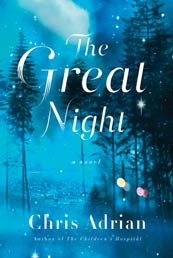 The Great Night is a modernized retelling of Shakespeare's A Midsummer Night's Dream, set in Buena Vista Park in San Francisco in 2008. A group of humans stumble into a disaster implemented by the Faery Queen, Titania, who is in the throes of deep sorrow. Following the death of their latest changeling child, Titania and Oberon had one of their marital spats -- but this time, Oberon doesn't seem to be coming back. Desperate to get the King to show himself and so absorbed with her grief that she loses all sensibility, Titania lifts the controlling enchantment off of Puck, also known as the Beast, freeing him to wreak havoc in the park. (The greater world is protected by walls of air -- nothing, mundane or fantastical, gets in our out of the park while those walls, presumably conjured by Oberon, are up). The mortals trapped within are: Molly, recovering from the suicide of her boyfriend; Will, in love with a strange woman who dumped him a year ago; Henry, who can't remember any of his life before the age of thirteen, and whose obsessive-compulsive habits drove away his boyfriend; and a group of homeless people rehearsing for a musical version of Soylent Green, led by Huff, who believes the Mayor of San Francisco is feeding the indigent population to each other in the soup kitchens. These mortals get wound up in the actions of the faeries, who are either giving over to sensual indulgence in what they presume to be their last hours, or who are seeking ways to put the Beast back under control.
There are things about this book which are really great. It's definitely at its best when the faeries are the main focus. Titania and Oberon are sweeping, dramatic figures, and Adrian describes the lesser faeries in a way that balances nicely between whimsical and grotesque. The flashback section where Titania and Oberon have to watch their changeling child die is the strongest portion of the book. Because their magic cannot work on anything they care for, they have to turn to human medicine to try and save the Boy. They're also struggling to deal with the emotional consequences of actually caring for a mortal child, as their self-absorption usually prevents such deep attachments to their changelings. Adrian does a great job showing how mortals perceive the faeries when they enter the mundane world, how the little magics affect them. He also -- through his own background as a pediatrician -- is able to evoke the tormented feelings of parents watching a child die with great sympathy and precision. The emotionality of this section is strong and compelling, and it paints a very clear picture.
As for the humans, their stories generally start off well enough -- Molly, Will, and Henry, at least, inhabit complex emotional and psychological worlds. Huff and his tribe I could have done without. They seemed extraneous, none of them besides Huff developed any real personality, and I can't figure out the purpose of the Soylent Green trope. Not having enough of a familiarity with that source material, I don't know if there's some larger theme at work there, or if the fixation is just a way to demonstrate the extent of Huff's delusions. Regardless, it seems like that subplot only exists as a tacked-on way to have an analog for the Mechanicals, so that Titania has a fool to dote on when the Beast places her under an enchantment. But the lover-analogs are fascinating, if not wholly likeable. They all enter the story in liminal states, hedging between decisions, scared to take decisive action in controlling their lives, hesitant and varying degrees of pathetic. In this way, they're precisely the opposite of Shakespeare's lovers, who take to the woods for very specific reasons, but their ambiguity serves the opening of the story, because it makes them vulnerable to ethereal interference.
The second half of the book degrades into confused chaos, though. As the humans fall deeper under the faeries' spell, the narrative quickly becomes jumbled and hazy. Molly and Will, whose stories had been compelling, get lost entirely in the enchanted shuffle. Henry's experience is only somewhat clearer. The reader does learn some more pieces of the backstory, some threads that tie these seemingly unrelated people together, but there's no real sense of a greater point to it, no driving force behind what's happening, and no ultimate goal for them to work towards.
And perhaps that's all to the author's purpose. Perhaps that chaos is precisely what Adrian is aiming for, to portray the senselessness of the whirlwind the Beast creates. Which is why I say, if that's the case, then it's extremely well-done. But even well-done, it interfered with my ability to enjoy the book. I like a good, solid story, some sense of cohesion, which The Great Night lacks. As the mortals falls deeper into the madness of the night, their experiences become clogged with symbolism. Adrian takes it a step too far, I think, laying the metaphors on a bit too thick, and the story loses both coherence and emotional engagement as a result.
The ending of the book is a problem. Abrupt and anticlimactic, it circumvents any kind of resolution for the characters. The mortals' stories, set up so well at the beginning, reach no conclusion. They don't even move along -- we don't see any indication that they've been changed by their time in the woods, that they'll go back to real life different than before, because we don't see them at the end. There's no sense of alteration or growth. No one has a dramatic arc except Titania, perhaps, and even her story ends ambiguously, with no denouement. Adrian throws the reader into a maelstrom and then never calms the seas. Again, this confusion might be intentional, but it's unsatisfying.
 Tags:
book reviews,
cass has thoughts
04 February 2011
Imprimis: Links and Tidbits, 4 February 2011
This week brought us scholarship through Twitter, a new podcast from the ASC, enlightening research on Shakespeare's world, and the ongoing debate about the humanities in education.
- I had a blast during #AskShakespeare Day. This idea, cooked up by the Shakespeare Birthplace Trust, brought scholars from all over the world together to answer questions about Shakespeare posed on Twitter. It was so wonderful to see how many people out there cared enough to ask questions about Shakespeare, and I got to trade ideas with some great scholars. We did see the authorship question pop up a few times, and plenty of people wanted to ask scholars and practitioners what our favorite plays and characters are, but we also encountered a range of other questions, some with concrete answers, but many that invited speculation: What race was Othello, really? Why do people talk about Hamlet having an Oedipus complex? Did Shakespeare pursue his own publication? What's the most gruesome scene in an early modern play? (Votes went to the heart-on-a-knife in 'Tis Pity She's a Whore and the head-bashing in Tamburlaine -- both of which you'll be able to see at the Blackfriars next year!). What's the most underrated of Shakespeare's plays? How would the plays have been different if women had been allowed on the stage? The whole experiment was so entertaining and a real intellectual rush. I think we should do it once a month. Of course, I'm happy to answer questions any day of the year -- just ping @ASC_Cass.
- The first Actor-Scholar Council podcast is up and waiting for you to listen to it. Greg Phelps, Tyler Moss, Sarah Fallon, John Harrell, Chris Johnston, and Jeremiah Davis joined a panel of scholars to discuss The Comedy of Errors. We'll be recording the Council session on Look About You next week.
- If you're within easy traveling distance of Staunton, be sure to see Shannon Schultz's directing project, an all-male version of Romeo and Juliet, on February 7th and 8th. The Staunton Newsleader interviewed Shannon about the project. (Please note that the Newsleader article has the performance time wrong: the show will start at 8pm both nights).
- "Hellraising Antics of Shakespearean Actors Revealed": The London Telegraph has posted an interesting article on what recent research has revealed about the theatrical world in which Shakespeare lived. Kidnappings, riots, thefts, vandalism, all brought to light courtesy of the new Early Modern London Theatres database.
- If you still haven't read James Shapiro's Contested Will, here's another review praising it as "an entertaining reappraisal of Shakespeare's enduring fascination and a conspiracy story worthy of play by the great man himself."
- Dale Salwak of Citrus College, CA, shares his approach to getting his students to love Shakespeare. Cass says: I agree with a lot of what he has to say -- that students say they hate Shakespeare because they really hate the way it's been taught, that you don't need to waste time teaching the plot, that it's okay for art to make demands of the audience -- but I still think he's missing some key elements. His approach remains very page-based, with the augmentation of audio recordings. There's so much to be gained by teaching the plays as plays and making the students take on the responsibilities and decision-making of actors.
- And, because no edition of Imprimis would be complete without some links discussing the value of the humanities in education: How Liberals Killed the Liberal Arts, and The Humanities in America: An Endangered Species?
02 February 2011
Book Review: Ruled Britannia
On yesterday's #AskShakespeare day on Twitter, someone asked for recommendations on Shakespeare-related books of fiction. As it happens, yesterday I was about 50 pages from the end of an excellent alternate-history thriller featuring Shakespeare as the main character. I finished last night, and so now I'd like to recommend it to you all.

The premise of Harry Turtledove's alternate history tale, Ruled Britannia, is that the Spanish Armada did manage to take over England in 1588. Philip II installs his daughter Isabella and her consort Albert on the throne of England, imprisons Elizabeth in the Tower, and returns England to Catholicism. Ten years later, Philip is dying, Elizabeth is yet imprisoned, and while most of the populace complies with the will of their Spanish overlords, a current of discontent still runs beneath the surface.
The driving plot of the book centers on William Shakespeare, presented as a humble playwright and an actor of middling skill, whose talent for composition gains the attention of those in high places. First, William Cecil, Lord Burghley, commissions Shakespeare to write a play to inspire the English people to an uprising. Loyal to Elizabeth, Burghley has been planning a revolt to occur after Philip's death, but he wants words to inspire the masses to back his maneuver. For the topic, he chooses a story out of Tacitus: Boudicca, the Iceni queen who revolted against the Romans in the first century. At nearly the same time, one of the Spanish dons requests that Shakespeare craft a play to be a fitting epitaph to King Philip. Shakespeare writes both, and the company rehearses both, not knowing which they'll actually mount. During the process, Shakespeare finds himself wishing the task had been given to another man -- especially as the bodies of those who might impede his progress start piling up around him.
Turtledove includes lots of nice historical touches, and the cast of characters is well-researched and comprehensive. The book does a wonderful job bringing the world of early modern theatre to life, even with the adjustments made for the alternate history. Burbage and Kemp are major characters, with references to Burbage's family's theatrical history and to Kemp's Nine Days' Wonder. Marlowe's still alive and writing plays at the beginning of the book, and he seems torn between admiring Shakespeare's talent and sourly resenting that it has eclipsed his own. His probable historical murderers, Ingram Frizer and Nicholas Skeres, play shadowed but critical roles, clearing the path for Shakespeare's success and Cecil's rebellion, as does Thomas Phelippes, historically one of Francis Walsingham's intelligencers, here a cunning double-agent. Robert Devereaux, known to our history as the traitorous Earl of Essex, makes an appearance towards the end of the book. Shakespeare's opposite number throughout the book is Lope de Vega, one of Spain's most prolific authors, whose reputation there is second only to Cervantes. Turtledove takes him out of his native land and brings him ashore with the Armada. The English theatre fascinates de Vega, and he becomes friends, of a sort, with Shakespeare and Burbage. His presence threatens the production of Boudicca, however, as the company clearly cannot rehearse with him hanging around. His presence augments the tension behind Shakespeare's dilemma and keeps the action clipping along at an exciting pace.
The book is a goldmine for the Shakespeare-lover. Turtledove sprinkles his characters' dialogues with lines from Shakespeare's plays, and recognizing them can be a bit of a game to go along with following the main plot. I almost wish I'd kept a tally of how many I found while I was reading. While extremely clever, however, they could be a bit overwhelming in places, and occasionally they did seem somewhat forced, as though Turtledove just really wanted to include that line no matter how. He managed not to stray into seeming kitschy or cutesy with the references, however (which is not something that can be said of all novels featuring Shakespeare as a character); on the whole they were quite sly without feeling obnoxious. I also took issue with a few of the choices Turtledove made -- for instance, having the company play Macbeth in 1597. I'm not arguing the date itself -- in an alternate universe, I'm willing to entertain all kinds of shifting around of chronology. But Macbeth would just plain never have been written without King James on the throne, so that element jarred me out of Turtledove's mostly-seamless historical diversion. I'm also not positive that Turtledove fully understands what iambic pentameter is and how it works, that it's more than just ten syllables to a line -- some of the lines he invented for Boudicca and King Philip don't scan properly at all, even though he discusses them as though they're perfect iambic lines. Despite those nitpicks of mine, however, his alterations generally hold together as a reasonable presentation of the early modern theatre world under slightly different conditions than we know it.
Overall, I thoroughly enjoyed Ruled Britannia. Turtledove does an excellent job of relating the ability of language to move hearts and inspire an audience. He also gets his reader emotionally invested in the characters and their dire straits; by the end of the book, I passionately wanted to see Shakespeare and the company present Boudicca, and I wanted the rebellion to succeed, but I also cared about what happened to de Vega and the other side characters. Turtledove presents the humanity on both sides of the conflict quite well. The climax of the book is thus both thrilling and emotionally moving. I can cheerfully recommend Ruled Britannia as a delightful read to Shakespearean enthusiasts and other Anglophiles looking for high-quality brain candy.
14 January 2011
Imprimis: Links and Tidbits, 14 January 2011
For reasons unknown, the Authorship Controversy seems to have been rearing its hideous head on the Internet this week, along with more connections to Shakespeare sprouting out of the Huck Finn controversy, and the continuing debate over the worth of teaching literature.
- To start with, from last weekend's Shakespeare Theatre Association Conference, our managing director, Amy Wratchford, blogged about Shakespeare's relevance and about the value of discussing Shakespeare on Twitter.
- This blogger equates being a Stratfordian to being a stroke victim. Cass says: If you're not quite sure what to do with that (or can't decide to whom that's most insensitively offensive), you're not alone.
- The I Love Shakespeare blog defends the Stratfordian cause rather sassily, noting that the only way other theories make sense is if you "fudge the historical record with airy fiction."
- And then this article refutes the anti-Stratfordians, but then overshoots and goes into the "Shakespeare as a secret Catholic" theory.
- An op-ed in the Washington Post theorizes that educators can't be reformers.
- The Shakespeare Center of Los Angeles is putting Hamlet on trial, with Supreme Court Justice Anthony Kennedy presiding. Sarah says: We did that!
- A writer for NPR uses the Huck Finn censorship controversy to expound his thoughts on why Shakespeare needs translation. Sarah says: Oh, no. Interesting that he uses the word "bowdlerized" in his discussion, since that man is roundly criticized for doing exactly what this author proposes. The quote he uses from Measure for Measure: "Of government the properties to unfold / Would seem in me to affect speech and discourse / Since I am put to know that your own science / Exceeds, in that, the lists of all advice / My strength can give you," is, as in most of Shakespeare's "hard language," offering a tremendous number of clues to the actor and reader about what kind of character this is. When we look at Shakespeare as performance-based literature, the "hard stuff" becomes a tool for discovering insights about characters and playable moments. It becomes its own translation when staged.
- Gilbert, Arizona is cutting literature from its high school curriculum. Sarah says: This came across my Google Alerts just moments after Cass posted our "book wish list." A very scary tenet is working in Arizona, apparently. It seems they think kids need to read more non-fiction (and less Shakespeare) in order to become better prepared for the business world. Wonder if they realize how much business theatres generate, or how hungry people are for innovative, creative, and critical thinkers. They are doing their students a deep disservice. Cass says: And not just stage theatres -- movies, books, and musicals generate how many billions of dollars in revenue each year? Not to mention how important it is to examine the stories a culture tells about itself and what they say about who who we are, who we've been, and who we want to become.
- Finally, check out this review of James Shapiro's Contested Will. Sarah says: And then come see us discuss the book at the Charlottesville Public Library on April 15th.
15 October 2010
Review: "Hear My Soul Speak: Wedding Quotations from Shakespeare"
Duane over at ShakespeareGeek has written a book, Hear My Soul Speak: Wedding Quotations from Shakespeare, and, as one of his fellow Shakespeare bloggers, I can heartily recommend it as an asset for brides, grooms, and their friends and family.
The idea of the book came from an over-inundation of the same sonnet (#116, "Let me not to the marriage of true minds") at weddings. Tired of hearing the same material over and over again, Duane decided to compose a comprehensive guide to Shakespearean quotations about love, family, and knitting those eternal bonds. Rather than just presenting the quotes, Duane gives them context and explicates the language, helping the Shakespeare novice find the meaning in some less-obviously-romantic passages. Most helpfully, the quotes are divided up topically: there's a section for proposals, one for exchanging vows, one for the father-of-the-bride, one for reception toasts, and so forth. My only wish, really, is that Duane had gone further with that theming. I would've loved a section for bridesmaids and maids of honor, since Shakespeare's women have so many great things to say to each other about friendship and loyalty. All of the quotes he's pulled are great, though, whether you're looking for something to use during the ceremony, to say at the reception, or just to print on little cocktail napkins.
What's really great about the book is its accessibility. It really is Shakespeare for anyone who wants to pick it up, but not, I think, at the cost of cheapening Shakespeare's words. To the contrary, I think the book might make someone who picked it up just looking for wedding ideas actually want to read further and explore the plays. Duane's explanations of the lines bring up some intriguing points, and they shine a light on some of Shakespeare's best characters and most sparkling moments. I'm a fan of anything that can be a gateway to getting more people more interested in the plays, and I think this book could accomplish that goal.
Duane also helps conquer some ShakesFear by including a section of tips on how to deliver Shakespeare's words. He covers, to my delight, scansion, with a non-intimidating rundown of iambic pentameter, and he even manages to slip in some rhetoric without using the Greek and Latin terms that could easily send a casual reader running for the hills. Then he goes on with a few general public-speaking tips which I think would be helpful to anyone who gets a bit nervous at the thought of it.
Hear My Soul Speak is available online, for eReaders or as a PDF download, at www.hearmysoulspeak.com -- and if you don't already follow Duane's blog, you should. The content is always thought-provoking and and thoroughly entertaining as well.
So now I'm wondering -- is there a market for a whole line of books like this, Chicken-Soup-Style? Shakespeare for All Special Occasions? Certainly he has enough things to say about learning and scholarship to fill a book for graduations or for those heading off to college. You could easily use Shakespeare's words to fill a book on bereavement or to provide a compendium of comfort for those nursing broken hearts. How far could it go? I'm not sure, but it might be worth exploring, if only to further the truth that, yes, Shakespeare has applications to the situations and emotions of modern life.
Tags:
book reviews,
cass has thoughts
Subscribe to:
Posts (Atom)