Showing posts with label shakespeare's contemporaries. Show all posts

22 February 2013

The Rabbit Hole of Textual Oddities

This story started innocently enough. One of my current projects is to complete a full metrical and rhetorical analysis of Romeo and Juliet (as I did for Julius Caesar last year), but in order to begin that, I first have to complete a full check against the Folio. At ASC Education, we like to return to the 1623 First Folio to recover stage directions, emotionally inflected punctuation, and other textual variants which editors have sometimes obfuscated over the years. This practice can lead to a lot of intriguing discoveries; little did I know that one such curiosity yesterday would end up devouring a significant portion of my morning.

While checking 1.4, where Mercutio and Benvolio attempted to cheer Romeo up as they head for the Capulets' ball, I ran across the fascinating error at right: Hora. as a prefix, presumably for Horatio. There is no character in Romeo and Juliet named Horatio, though the stage direction for this scene does specify the presence of "five or six other Maskers, Torch-bearers." 'How odd,' I thought. 'I wonder if that error is in the Q2.' The 1599 second quarto of Romeo and Juliet is the other reliable text for this play; most modern editions conflate elements from the Q2 and the Folio to arrive at their preferred version of the text (though many slip in elements from Q1 as well). As you can see below, yes, the 1599 Q2 does contain this error -- even more explicitly as Horatio. The Folio, then, simply retains what Q2 shows.

So I wondered, 'Huh. How strange. Does this error exist in Q1, then?' A quick check revealed that: no, it doesn't. These lines are not in Q1, which jumps straight from Romeo's "So stakes me to the ground I cannot stirre" to Mercutio's "Give me a case to put my visage in," skipping the pictured section of dialogue entirely. So how did the wandering speech-prefix come about? (And ought I to call it a prefix-errant?).

The simplest explanation is basic printer error: speech prefixes and names were often struck as sets, rather than assembled from individual letters. This practice is why the prefixes and names within the verse generally appear in an italicized font rather than the plain text. It's easy to imagine, then, that a Horatio, struck for some other play, somehow got mixed in with the Mercutios intended for this scene, and that the type-setter's quick fingers grabbed it and placed it without the type-setter consciously noticing the incongruity. It's possible, though I suspect far less likely, that the printer did strike the speech prefix Horatio for this single instance. Perhaps Shakespeare wrote Horatio once where he meant Mercutio (in simple Italianate error, or perhaps thinking of another role the same actor played) and that error stayed in the fair copy or prompt book Creede received to set the type off of. Other similar errors exist, as in the editions of Much Ado about Nothing which have Kemp instead of Dogberry -- but each of those gets used more than once. It seems less likely that Creede would create and strike a new full-length nameplate to use only once, so, for the intellectual exercise, I decided to pursue my first theory.

I was at first only tickled by this appearance, amused to picture Hamlet's best friend getting ready to go to a party in Verona. Did he take a weekend trip away from Wittenburg? Did he decide to move south after the tragedy at Elsinore? Fanfiction-like possibilities abound. But then I remembered -- the Romeo and Juliet Q2 was printed in 1599. The first quarto of Hamlet wouldn't be printed for another four years, so it's unlikely that the speech prefix was struck for Hamlet's Horatio. The light amusement began to grow into a prickling curiosity. What character could it have existed for, then?

The only other Horatio who jumped to my mind is the gentleman in Thomas Kyd's A Spanish Tragedy -- which, as it turns out, had a quarto printed in the same year as the Q2 of Romeo and Juliet in which this error originates. Ah-ha! This seemed to fit my theory perfectly. How easy to make the error if both plays were being printed at the same time, or at least within a reasonably close amount of time -- especially since both are full of Spanish/Italianate names.

So, I went to Early English Books Online (EEBO) to find out, first, who printed the Q2 Romeo and Juliet, and if that was the same printhouse that put out the 1599 Q3 of The Spanish Tragedy. Answer: No. Thomas Creede printed the Romeo and Juliet Q2, while William White had the 1599 Spanish Tragedy. The next-earliest Spanish Tragedys were in 1592 and 1594, printed by Edward Allde, so there's no strong connection there, either.

Who, then, is Horatio? How did this speech prefix sneak in? I felt compelled to push my theory farther. If we accept our Occam's-Razor-Compatible explanation of a wandering prefix from something else originating at the same printhouse, then what other plays and books were that printer putting out around the same time, and was there a Horatio in any of them? Between 1597 and 1599, Creede printed six other plays, including the 1598 Richard III, John Lyly's Mother Bombie, and the anonymous Famous Victories of Henry the Fifth, as well as a lot of prose histories. I skimmed through a couple of the plays -- no Horatios (though, as a side note, skimming just the stage directions in an unfamiliar play can give you an interesting perspective on it. The Comicall Historie of Alphonsus apparently includes a brazen head, Venus and the Muses, Medea and Iphigenia having a conversation, and at least one murder). I, sadly, do not have the time to look through all of the narrative histories and discourses to see if Horatio appears in the text of any of them. As such, I have no notion where this error originates, who that first Horatio was that ended up reveling with Mercutio and Benvolio, and I may never have that curiosity satisfied. Such is often the travail of academia.

Why does any of this matter? I recognize that, while I found this to be a wonderful scavenger hunt and an entertaining game, not everyone is thoroughly geeky enough to share those effusive emotions about a relatively minor textual variant. So what's the practical application? Well, that has to do with the choices editors have made in repairing the error over the years. Every modern edition of Romeo and Juliet that we have here in the ASC Education office assigns those lines to Mercutio. It makes sense. He and Romeo are enjoying a back-and-forth. But... they don't have to be Mercutio's lines. Would anything change by giving them instead to Benvolio? It would certainly make him more involved in Mercutio and Romeo's conversation, part of their lively sparring, not separate from it. What sort of a different Benvolio might that yield for the entire production? I don't know, but I'd like to give that option back to production companies and classroom discussions so that we can find out.

31 December 2012

ASC Education in 2013

As we wrap up another great year at the American Shakespeare Center, we're gearing up to offer even bigger and better programming in 2013 (and beyond). Here's a sneak peek at what we'll be bringing you over the next twelve months:
  • The No Kidding Shakespeare Camp: London Edition: This adventure is something we've been wanting to do for several years now. Dr. Ralph Alan Cohen, drawing on his experience founding JMU's Studies Abroad program and leading overseas trips for many years. This program will focus on Shakespeare's London and the theatrical joys of the modern city. Highlights will include the Globe Theatre, the Museum of London, the British Museum, the Victoria and Albert Museum, Regent's Park, walking tours of important neighborhoods, a day trip to Oxford, and visits to some of London's finest pubs. Registration is now open, and we would love for you to join us next summer.
  • From Class to Cast: 2013 Summer Teacher Seminar: With NKSC heading overseas, we're expanding our Summer Teacher Seminar to a three-day adventure in the mechanics of putting together a play in your classroom. From cutting, doubling, and casting to costume considerations to the language work that forms the basis of all of the ASC's productions, we will walk teachers through some techniques to get Shakespeare's plays up on their feet and into their students' bodies.
  • The 7th Blackfriars Conference: Our biennial celebration of Shakespeare, his contemporaries, and the early modern theatrical world will take place 23-27 October 2013. The gathering will honor George Walton Williams IV and will include keynote addresses from Russ McDonald, Ann Thompson, and Peter Holland, among others. Registration and Abstract Submission are now open.
  • Conferences: Members of ASC Education will make appearances at the Shakespeare Theatre Association conference and at Shakespeare Works When Shakespeare Plays at UC-Davis in January, at the Shakespeare Association of America conference in April.
  • Even more new and improved ASC Study Guides: In 2013, our Lulu offerings will expand to include Othello and The Merry Wives of Windsor, with mini-guides on All's Well That Ends Well and Henry IV, Part 1. I'll also be updating As You Like It and Romeo and Juliet with some fresh new activities.
  • More Education Artists -- meaning more programming for you: Sarah and I spent a week in December training and auditioning new Education Artists, and once they are settled in, they'll be helping us out with workshops, Little Academes, Educational Residencies, Leadership Programming, and much more. Together, we will welcome colleges from all over the country to the Blackfriars Playhouse, including old friends from James Madison University, the Federal Executive Institute, Grove City College, the University of South Dakota, Indiana Wesleyan, and International Paper. Remember, we also take this show on the road with Leadership Programming in Germany and more residencies on the books in 2013.
  • A plethora of pre-show entertainment: Our Dr. Ralph Presents Lectures and Inside Plays Workshops will begin again in just a few weeks with insights into the plays of the Actors' Renaissance Season. Join us select Wednesdays and Thursdays throughout the year at 5:30pm to brush up your knowledge of old favorites or to get an introduction to unfamiliar works. Podcasts of these lectures and our Actor-Scholar Councils will also be available to further enhance your play-viewing pleasure.
  • Slightly Skewed Shakespeare: The 2013-2014 Staged Reading series will feature works that are familiar yet off-kilter, almost-but-not-quite the Shakespearean plays you love and recognize. Join us for the First Quarto of Romeo and Juliet, the forgery Vortigern and Rowena, Nahum Tate's infamous adjustment of King Lear, and the anonymous history The Famous Victories of Henry the Fifth.
  • ASC Theatre Camp: This year's campers will explore Pericles, As You Like It, Richard II, The Taming of the Shrew, John Fletcher's The Wild Goose Chase, and Ben Jonson's Volpone. Registration is now open.
  • Student Matinees: In 2013, we'll be offering nine titles: Julius Caesar and Henry VIII in the Actors' Renaissance Season, Twelfth Night and Love's Labour's Lost in the Spring Season, Romeo and Juliet, All's Well That Ends Well, and Troilus and Cressida in the Fall Season, and A Christmas Carol in the Holiday Season, with a special preview of Spring 2014's Othello.
A very happy New Year to you all -- we look forward to seeing you at the Blackfriars Playhouse in 2013!

22 October 2012

Adventures in Dramaturgy: Patterns in History

Having completed this year's Study Guides, I am now neck-deep in dramaturgical work -- and happy as the proverbial clam about it. Dramaturgy is particularly important when the play is itself a historical one, not only for the context of the history depicted, but also for the early modern context in which the author was writing. The actors need to know how their characters relate to each other, what the story of the play covers, and what conflations, adjustments, or flat-out errors there might be in the playwright's version of events, but it may also be helpful to know what societal and cultural conditions the playwright might have been reacting to -- or contributing to. Knowing what broader conversation the play might have been a part of in its own day can help actors to tell the story most effectively to a modern audience.

The past two weeks, I have been working simultaneously on the packets for the upcoming Actors' Renaissance Season's Julius Caesar and for the Staged Reading of Edmund Ironside. Though these both involve similar kinds of research pertaining to historical events, primary documents, and chains of cause-and-effect, they've been quite different experiences for me based on my level of familiarity with the periods involved. As I am half a classicist, researching Julius Caesar has been a dream -- going back to Plutarch, Appian, and Suetonius is like visiting old friends, and since I mostly have the storyline set in my memory, compiling the packet has been more a task of confirming my sources and pulling juicy quotes out of them.

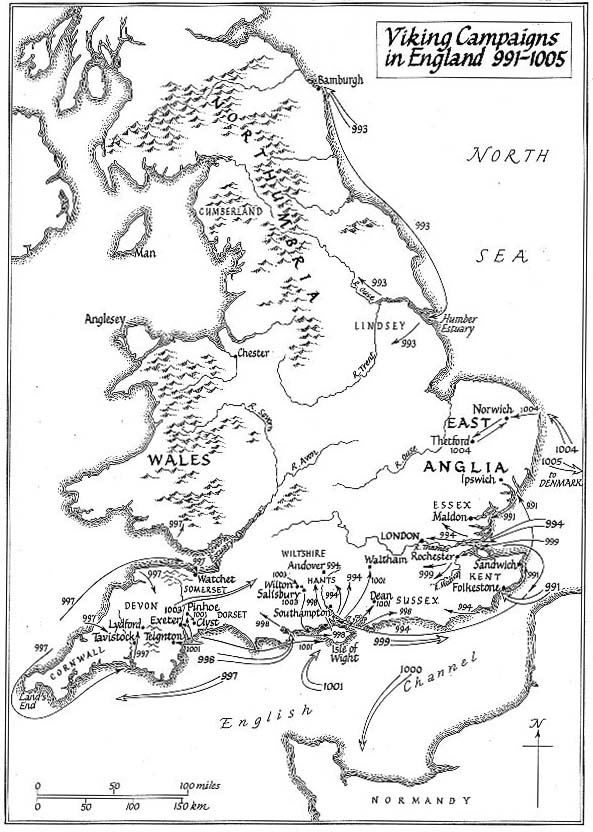
Researching Edmund Ironside, however, drew me into a period of history I did not previously know that much about: the late-10th and early-11th century, in the decades leading up to the arrival of William the Conqueror. Even in my medieval history courses in undergrad, it's something that tends to get skipped over between the fall of the Roman Empire and the rise of the Plantagenets. We get a brief nod to the various invading tribes, a mention of Alfred the Great "unifying" England (though it had an appalling tendency to fall right back apart again), and then we skip merrily on to the Norman Conquest. The Danelaw was something I had seen on maps but never really understood, and the transmission of the crown remained incredibly murky. I had a lot further to go on my own knowledge of the background to this play before I could convey any of it usefully to actors.

Primary sources from this period are few and far between, so I couldn't jump to those as readily as I could for Julius Caesar, and even secondary sources are less easy to get one's hands on. I found I was able to rely on two excellent podcasts: The History of England and Rex Factor (both of which I can highly recommend to any English history enthusiasts). Leaning on their guidance, I was able to sort out this series of events leading up to the events of Edmund Ironside:
  • Edgar the Peaceful of the House of Wessex reigns over the Kingdom of England for sixteen years. He re-conquers the Danelaw, a section of England long held by the Danish, and manages to unite England under Anglo-Saxon rule. 
  • Upon his death, his nobles quarrel over which of his sons, Edward or Aethelred, should succeed. Though Edward was older, he was possibly illegitimate and Aethelred’s mother was perceived as Edgar’s “true wife”. 
  • Edward manages to seize power and is crowned by two archbishops. His reign is marked by famine and “manifold disturbances”. 
  • Edward gets himself murdered in 978, for reasons that are unclear. It is possible that Queen Aelfthryth, Aethelred’s mother, helped in the plot. 
  • Younger brother Aethelred takes over, possibly only about 12 years old at the time. 
  • In 980, Danish raiders start raiding the English coast. 
  • Over the next decade, they win more territory and crush the English armies at the Battle of Maldon in 991. Aethelred then begins paying Denmark tribute. 
  • Aethelred marries Aelgifu, daughter of the Earl of Northumbria. They have ten children; the most important son will be Edmund, later called Ironside, third-born. 
  • Peace lasts for a few years, but in 997, the raiding starts up again, and in 1001, a large Danish fleet lands in southeastern England.
  • In 1002, Aethelred orders a massacre of all Danes in England – despite not having control of nearly a third of the country at that time. The King of Denmark at this time was Sweyn Forkbeard, and his sister was killed during the massacre, prompting his full-scale invasion of England. 
  • Aethelred marries Emma of Normandy (linking the English throne for the first time to the Dukes of Normandy). They have three children: Edward, Aelfred, and Goda. 
  • Over the next several years, the Danes re-establish the Danelaw, and in 1013, they overwhelm the English entirely, forcing Aethelred into exile in Normandy. 
  • Sweyn dies suddenly in 1014. 
  • Danish lords immediately swear allegiance to his son Canute (though only in England; his older brother Harald became King of Denmark), but the English noblemen begin work to restore Aethelred. 
  • Aethelred launches a counter-offensive against Canute and his allies, and within two months of his father’s death, Canute withdraws from England to avoid open war. 
  • In 1015, Aethelred’s son Edmund Ironside rebels against his father and sets himself up in control of the former Danelaw – where the people had come to hate both Aethelred and Canute equally. 
  • Canute goes on to conquer most of the rest of England. 
  • Edmund rejoins his father to defend London shortly before Aethelred dies in 1016. 
  • Edmund and Canute declare open war.

Not to spoil something that happened nearly a thousand years ago, but Canute eventually prevails. Twenty years later, however, control of the English crown ended up reverting back to the Saxon descendants of old Aethelred, simply because they ran out of qualified Danes. The dynastic victory was short-lived, however; Edward the Confessor (an overly pious and weak-willed king who would set the form for Richard II and Henry VI) did not have issue of his own and failed to specify an heir. The Saxon Earls of Wessex seized control based off of an ambiguous gesture the dying king may or may not have made, supposedly indicating Harold Godwinson as his heir. Edward had feared that family's power, however, and had not liked Earl Godwin personally, and so had spent much time cultivating relationships in Normandy, where he had grown up in exile. Duke William felt sure that Edward had intended the crown for him -- and thus began the invasion which marks the start of English history as most of us know it.

At the heart of all of this is a succession problem -- something that plagued the English time and again. We tend to look back at history through a filter, and what several centuries of more-or-less unchallenged succession have taught us is that the oldest son of the king gets to be king when Dad dies -- and if there's no son, then it's the oldest daughter. Simple and straightforward. But this wasn't always the case, and the English had to spend a few hundred years sorting out how their succession would work. The Germanic tradition, which caught on in much of Europe following the collapse of the Roman Empire, was to divide property more or less equally between all of one's sons, and to dower daughters accordingly, so that they would take property with them to their husbands. This splitting, recombining, and sub-splitting of property is how the Holy Roman Empire ended up its hundreds of kingdoms and fiefdoms, and how the prolific French kings were frequently ending up with more Ducs-royales than they knew what to do with.

In English succession, well into the 15th century, might tended to make right. The tradition capped off by Henry Tudor had its roots here, centuries earlier. English law's ambiguity on this matter had led to trouble again and again: Aethelred and Edward the Confessor created similar problems to those of Henry I (when his male heir died unexpectedly and he tried to leave the kingdom to his daughter Matilda, his nobles rebelled and chose his nephew Stephen instead, leading to a decades-long civil war), Henry II (you can see his troubles on-stage in The Lion in Winter), Edward III (his male heir died, and no one quite seemed certain if it should pass to his young grandson or to an adult, capable son), Henry V (died young, leaving his 9-month-old son King, with a host of bickering uncles ready to fight for control), and Henry VIII (had trouble conceiving a male heir, had to change the entire course of English religion in order to get one). The cycles repeat themselves in almost alarmingly similar patterns.

As Elizabeth Tudor entered her dotage with no direct heir-apparent, the future of England was again uncertain, as it had been so many times in the past. The English populace was restless, and not without cause, particularly for those who knew their history. During this period, a spate of plays crop up dealing with previous iterations of the succession crisis, perhaps reflective of London's mood towards the end of the 1590s. Edmund Ironside fits in nicely to the set, focusing not only on the importance of designating a clear heir, but with the added bonus of using patriotic themes to emphasize the need to pick one without too many troublesome continental entanglements. It's interesting to me to be looking at these plays and these historical cycles now as an American. We may not have issues of primogeniture or hereditary succession to worry about, but we're definitely currently concerned with the succession of control of our government.

This Sunday, October the 28th, you can see two succession-oriented plays on stage at the Blackfriars Playhouse: come for the 2pm matinee of King John and stay for the 7:30pm Staged Reading of Edmund Ironside. The Staged Reading is Pay-What-You-Will and open to the public, so we hope to see you there!

24 February 2012

Imprimis: Links and Tidbits, 24 February 2012

A few notes and points of interest from the world of Shakespeare studies this week:
  • London's Globe Theatre has awarded its first PhDs to Sarah Dustagheer and Penelope Woods. These women are both friends of the ASC: Woods presented on audience studies at our 2009 Blackfriars Conference, and Dustagheer observed an Actors' Renaissance Season, giving presentations to the MBC MLitt/MFA program on the differences between playing the Globe and playing the Blackfriars Playhouse. Congratulations to them both, and to the Globe for enacting this joint degree-awarding venture with Queen Mary, University of London, and King's College London.
  • The new "Shakespeare's Sisters: Voices of English and European Women Writers, 1500-1700" exhibit at the Folger Library challenges the notion that early modern women didn't write (or, as Virginia Woolf famously asserted, that, if they did, they must have been driven mad by the frustrations of it). The exhibit celebrates such notable female authors as Veronica Franco, Lady Anne Clifford, Lady Mary Wroth, the Mancini sisters, Aemilia Lanyer, Aphra Behn, Susanna Centlivre, and (my personal favorite early modern woman) Lady Mary Herbert. If you can't make it to DC to see the exhibit in person, selections from it are also available online.
  • This week, the ASC welcomes alumni from Dartmouth College for a weekend of entertainment and scholarship. Peter Saccio, the Leon D. Black Professor of Shakespearean Studies at Dartmouth College, was the editor of A Mad World, My Masters for the Middleton Complete Works. Saccio gave a public lecture last night, detailing some of the textual oddities of the script and what that can mean for the stage, and will give several private lectures to the Dartmouth group throughout the weekend.
  • Education Week featured an article on the challenge educators face when attempting to tie their lesson plans to Core Curriculum Standards. "Their current materials fall short, and there is a dearth of good new ones to fill the void." ASC Study Guides (now available on lulu.com!) feature not only guidelines for fulfilling Virginia's Standards of Learning, but also the U.S. Core Curriculum Standards.

As a final note, remember that you still have a few days to get in your nominations for the 2012 Shakespearean March Madness. I've already heard support for Hotspur, Cassius, the Duke of Cornwall, and Richard II. Pitch your pick for this no-holds-barred brawl here.

21 February 2012

"The pancake bell rings, the pancake bell! Tri-lil, my hearts!": Shrove Tuesday in Early Modern England

Nowadays in America, we know today -- the day before Ash Wednesday, 41 days before Easter -- as Mardi Gras, a festival of extravagance and delight, with traditions passed down to us from the French and Italians. From the bayou to Rio, the Carnival season ends in a triumphant celebration of life and laughter, with parades, parties, fantastic costumes, throwing of beads, and yes, some degree of inebriation.

But for Shakespeare and his contemporaries in late-16th century England, this day was something different: Shrove Tuesday. And on Shrove Tuesday, you ate pancakes. Why pancakes? Because they involved many of the rich foodstuffs -- sugar, fat, flour and eggs -- whose consumption was restricted during Lent (which Anglicans still observed, despite the break with the Catholic Church). It was also a day to gorge yourself on meat and drink, to clear the larders of all those things you couldn't eat during Lent and couldn't afford to let spoil in the meantime.

This tradition is the subject of several scenes in Thomas Dekker's The Shoemaker's Holiday, where the apprentices of the City of London look forward to a great feast:
Firk: I'll lead you to victuals, my brave soldiers. Follow your captain. Oh, brave! (Bell rings). Hark, hark!

All:
The pancake bell rings, the pancake bell! Tri-lill, my hearts!

Firk:
Oh brave! O sweet bell! O delicate pancakes! Open the doors, my hearts, and shut up the windows. Keep in the house, let out the pancakes. Oh, rare, my hearts! Let's march together for the honor of Saint Hugh to the great new hall in Gracious Street Corner, which our master the new Lord Mayor hath built.

Ralph:
Oh, the crew of good fellows that will dine at my Lord Mayor's cost today!

Hodge:
By the lord, my Lord Mayor is a most brave man. How shall prentices be bound to pray for him and the honor of the Gentlemen Shoemakers! Let's feed and be fat with my lord's bounty.

Firk:
Oh, musical bell still! Oh Hodge, o my brethren! There's cheer for the heavens: venison pasties walk up and down piping hot like sergeants, beef and brewis comes marching in dry fats, fritters and pancakes comes trolling in in wheelbarrows, lemons and oranges hopping in porters' baskets, collops and eggs in scuttles, and tarts and custards comes quavering in in malt shovels.

Enter more prentices.


All:
Whoop! Look here, look here!

Hodge:
How now, mad lads, whither away so fast?

First Prentice:
Whither? Why, to the new great hall. Know you not why? The Lord Mayor hath bidden all the prentices in London to breakfast this morning.

All:
O brave shoemaker! O brave lord of incomprehensible good fellowship! Hoo, hark you, the pancake bell rings.

Cast up caps.


Firk:
Nay, more, my hearts: every Shrove Tuesday is our year of jubilee, and when the pancake bell rings, we are as free as my Lord Mayor; we may shut up our shops and make holiday. I'll have it called Saint Hugh's holiday.

All:
Agreed, agreed! Saint Hugh's holiday!

Hodge:
And this shall continue forever.

All:
Oh brave! Come, come, my hearts! Away, away!

Firk:
Oh, eternal credit to us of the Gentle Craft! March fair, my hearts. Oh, rare!
As someone who has had the "oh, rare!" honor to play Firk in a production of The Shoemaker's Holiday (directed by Casey Caldwell back in 2010, as part of his MFA), I can verify that this scene only works if you embrace its jubilant madness entirely -- much in the spirit of Shrove Tuesday or its modern descendents. You have to let the good times roll over you and indulge thoroughly in the exuberance -- and there's something marvelously freeing about giving yourself over to that on stage.

But, as a scholar, I enjoy what this scene tells us about the historical celebrations: Firk gives a detailed menu, listing what the prentices can look forward to at their feast; the ringing of the bell to announce the holiday has historical precedence; and the freedom to "shut up shop" for the afternoon is likewise chronicled elsewhere. Dekker thus provides social historians with a glimpse into Shrove Tuesday's place in the religious and celebratory calendar of early modern England. The tradition lives on -- pancakes are still a typical Shrove Tuesday meal in many Anglican and Lutheran communities, and several cities in England still hold pancake races on the holiday.

So -- Who's up for some pancakes?

06 February 2012

2012 MLitt/MFA Thesis Festival: Session 2

Good morning, scholars -- We're back again, bright and early, for Session 2 of the MLitt/MFA Thesis Festival. This session runs from 9:30am to 12:00pm.

Clara Giebel: "Playing Paper"

Giebel's presentation begins with an interesting tableau: Katy Mulvaney, Linden Kueck, and Amanda Noel Allen on-stage, crafting -- rather than, as we might expect, sitting on the gallant stools holding scripts. Giebel explains that sometimes a tradition should be broken "just because there's something we'd rather do," and that she hopes their presence will provide a meaningful counterpoint to her ideas.

She moves into discussing the typical structure and tropes of fairy tales, and she shares illustrations from some classic fairy tales via a Powerpoint presentation. She explains that these images are not only beautiful but "look right to our eyes", with conventional tropes reminiscent of illuminated manuscripts. She expands the idea further, referring to how Disney's fairy tale movies often open with the frame narrative of books, giving images of pages turning before the animation begins. Giebel explains these frame devices as important because of the "time of textual transmission" we currently exist in. The movement of page to screen, first scene from books to movies, is now prominent in the idea of moving from books to e-readers. She demonstrates various "skins" and covers for e-readers which attempt to recover the tangible and visual elements that are lost in the transmission to digital text. She posits that the two most important elements lost are the paper itself and the "codex", or non-textual visual information, which she demonstrates through a reading of "The Monster at the End of This Book" and through a consideration of pop-up books, which "glory in the paper-ness of paper". Giebel talks about the importance of sound, smell, and texture to the experience of reading, and relates those concepts to ideas of crafting.

Giebel then brings her ideas around to the early modern period, looking at the history of textile handwork, particularly with regards to gender assignations of various tasks such as embroidery and knitting, seen as female tasks both in the early modern period and in the 21st century. She notes, however, that these tasks no longer have the same cultural significance, thanks to mass marketing -- similar to the fading essentialism of paper in books.

Teachers, parents, and the media, as Giebel points out, teach fairy tales to children, but particularly to girls, emphasizing the female character "as the object of other characters' acts and desires", not as the agent. She notes that Shakespeare's All's Well That Ends Well both draws on and inverts these fairy tale tropes, featuring not just one, but several active women. Helena has to mangle her own sentences to try and fit herself into the expected passive role. All's Well is "a fairy tale, but a problematic one... a deliciously messy one" in contrast to the neat, happy endings of Disney's fairy tales. Giebel has worked with Linden Kueck to design a paper-based set for All's Well That Ends Well based on these concepts, particularly as an exploration of the gender issues at play. She ends by foregrounding the need to examine, in this concept of textual transmission and shifting gender roles, what we want to keep from the past and what we want to move on to -- a world where we can both read blogs on our cellphones, but also enjoy the texture and physical reality of paper, "where boys can learn embroidery and girls can be the king".

Brian Maxwell: "The First Generation: The Dawn of American Shakespeare"

Maxwell's presentation begins by interrogating our awareness, in the American Shakespeare Center, of the history of Shakespeare in America. Actors Jarom Brown, Brian Falbo, Rebecca Hodder, and Zach Brown assist by taking on the personas of various 19th-century American Shakespearean actors. Maxwell contrasts the various acting styles of these historical actors: Forrest, Cushman, Booth (Edwin, not his infamous brother), and Jefferson. Forrest represents the emotional style, requiring the actor to give himself over entirely to the affect of the character. Maxwell notes that this style was incredibly popular in the first half of the nineteenth century in America and drew in the working-classes to the theatre. By contrast, Booth and Jefferson display the style which became popular in the second half of the century. This style was a "launching point for Stanislavski's method", praised for its naturalism, but less popular with those of the working classes seated in the galleries and a bit too far from the gaslit stage to appreciate the nuances.

Maxwell then encourages Forrest and Booth to dueling monologues. The contrast, with Forrest's bombastic style and Booth's understated delivery, makes plain the differences between the early and late methods. Maxwell credits both styles as important to American theatrical heritage. He also posits that these actors, others like them, and their companies gave America cultural credit on the world stage. He shares a 1902 video of Jefferson as Rip Van Winkle and an 1890 wax cylinder audio recording by Edwin Booth.

Daniel Kennedy: "From Place to Space: The Abstraction and Diminution of Hell on the Renaissance Stage"

Kennedy begins by coaxing us all into singing "Happy Birthday" to Christopher Marlowe. He then discusses the ASC Actors' Renaissance Season production of Marlowe's Doctor Faustus, and the dismay of the actors when, each time they revealed the painted-plywood hellmouth, the audience chuckled. Kennedy sketches out the history of the hellmouth, with its roots in medieval representations of Biblical stories. Early illustrations envisioned "an open pit" to invoke Hell; later a volcano, initially considered appropriate for its fiery and sulpherous nature, but later rejected as too passive; later the heads of beasts, particularly dragons. He positions the evolution in relation to attempts to convert the Danish pagans of north England: "Now, if I know Vikings, at least one of those bad motherf*ckers has walked out of a volcano. I don't think any have walked out of a dragon's mouth." Clearly, this imagery would have had a resonance for the England-occupying Danes.

The hellmouth became a convention of the morality plays, an intricate construction, but one which, Kennedy notes with some dejection, audiences found "amusingly wonderful" rather than terrifying or awe-inspiring. He shows an illustration of the stage mansions of Valenciennes, the elaborate decorated carts used for these plays. He notes that, while the hellmouth itself disappeared, the opposition of Heaven and Hell remained prominent. While the structure of the medieval stage mansions positioned Heaven and Hell in horizontal opposition, the early modern audience was conditioned to think of up, the balcony or "heavens", as good and down, through the trap, as bad. The stage pictures became less religious spectacle, less a stylistic presentation, and more an interpretation of inner struggle.

Kennedy moves on to a discussion of the various texts of Doctor Faustus, noting that the A text, earlier published, lacks elements present in the later B text, considered the version closer to Marlowe's intended play. The stage direction "Hell is discovered" indicates that, reminiscent of the medieval morality plays, Hell must be visibly represented on the stage. Where, however, remains ambiguous. Kennedy presents it first as revealed in the discovery space, drawing on the image of a dragon's head gaping open to consume Faustus; then a second time, using the trap. In the second version, the Bad Angel's description becomes more critical to feeding the audience's imagination as the means for invoking Hell, rather than an actual stage depiction. Kennedy notes that while Shakespeare never directly calls for a hellmouth as Marlowe does, he still visually invokes the concepts of Hell, demons, and the afterlife in several plays (Hamlet, Macbeth, 1 and 2 Henry VI). He suggests that the accepted convention of the trap as Hell can inform the interpretation of the ghost of Hamlet's father; if he enters from the trap, the audience may assume him as a demonic figure. He also relates the concept to certain resonances in Macbeth to the idea of the Harrowing of Hell, particularly as relevant in the Porter scene.

Elizabeth Rentfro: "For I Am She: The Development of Margaret of Anjou in Performance"

Rentfro's presentation opens with a presentation from Richard III, with most of the cast (Liz Lodato, Brian Falbo, Mel Johnson, Dane Leasure, Deb Streusand, Jessica Schiermeister, Stephanie Tschetter, Kelly Elliot, and Rachel Ratkowski) on-stage, and Rentfro, as Margaret, moving in from the audience. Following Margaret's intrusion into the body of the scene, Rentfro details her experience having played Margaret in both full productions and staged readings across the "Margaret canon" of Henry VI, Parts 1-3 and Richard III. She prefaces that the presentation will work through the scene with a few breaks for her to explain her exploration as a self-evaluating performance study.

As they progress through the scene, Rentfro notes that while Margaret harbors special hate for Richard III and is the first person to see him for what he is, she also feels a kinship with him due to some of their inherent similarities. Likewise, she sees a reflection of herself in Elizabeth, the "poor painted queen" she mocks. Rentfro moves on through Margaret's exit, leaving the Yorkists behind to "muse why she's at liberty". She then relates her experience to that of Sarah Fallon, someone else who has seen Margaret all the way through her arc. She notes the experience as fairly rare, since so few companies perform the full tetralogy.

Jared Fair: "The Grieving Parent in Shakespeare and the Early Modern English Children's Epitaph"

Fair begins by positing the opinions of Laurence Stone as to the emotional distance between parents and children in the early modern period, which he views as necessary due to the high child mortality, depicting these parents as detached and unemotional even upon the death of a child. Fair juxtaposes this with the ideas of David Cressy, who claims that early modern people were deeply emotional and loving, with a great capacity for tenderness both in their families and their communities. Cressy uses diaries and letters as examples that early modern people experienced intense emotions upon the death of a loved one.

Fair presents (through actors Jarom Brown and Dr. Julie Fox) epitaphs from the early modern period, which demonstrate the emotions felt by parents upon the death of a child. These epitaphs imagine sleep as a death, which Fair suggests as a coping mechanism to soften the blow. They also suggest that "death is not the end, that life continues for the child." He presents an epitaph written by Ben Jonson on the death of a child actor, the first epitaph to so commemorate an actor. Jonson also wrote an epitaph when his own daughter died at 6 months and when his son died in the plague of 1603. Fair points out that Jonson describes himself as possessed by his own emotions; the epitaph serves as method to "loose" the bonds that hold him in thrall to grief. Fair then moves to considering Shakespeare's experience with a child's death, particularly in the proximity of the composition of King John to the death of his son Hamnet. Constance's grief "is anticipatory", upon Arthur's disappearance. Fair argues that if Hamnet suffered an illness rather than a sudden death, Shakespeare's own emotions may have informed this sense of anticipatory dread. He notes that Constance sinks into a suicidal depression, haunted by her son's image, reminded of him everywhere. She later dies "in a frenzy", inconsolable. Fair links this depiction of dramatic pain to Shakespeare's personal experience as a parent.

--

For the rest of the Festival, see these posts:
Session 1
Session 3
Session 4

05 February 2012

2012 MLitt/MFA Thesis Festival: Session 1

Good evening, all. Tonight and tomorrow at the Blackfriars Playhouse, twenty-three students from Mary Baldwin College will give presentations on their MLitt and MFA projects. These presentations are a required portion of the thesis project for all candidates. The ASC education team will be live-blogging throughout the both days of the event. The first session runs this evening from 6:30pm-9:30pm.

With his characteristic wit, Dr. Paul Menzer opens by apologizing for scheduling this event during that great Sunday ritual, but reminds us that Downton Abbey re-airs on Thursdays. He also notes the infeasibility of sharing chicken wings and airing misogynistic commercials between presentations.

Amy Bolis: "Color-Conscious Shakespeare: A Dramaturgical Investigation of 'Othello' and Its Legacy

Bolis begins by noting that, in Othello, the word "Moor" appears more times than Othello's actual name; she then moves on to a list of the "contradictory characterizations" of the title character contained within the play. She then probes the "problematic construction of blackness" within the play, questioning what role Othello should hold in modern theatre. The problem, as she notes, is further complicated by the divergent opinions of those in the field; her actors Brittany Fauzer and Katy Mulvaney read from such opinions throughout the presentation. She uses the example of Patrick Stewart's photo-negative production, but notes that such a production encourages white audiences still to sympathize with the white man, experiencing only the fear of losing their own privilege. She notes that, for the remainder of the presentation, she will focus on Harlem Duet by Djanet Sears.

Harlem Duet is an Americanized prelude to Othello, set in Harlem during the 1990s, with flashbacks linking different moments of black experience in American history. She foregrounds four questions: 1) What is the relationship between non-white theatre practitioners and the Shakespeare canon? 2) Given lack of roles for non-white characters, how can modern companies approach these plays? 3) Where do actors of colours reside within the realm of Shakespeare performance? 4) Given Harlem Duet's critique, what is the legacy of Othello?

Fauzer presents a monologue from Harlem Duet by Billie, Othello's first wife, where she discusses her decision to poison his handkerchief. Through this story, Sears gives the handkerchief a tangible history, positioning it as an heirloom that "holds the ancestry of generations" through slavery and emancipation, rather than as a magical object of ambiguous origin. Fauzer also presents a statement from Sears on the need to integrate the black narrative into the theatrical world. Bolis concludes with the thought that, "Adaptation has allowed for a different dream of Othello," one that allows for a shifting of the play's legacy.

David Ashton: "Staging the Censored Text"

Ashton's presentation explores the question of "How do you stage a censored text?", focusing on the most obviously altered sections of George Chapman's 1608 The Conspiracy and Tragedy of Charles Duke of Byron. Actors Amanda Noel Allen and Brian Falbo present an altered scene, where characters report on a conversation involving Queen Elizabeth and French politics. The alternations make the scene noticeably awkward. Ashton suggests that, while theories exist as to the reason for the alteration, none seem plausible. He looked to production history for possible illumination.

Ashton relates his methodology to that of Genevieve Love, exploring the theatrical impact of absences and voids for those early modern plays which have no strong performance record. He posits the notion of "fantasy performances" suggested by those absences, which may be a means of recovering the pre-censored version. Ashton claims that Act Four allows for at least three "fantasy performances" using the extant text as sole source, a fourth informed by historical context, and a fifth from textual criticism. Actors Maxim Overton, Melissa Tolner, Allen, and Falbo present Ashton's various possibilities.

The fourth version draws from the historical context of the play's censorship, which Ashton details; Chapman apparently wanted his plays printed and fought for their restoration. Chapman's history suggests that he was likely involved in the printing of the plays, often overlooking proofs before they went to print, and that he thus authorized leaving the 1625 reprint unchanged from the 1608. Moreover, Ashton posits that statements from Chapman suggest that he believed readers could fill in the gaps on their own, that "a reader's mind is capable of imagining moments of theatrical effect." This fourth version of the scene, then, is a conflation of the extant texts with what Chapman assumed his readers could fill in, the shade of an original performance. Ashton's suggested fifth version takes critical context into account, a methodology he believes most likely as a way to "stage the censored text", an exercise both in edition and creation.

Elizabeth Lodato: "From Alehouse to Household: Women in Service in Early Modern Drama"

Lodato begins by having the audience close their eyes and imagine being in a 16th-century alehouse; she suggests that we, as she would have months earlier, probably conjured a romanticized vision of a warm, happy tavern populated with cheerful folk. The reality, she notes, was somewhat darker, as alehouses were often dens of criminal behavior, including prostitution, money-lending, thievery, and fugitive-harboring. She then posits that alewives suffered more complaints and condemnation because of the economic threat they posed to working men, suggesting considerably anxiety about a female-dominated trade.

Lodato's presentation examines depictions of alewives in both dramatic and non-dramatic literature, with the aid of actors Stephanie Tschetter, Angelina LaBarre, and Elizabeth Rentfro. The popular depictions, Lodato argues, grossly dominated over the actual faults of the trade, often along themes of uncleanliness. She notes the odd juxtaposition of positive statements on an alewife's congeniality and sociability with the insults regarding unsanitary brewing conditions and dishonesty of practice. She then moves to noting the difference in depiction of alewives in early modern plays, where the women are less often gross caricatures of slovenliness, and more amiable comedic characters, "full of malaprops and earnest". She suggests that the plays present male hosts as far more dishonest characters than their female counterparts. Lodato pulls examples from the anonymous Every Woman in Her Humour and Heywood's Fair Maid of the West. The latter particularly displays a virtuous woman defending her reputation against bullies and cheats. Lodato finished by summarizing the sexist depiction of alewives in popular literature and its connection to male anxiety over female independence, and her desire to further investigate the evolved role those characters hold in early modern theatre.

Kimberly Lenz: "'What's in a Name?': Proper Name as Performance Clue"

Lenz opens by commenting on the attraction of the idea of demonic possession in the entertainment industry. She relates the idea of the power of a proper name to expel a demon to the notion of characters in a play using a proper name to exercise power over another character. She uses The Maid's Tragedy as her example, noticing the frequency with which other characters use Amintor's name, particularly by those characters who are manipulating his fate. Lenz notes that there seemed to be an epidemic of demonic possession and exorcism in England in the 16th and 17th century. Some men won great fame as exorcists, though often fell from grace and were exposed as frauds; popular awareness of the phenomenon found its way into plays such as The Devil is an Ass (scenes presented by James Byers, Mel Johnson, Joshua Brown, and Justine Mackey).

Lenz describes that her project aims to explore the applicability of the idea of the power exercised through use of proper names. She admits that the results are in no way quantifiable, but that they are nonetheless valuable. Her actors present an exploration of a scene from King Lear. Lenz notes that she is developing rehearsal techniques based around this idea and intends to explore the idea further.

AJ Sclafani: "Distancing Techniques in Modern Early Modern Playhouses"

The presentation opens with the inimitable Dane Leasure giving a version of the traditional pre-show Playhouse-opening speech, Maria Hart giving out tickets for a raffle, and Dan Stott giving the actor's pre-show speech on our staging conditions. Jessica Schiermeister then enters in an approximation of Sclafani's sartorial style and takes the podium. Sclafani eventually reclaims the stage and notes that his project looks at the paratextual material of the Blackfriars Playhouse.

He discusses how some of the paratextual material, such as the posters for the shows, emphasizes to the audience that they are about to see actors in a play. He suggests that posters containing the actors' faces, actors' names, photographer's name, and title of the play, but not the name of character portrayed, leads the audience to focus on matters other than the actor's representation of the role. He moves on to the pre-show speech, which he states positions the audience as an observer of the customs of the Playhouse. He notes that some aspects of the pre-show have become vestigial, while others (asking for donations and asking audience members to turn off cell phones) has reversed the effect of the speech, originally designed to integrate unfamiliar audiences into the unique conditions of ASC productions. He argues that, especially in the context of "problem" plays, distancing techniques transfer the creation of synthesis onto the audience.

Monica Cross: "Modern Adaptations of 'Hamlet'"

Cross begins by noting the proliferation of adaptations in the MLitt/MFA program within the past few years, and declares her intent to examine how adaptations comment on their source material. She looks at several adaptations of Hamlet from the 1990s and 2000s: Fortinbras, by Lee Blessing (1992), Claudius, by Ken Gass (1993), Something's Rotten, by Michael Burdick (2003), and 12 Ophelias (a play with brokensongs), by Caridad Svich (2004). She focuses in this presentation on Fortinbras and Something's Rotten (with scenes presented by Clara Giebel, Linden Kueck, Celi Oliveto, Stephan Pietrowski, and Shane Sczepankowski), the latter of which was presented in a one-act version at the 2011 Blackfriars Conference.

Something's Rotten follows the reactions of the the gravediggers to the play and its aftermath, taking fragments from Hamlet's language. Shifting the focus from court life to commoners "breaks the Aristotelian model", particularly with such prominent speeches as "To be or not to be". Burdick's reimagining breaks the concept down into ideas of being an aggressor or being a victim, as represented by the two gravediggers' divergent opinions. It also examines the concept of different kinds of death. Fortinbras, by contrast, features the titular character trying "to manipulate the story of Hamlet to suit his own purposes". This play breaks traditional modes and the fourth wall equally, having characters comment on their own situations. One character actually gets a hold of Shakespeare's Hamlet and becomes engrossed, suggesting, as Cross notes, that even the characters in the play find the original superior to the adaptation. Cross positions her interest in these plays in particular for what they have to say about the role of adaptation as a form of commentary.

--

And that's it for tonight -- We're back at 9:30am tomorrow (Monday, February 6th) for a full day of presentations.

For the rest of the Festival, see further posts:
Session 2
Session 3
Session 4

13 January 2012

ASC Education in 2012-2013

The announcement is officially out, the Facebook Jeopardy game is complete, and that means I can share ASC Education's plans for the upcoming year. If you've missed the information elsewhere, here's the American Shakespeare Center artistic line-up for 2012-2013:

Summer
The Merchant of Venice
The Lion in Winter, by James Goldman
The Two Gentlemen of Verona

Fall
Cymbeline
King John
The Merchant of Venice
The Lion in Winter, by James Goldman
The Two Gentlemen of Verona

Holiday
A Christmas Carol
Santaland Diaries
, by David Sedaris
The 12 Dates of Christmas, by Ginna Hoben

Actors' Renaissance
Julius Caesar
The Country Wife
, by William Wycherly
Henry VIII
The Custom of the Country
, by Francis Beaumont & Philip Massinger
Two Noble Kinsmen

Spring/Tempt Me Further Tour
Twelfth Night
Love's Labour's Lost
The Duchess of Malfi
, John Webster

What does this mean for Shakespeare Education at the ASC? For a start, throughout the year, we'll be offering Student Matinees of The Merchant of Venice, The Two Gentlemen of Verona, Cymbeline, A Christmas Carol, Julius Caesar, Henry VIII, Twelfth Night, and Love's Labour's Lost. To complement these opportunities to bring your students to the Playhouse, I'll be preparing brand-new full-length Study Guides for The Merchant of Venice, The Two Gentlemen of Verona, and Twelfth Night, as well as revising (and, quite possibly, adding to) last year's Julius Caesar guide. I will also produce mini-guides for Cymbeline, Love's Labour's Lost, and Henry VIII.

We will, again, have four Teacher Seminars in the 2012-2013 season. On August 10th, we'll be looking at that perennial curriculum favorite, Romeo and Juliet (for which I will also be producing a full-length Study Guide), where both the construction of the language and the complex interplay of comedy and tragedy provide many opportunities for exploration. Our Fall Seminar, September 14th-16th, will focus on The Merchant of Venice and The Two Gentlemen of Verona. I'm excited to tackle the challenge of these two off-kilter comedies, from the racial tensions in Merchant to the troubled ending of Two Gents. Both plays are full of emotionally charged moments, opportunities for audience contact, and clever, fast-paced language, all of which make wonderful fodder for teachers. As we did in 2011 with The Comedy of Errors, we will be linking these non-curriculum plays with their more-frequently-assigned cousins, in order to provide teachers with the greatest opportunity to incorporate staging with study. We also champion these plays as ideal for teachers who are tired of always retreading the same material. The Merchant of Venice and The Two Gentlemen of Verona will provide intrepid educators with a new, invigorating approach to Shakespeare's word- and stagecraft.

Our Winter Seminar, February 2nd-3rd 2013, will focus on Julius Caesar, a play I can never get enough of and can't wait to return to. That play features so prominently two of my favorite things to talk about: rhetoric and audience contact. Those two elements define Caesar for me, more than anything else, and they provide wonderful avenues for making the play exciting for students. Our Spring Seminar, April 12th-14th 2013, will focus on Twelfth Night: frothy fun with some dark undercurrents. I look forward to reawakening some of the same topics I've looked at in As You Like It, The Comedy of Errors, and Much Ado about Nothing -- twins, gender-bending, gulling, etc -- as well as exploring the role of music on the early modern stage.

Throughout the year, we'll continue to hold our lecture series, on select Wednesday and Thursday nights, prior to the evening shows. We've moved the timing of these events to 5:30pm, which will allow attendees enough time to go get a quick bite or a drink at one of downtown Staunton's fabulous eateries before the show begins. I'm pleased to announce that this year, we will have both a Dr. Ralph Presents lecture and an Inside Plays workshop for every play in the Fall, Actors' Renaissance, and Spring Seasons. We're especially pleased that this will allow us to offer audiences some more insight into the shows which are enjoying their Blackfriars Playhouse premieres in 2012 and 2013. See the schedule on our website for more information.

Our Staged Reading series also continues in 2012-2013, with four dynamic titles: the anonymous Edward Ironside (October 28th), an early English chronicle play full of patriotic glory, violent energy, and inventive language; George Chapman's An Humorous Day's Mirth (November 4th), where jealous husbands, absurd courtiers, lapsed Puritans, and lustful monarchs collide; Aphra Behn's Restoration hit The Rover (March 24th, 2013), a quick-witted and wickedly wanton comedy where a group of amorous English exiles revel their way through Naples; and The Insatiate Countess (April 28th, 2013), by John Marston and collaborators, a play of merry widows, virtuous wives, and subverted theatrical conventions. We're in the process of making some exciting changes to how the Staged Readings operate, and we'll have more information on that for you as the year progresses.

And, of course, summer 2012 will be full to the brim with camps for Shakespeare enthusiasts of all ages. ASCTC Session 1, June 17th-July 8th, tackles Twelfth Night, Romeo and Juliet, and John Lyly's Gallathea, while Session 2, July 15th-August 5th, takes on Much Ado about Nothing, 1 Henry VI, and Francis Beaumont & John Fletcher's A King and No King. Our Midsummer Day Camp for ages 9-12, July 9th-13th, moves from the light-hearted comedies of the past few years to the high-octane thriller, Macbeth. Finally, the No Kidding Shakespeare Camp for adults, June 25th-29th, will explore Movement -- both the movement of the actor on stage and the movement of plays from one playhouse to another and out on the road.

It's almost hard to believe that here we are in January 2012, already planning for April 2013, but that's the way of it. The whole education team is looking forward to a full and fabulous year -- we hope you'll be joining us for these explorations into early modern staging.

04 November 2011

Imprimis: Links and Tidbits -- 'Anonymous' Edition

As I'm sure you've all noticed, a movie came out last week which, despite its risible nature, seeks to ruffle feathers in the world of Shakespeare studies. Many scholars would rather not dignify the nonsensical issue with a response (not to mention our reluctance to give Emmerich more free publicity), but the matter has pressed itself sufficiently that the community has responded. If Anonymous realized its own fictional nature and were not attempting to masquerade its inventions as fact, perhaps we wouldn't have such a problem, but because Emmerich has taken to the media, smugly pronouncing himself the savior of truth, and because Sony has begun distributing supposedly "educational" packets to high schools (I've seen them; they're alarmingly misleading and ethically irresponsible) -- those conditions provoke the defense that Shakespeare deserves. The kid gloves have come off, and rather than dancing delicately around the issue, many scholars have attacked the issue head-on and free of hedging. I submit here, for your perusal, a smattering of the reviews and opinions published in response to the Anonymous absurdity.
  • James Shapiro, author of Contested Will, took to the New York Times in defense of Shakespeare: "Promoters of de Vere’s cause have a lot of evidence to explain away, including testimony of contemporary writers, court records and much else that confirms that Shakespeare wrote the works attributed to him. Meanwhile, not a shred of documentary evidence has ever been found that connects de Vere to any of the plays or poems."
  • The Times also has a piece by Stephen Marche, which not only disapproves of the attempt to portray the film as educational but also derides the conspiracy theory in general: "No argument could ever possibly sway the Oxfordian crowd. They are the prophets of truthiness. 'It couldn’t have been Shakespeare,' they say. 'How could a semiliterate country boy have composed works of such power?' Their snobbery is the surest sign of their ignorance."
  • An editorial in the Washington Post sought out opinions from James Shapiro, the Folger's Michael Witmore, and eminent period scholars Eric Rasmussen and Stephen Greenblatt.
  • Simon Schama advises, simply, "Don't buy it" in regards to Emmerich's spurious claims. "None of which would matter very much were there not something repellent at the heart of the theory, and that something is the toad, snobbery—the engine that drives the Oxfordian case against the son of the Stratford glover John Shakespeare. ... The real problem is not all this idiotic misunderstanding of history and the world of the theater but a fatal lack of imagination on the subject of the imagination. The greatness of Shakespeare is precisely that he did not conform to social type—that he was, in the words of the critic William Hazlitt, 'no one and everyone.'"
  • A public radio commentary fights the idea of privilege attached to the Oxfordian theory: "I could never stand before a class of high school students and tell them that great writing, and a deep understanding of humanity can only be achieved by the educated elite."
  • Woman About Town links the "controversy" to other conspiracy theories. "It was only as the centuries passed and Shakespeare’s work began to be seen as the pinnacle of artistic achievement that it was that ‘doubts’ emerged. And the biggest reason appears to have been plain old-fashioned snobbery and frustrated romantic yearnings."
  • Jonathan Hobratsch for the Huffington Post presents 10 reasons why Shakespeare is Shakespeare.
  • Slate.com has a movie review, complete with podcast, demonstrating that even objective reviewers with no dog in the fight find the whole premise absurd. The podcast is particularly interesting for what the reviewers have to say about the relationship of modern actors to the conspiracy. Another article on the same site asserts the need to defend Shakespeare: "To remain silent in the face of stupidity this blatant is to acquiesce to a kind of culture-destroying ugliness. ... Most of all, I hate the way they pride themselves on the vain, mendacious conceit that they’re in on a grand historical secret deception that only they have the superior intelligence to understand. It’s an insult to everyone else’s intelligence if they’re taken seriously."
  • James Ley challenges Sony's choice to promote the fictional movie as educational: "There is something pernicious about the way Anonymous is being promoted. The 'teach the controversy' strategy, beloved of those whose arguments are on the wrong side of the evidence, is now apparently so normalised that an implausible work of speculative fiction can be brazenly offered as an exercise in historical revisionism and an educational tool."
  • Skeptical Humanities also challenges the movie presenting fiction as fact: "So, no, Anonymous is NOT just a movie: it is a huge propaganda machine that wants desperately to sway viewers and students."
  • Stanley Wells and Paul Edmondson, from the Shakespeare Birthplace Trust, have written an e-book which they’ve made freely available. Shakespeare Bites Back synopsizes the argument nicely and also advocates that we stop using the term "anti-Stratfordian" and begin calling a spade a spade with the term "anti-Shakespearean". Additionally, Edmondson and Wells discuss the issue in a short podcast, Wells has a piece in the Telegraph, and a series of posts from back in June demonstrates that Shakespeare solidly wins the debate.
  • Finally, the Utah Shakespeare Festival solicited responses from a number of scholars and practitioners from Shakespeare institutions around the country. When they asked the ASC for our thoughts, Sarah was kind enough (and brave enough) to let me reply -- so if you want to know what I personally think about the issue, my argument is encapsulated there in a 500-word essay.
I'm also in the process of finally reading Shapiro's Contested Will, which Simon & Schuster sent to me for a review, so hopefully I'll be able to post that soon. It's also worth noting what several of the scholars who've weighed in have pointed out: this conspiracy is not something that dominates the field of Shakespeare studies. It is a distraction from real work. As entertaining as it sometimes is to spork a ridiculous fiction, I think we'll all be quite pleased when the movie flops (as it's reportedly doing), the hype dies down, and we can go back to arguing about the finer nuances of scansion, pedagogical technique, and the merits of Q1 Hamlet.

29 October 2011

Blackfriars Conference 2011 – Plenary Session X

Hello - Charlene V. Smith here, welcoming you to Saturday afternoon of the 2011 Blackfriars Conference. I'll be liveblogging Paper Session X from 2:30pm to 3:45 pm. The session is moderated by Farah Karim-Cooper from the Globe Theatre, and the presenters were assisted by Mary Baldwin MFA actors A. J. Sclafani, Linden Kueck, and Angelina LaBarre.

Annalisa Castaldo, Widener University
"Here sit we down...": The location of Andrea and Revenge in The Spanish Tragedy

Thomas Kyd's The Spanish Tragedy opens with the entrance of the Ghost of Andrea and the figure of Revenge, and presumably they both remain onstage for the entire play. Castaldo mentions a footnote in an essay by Barry Adams pointing out Scott MacMillian's assertion that the characters would have appeared on the main platform of the Rose in full view of the audience.

Castaldo suggests that this set up is a ridiculous waste of two actors and stage space. Castaldo compares the play to Taming of A Shrew, where Sly, onstage for entire play, repeatedly interacts with the action. In contrast, Andrea and Revenge sit still, pretend that the actors cannot hear them, speak only to each other during breaks in the action. Andrea and Revenge act more like a modern audience than an early modern audience.

Other plays of the time suggest interaction form audience, so Castaldo wonders if an non-interacting Andrea and Revenge located onstage would have in fact been distracting to the audience. With that thought, Castaldo wonders how might the characters have moved around the stage? Where would they have been?

In the very first scene, Revenge says, "Here sit we down, to see the mystery." In an indoor theatre, they could take gallant stools. But there is no evidence that the Rose had seating onstage. Would stools have been preset? Would the actors have carried them on with them? Castaldo thinks these options seems unlikely. These problems can be solved if the characters enter above.

Further evidence for this idea comes in 3.2, during Hieronimo's famous "O Eyes, No Eyes" soliloquy. His speech is interrupted by a letter which falls from above. The letter comes from Bel-imperia, so it would make sense that Bel-imperia drops it from her balcony. However the stage direction from the printed text is ambiguous: "a letter falleth" suggesting instead a supernatural element. Castaldo argues that Revenge drops the letter, which he can do so from above.

Castaldo also points out the stage direction that appear between acts three and four, "enter Ghost." The previous action upsets Andrea and Castaldo says the "enter" indicates that Andrea appears onstage and shouts up to the sleeping Revenge, who is still above.

Castaldo ends her presentation with a strong recommendation that the ASC produces The Spanish Tragedy, a statement that is met with enthusiastic applause from the audience (much of it, admittedly, mine).


Jeanne McCarthy, Georgia Gwinnett College
The Two Blackfriars Theatres: Discontinuity or Contiguity?

E.K. Chambers conjectured that both Blackfriars theatres were located in the same place in the monastery. Later scholars have imposed great difference between the two theatre on what McCarthy calls "slim evidence." Scholars have come to view the first Blackfriars as inferior in location, size, and ambition, a failed attempt that was corrected with the second. McCarthy suggests this comes from a selective reading of the evidence.

Many scholars push first Blackfriars into northern end of the upper floor in the old buttery. This conclusion is based on misunderstandings of audience access, room size, and roof height. Documents from the period speak both of divided rooms and also one great room, suggesting a mutability of space. McCarthy points out evidence authorizing the removal of walls.

McCarthy argues that the desire of scholars to seek a permanent purposed built theatre in the Blackfriars is anachronistic. The documents are evident, instead, of a fluid, transformable sense of space.


Joe Falocco, Texas State University – San Marcos
"What's in a Name?": Defining an Appropriate Nomenclature for Elizabethan/Original Practices/Early Modern/Renaissance/ Shakespearean Staging

Since late 19th century, theatre practitioners have sought to emulate the staging conditions of Shakespeare's playhouse. Falocco's paper investigates what we should call this movement. Early incarnations were known as Elizabethan Revival. This causes problems, the chief of which is the name Elizabethan is historically inaccurate. Early Modern is more accurate, but few people outside of English departments know what that means. Falocco says that calling the movement Renaissance Staging would avoid these pitfalls, but unfortunately would cause tension with disgruntled medievalists.

The term Original Practices has gained some popularity recently, though there has not been complete agreement over what these practices are. This term has been associated strongly with Mark Rylance's tenure at the Globe and the New American Shakespeare Tavern in Atlanta. Theatre historians, however, have pointed out the Globe's ahistorical use of the yard for entrances, exits, and processions. At the Shakespeare Tavern, the audience is seated in front and does not surround the playing space. Nor does the tavern consistently employ universal lighting.

Jim Warren, Artistic Director of the American Shakespeare Center, told Falocco that everyone used to refer to Shakespeare's staging conditions. Falocco suggest Shakespearean Staging as a viable alternative to these other terms. However he admits that this terms shortchanges Shakespeare's contemporaries and also causes confusion, as every production of Shakespeare play is in some sense Shakespearean staging. But, Falocco argues, the benefits of name recognition might outweigh these drawbacks.


Ann Jennalie Cook, Vanderbilt University and Sewanee School of Letters
Light and Heat in the Playhouses

Cook begins her presentation by noting that even in our original practices productions we don't fully realize the influence of light and heat in the early modern period. The availability of light regulated activity in the early modern period. Torches and candles were expensive. Whatever happened at night involved spending money.

It was, additionally, really cold most of the time. The period was consistently colder than temperatures have been in the 20th century. Weather conditions caused permanent snow on Scottish hill tops and frequent storms brought rain and crop destruction. The Thames River froze solid at least eleven times during the 17th century.

1601 was the coldest summer in 2,000 years. The weather, like the light, had monetary implications. During the period, the price of fuel climbed steadily. Clothing was also expensive and shoes were a necessity, not a luxury.

Both factors of heat and light affected season attendance and governed activities in the playhouses. Cook wonders how often performances were curtailed or canceled due to weather? How many groundlings remained shivering until the end of the performance? To sit out of the rain and weather in an outdoor playhouse cost more money. Indoor playhouse likewise had a higher cost of admission.

Considering these elements will help us understand the plays better, Cook argues. Shakespeare's text clearly makes references to weather, season, and time. A Midsummer Night's Dream takes place at a time of year where the light and weather allow for lovers to sleep on the ground, and for rude mechanicals to rehearse in the woods. "Sleeping in mine orchard," as mentioned in Hamlet, was only possible for a limited period of the year. Looking at the season and the school schedule at Wittenberg, Cook suggests that Hamlet would have been at Elsinore when his father died. Cook states that the action of the plot of Hamlet begins in early September and "the days thereafter grow steadily colder."


Nova Myhill, New College of Florida
"The Concourse of People on the Stage": An Alternative Proposal for Onstage Seating at the Second Blackfriars

Ben Jonson's prologue to The Devil is an Ass is concerned with the physical restraints the stage-sitters put on the actors. Thomas Dekker makes similar observations about the behavior of these audience members in his plays. The Blackfriars recreation we are currently sitting in allows for eighteen occupants of Lord's Chairs in box like area, behind a half wall, and places twelve gallants stools on stage. This Blackfriars recreation follows scholarly opinion that assumes a small numer of spectators onstage. Andrew Gurr, for example, restricts the number to "as many as ten."

Myhill asks what would happen if we stopped looking at Jonson and Dekker's descriptions seen as satiric exaggerations. What if we maximize the possible number of onstage audience members rather than minimizing it? This thought brings up two areas of inquiry: how many stage-sitters were there, and where would they have been located.

Myhill tells about a strage law case in 1609 where a theatre employee was accused of receiving 30 shillings a week for the stools on the stage of the Blackfriars unknown to everyone else. Myhill states a cost of six pence per stool, extrapolating that according to the case, sixty people hired stools. Were there enough already onstage that sixty more would have been unnoticed?

One scholar has proposed that there were no boxes at the second Blackfriars, simply side seating, though an illustration from the time shows that there were. Myhill proposes that perhaps the boxes were located at the rear of the stage, allowing for more spectators on the stage itself.

Myhill ends by pointing out that the estimates of ten stage sitters, or even twenty to thirty, that scholars suggest can not produce the effects mentioned and bemoaned by Jonson and Dekker.


Lauren Shell, University of Virginia, Technical Direction MFA program
Lighting Effects in the Early Modern Private Playhouses

Shell states that we must realize that lighting design is not a modern concept. It began as early as the ancient greek and roman theatre, where plays called for torches brought onstage for certain moments. Here at the Blackfriars recreation we assume an even wash of light onstage and through out the house, but Shell argues that lighting effects were more nuanced that that and points out that text of the early modern plays we study suggest lighting effects.

Shell then discusses evidence of lighting effects in books and manuals from the 17th century. Some of these manuals provide instructions for how to achieve these effects. Shell then demonstrates her own models of possible early modern lighting machines.

First is a device whereby lit candles have covers over them. These covers are attached to ropes and can be lowered and raised, effectively dimming and increasing the level of lighting. Proof exists of such a device being used in court masques, so it seems probably that the same device could have been employed in private playhouses. Shell points out the difference between the stage directions "as if groping in the dark" and "a darkness comes over the place." These directions are not the same. The first deals with perceived darkness; the second, actual darkness.

Shell then demonstrates how colored lighting would have been created by placing containers of colored liquid in front of candles, the forerunner to modern day gels. Shell then shows a device where candles are surrounded by microreflectors that could be swung open and closed, creating a sudden burst of light.

Inigo Jones and Ben Jonson first collaborated on The Queen's Masque of Blackness. Jonson's text contains verbose descriptions of stage effects, including lighting effects. Future masques that Jonson worked on do as well. These effects, when employed in the private playhouses, brought the sophistication of court to the common man.

Blackfriars Conference 2011 - Plenary Session IX

The snow is falling, but the conference continues apace! Undaunted by the precipitation, we're back for Plenary Session IX, moderated by Marc Connor from Washington and Lee University. I'm Cass, and I'll be live-blogging from 9am to 10:15am.

Iska Alter, Hofstra University, and William B. Long, independent scholar: "Love's Labour's Lost Once, Love's Labour's Lost Once Again: What Happens When Plays Move House"

Alter opens by stating that they intend to demonstrate that, in addition to text, actors, costumes, sets, and the other typical components that contribute to a play's meaning, the theatrical space also contributes to its effect. Long takes over, discussing a theory that Love's Labour's Lost is the precursor of the modern "college comedy", characterizing the King of Navarre and his friends as "frat boys" in a recent Globe production. He notes that critics who saw the production at the Globe and those that saw the production on tour came to the same conclusion, but noticed other discrepancies. Long believes these differences were due to the difference in the space.

Long cites several contributory factors to the different effect in different spaces: the size of the performance space itself, the relationship of actors to audience, and the movement of actors in the space. Long details the space he and Alter saw on tour, a proscenium with a fully-seated audience. Though the stage provided opportunities for the actors to leave the stage and engage with the audience, Long believes that the effect fell flat. At the outdoor Globe, the "complex geometry" allowed for greater audience engagement, with the audience member "shifting and swerving" to keep up with the verbal sparring between characters. He also details the "almost physical equality" between actor and spectator when an actor changed levels, moving from a standing position to a crouching or recumbent position, which would place him on eye-level with the groundlings in the pit.

Alter takes over to discuss the differences created by light and sound, and how those factors contributed to the "raucous and bawdy" atmosphere. The indoor space attempted to emulate sunlight, but Alter felt that the conceit only "reinforced the artificial". She discusses the difficulties presented by the ambient sounds at the Globe, but suggests that those were less distracting than the reverberations of actors' voices in the indoor space. She concludes by saying that scholars ought to examine more frequently what happens when a play written for one space moves elsewhere.

Christine Parker, Victor Valley Community College: "Thomas Middleton's Use of the Gallery Space"

Parker proposes that Middleton uses the gallery to highlight characters who act with moral depravity. She prefaces her consideration with reference to A Game at Chess, a black pawn (representing a corrupt Jesuit) spouts Latin from the upper space, "in an attempt to inflame anti-Catholic sentiment". She concedes that Middleton does use the gallery for the usual conventional reasons, but that, more often than other early modern playwrights, he uses the space thematically. She cites The Changeling, where corrupt characters often occupy the space; also in The Witch, Women Beware Women. Parker connects this use with a reversal of expectations; corrupt rather than romantic, and elevating characters who would not typically be given status by rank.

She moves back to consideration of A Game at Chess, Middleton's play which was banned for religious and political reasons, partially for fear it would lead to anti-Catholic riots. She describes several politically controversial scenes which place devious or low-ranked characters in the gallery space. She thinks that the black pawn's position in the gallery was "an incendiary device". MBC actors present a short portion of the scene, and Parker states her belief that the intimidating effect of the Latin preached "as though from a puplit" would have been inflammatory in the original performance.

Amy R. Cohen, Randolph College: "Grand Scope and Human Scale: How Size Matters"

Cohen begins by jocularly confessing that she "betrayed her father" by choosing classical studies over early modern, due to the fascinating considerations presented by Euripedes. She comments on Aristophanes's opinion of Euripedes and Euripedes's response to criticism, also comparing Euripedes's use of low-status characters to the typically high-status concerns of Aeschylus and Sophocles. She then moves to the practical circumstances of performance space which contribute to a play's success, comparing the large outdoor Theatre of Dionysos to the small indoor Blackfriars Playhouse. She shows a Greek-style mask, large and thus easily seen,. Cohen cautions that "our actors can look like children, or tadpoles, or bobble-heads", especially if an outdoor performance moves into an indoor space. She thinks that, in an indoor space, it takes the audience twice as long to begin ignoring the masks in favor of the performance. The size, she thinks, reflects in the characters as well as in the masks, that plays written for an enormous space requires characters "of mythological proportion", and that those large characters may feel awkward in a smaller indoor space. The smaller space "requires characters on a more human scale, however noble or royal they may be".

The difference in the spaces leads to the differences in the plays written for them. Cohen also believes that this leads to Shakespeare's success in mixing high and low characters, "where Euripedes sometimes fails". The comic characters in Shakespeare "enhance, rather than diminish" the effect, even of deeply tragic plays. She anticipates that further exploration will reveal more about why Greek tragedies are the way they are, how that large scale affects the audience, and how it is successful in an appropriate space. In the "reach out and touch you" scale, she would like to speculate: Whether the size of the theatre is one of the circumstances of performance that allowed for the inclusion of low-status characters even in tragedy. She finishes by admonishing that early modern scholars remember, when discussing how their playwrights improved on the ancients, "that: we're bigger than you."

Jennifer Low, Florida Atlantic University: "Perspective and Painterly Technique in Jacobean Staging"

Low presents an aspect of art history relevant to early modern staging, first noting the visual parameters of an indoor space like the Blackfriars Playhouse. She posits that Dutch painting of the period was appropriate for use of the discovery space, as the techniques of Dutch painting used same frames, perspectives, and architectural settings which have a similar effect as that the audience experiences in an indoor early modern theatre. She speculates on the visual pictures created by scenes in The Changeling, discussing the delayed revelation of the visual, which augments both the audience's anticipation and their shock. MBC actors present the crucial scene of Beatrice-Johanna's mutiliation and death in two different ways: entering through the stage right door, or revealed through the discovery space.

Low argues that the tableau is more effective when using the discovery space. This would also provide opportunities for props and set pieces that could have "filled out" the image within the discovery space -- such as a bed, or a medicine cabinet (to augment the medical and pseudo-medical themes in the play). She posits that Beatrice-Johanna's revelation is then an invasion into other characters' attempts to restore rationality and normalcy. Low suggests that the original production tied the emotional experience to the optical experience, which would be stronger with the discovery space staging. The discovery space also offers an opportunity to present different sights in foreground and background (relating again to the Dutch painters' techniques).

Melissa Aaron, Cal Poly Pomona: "Play It Again, Hal: The 1605 Revival of Henry V"

Aaron relates the story of the 1605 revival of Henry V, which had to compete with the spectacles of James's court and the inventions of Inigo Jones. She positions the play in relationship to the company's financial state at the time of the first performance and at the time of the revival, arguing that material concerns could very well affect play creation and selection. The turbulent financial state of England at the time encouraged dependence on royal patronage, which led to a different concern: "How do you avoid becoming a fully-owned subsidiary of King, Co.?" Aaron examines the repurposing of plays for both the new space of the Blackfriars Playhouse and for the expansion of royal patronage, using the example that, if you get your hands on a bear suit, you find an excuse to use it (and our in-house bear demonstrates). Playing companies were also affected by new outbreaks of plague from 1603-1609; playhouse closures also enhanced dependence on the king's beneficence.

Aaron then traces the fortunes of the King's Men from 1603 to 1605, both the closures of the theatre and the court performances and attentant payments given by the king. She notes that Othello and Macbeth were written in this period, and also that The Merry Wives of Windsor seemed to be a favorite for royal performances. She suggests that, by the Christmas season 1605, the King's Men desperately needed a new play that Queen Anne had not yet seen. Henry V, with its dependence on imagination over theatrical spectacle, performed on January 7, follows a day after the performance of The Masque of Blackness, an elaborate spectacle. Aaron speculates that the King's Men were reducing, reusing, and recycling, using plays that had originally been in the same seasons together, economizing even in the face of Jonesian competition. The acquisition of the Blackfriars Playhouse allowed the King's Men to go back to a more independent company, less directly attached to royal patronage.

Peter Kanelos, Loyola University Chicago: "Ghost in the Machine?"

Kanelos interrogates why we, late-modern, have the originalist impulse to gather in an early modern space and re-create early modern productions. He wonders if it's a romantic impulse, a nostalgic fit -- then suggests the opposite, that "this enterprise, while it appears retrograde, is actually an intently post-modern one". He traces the impulse back to William Pole in the late 19th-century, who aimed to correct misconceptions about Elizabethan stagecraft that had developed over the past centuries. Kanelos positions this idea in relationship to Stanislavski's theories of acting, developing at the same time and, Kanelos argues, stemming from the same conditions and desires. He discusses the period's concerns with authenticity and the inwardness of character. "For all three, language and action are opaque, in need of literary analysis." It was the actor's duty to probe beneath the language for the true meaning. The 20th century, he says, created a widening gulf between artistic performance and academic analysis.

Kanelos then discusses how the post-modern ideas relate more to what seems true of the early modern plays: that there is nothing beneat the surface of the text, that everything about the character is there, in the words. "Early modern theatre created the illusion of inwardness." He says that we have reached an opposite of Stanislavski's principles.

Kanelos is then cut off by the bear, complete with a bear cub.