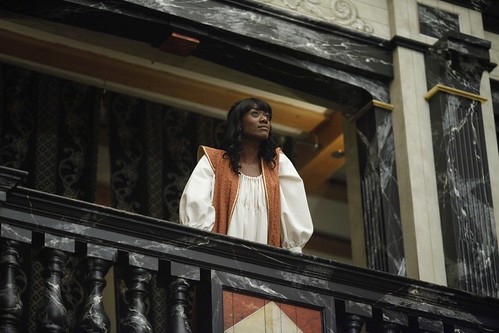
Showing posts with label shakespeare's staging conditions. Show all posts

09 January 2013

Adventures in Dramaturgy: Rehearsals - Special Effects

Just because the Blackfriars Playhouse is a theatre which embraces Shakespeare's staging conditions doesn't mean that we don't use technology in our shows; it means that we use technology that would have been available to Shakespeare and his company, and in many cases, those techniques can produce dazzling effects. Watching the 2013 Actors' Renaissance Season troupe rehearse Julius Caesar allowed me to see the wonderful resourcefulness and creativity that goes into creating a spectacle on the Blackfriars Playhouse stage.

Dan Kennedy and Rene Thornton Jr.;
photo by Jay McClure
I talked in my last blog post about the traffic patterns backstage, and those patterns are particularly important during the storm scene in Julius Caesar -- which actually crosses over parts of four scenes, from 1.3 through 2.3. Even when only two or three characters appear on-stage, every actor in the troupe has something to do, either creating special effects or preparing to enter -- or, very often, one and then the other, in rapid succession. It puts me in mind of a swimming swan: the surface image may be polished and serene, but underneath the water, there's an energetic whorl of action. Conversations during the storm creation process then depended largely on who could be where when and for how long. Alli Glenzer, for example, is creating a visual effect using the Rose Window, which is a bit of a hike from the stage, and so she had to figure out how much of the storm she could create that effect for in order to leave her enough time to make her entrance in 2.1. Who could take over the thunder sheets so that Ben Curns could get downstairs for his entrance in 2.2? How long should the ocean drum keep going before it becomes distracting? Is this "thunder and lightning" cue long, short, or medium? The troupe had to negotiate all of these considerations to form a coherent scene.

Many of the special effects also demonstrate the benefit of a repertory troupe. While putting the storm together, I heard John Harrell say, "Remember what we discovered last year, about the bass on the piano?" He set to work re-creating that sound, and Friday night, I heard another audience member commenting on it as part of the soundscape. Other influences came from recent productions both in Ren Seasons and Summer and Fall Seasons, from The Tempest, from Dido, Queen of Carthage, from The Roman Actor. Conversely, for the battle noises in Act Five and the flourishes throughout, the troupe consciously chose not to use the same effects they have been using in the past. For four years now, the Ren Season has featured the three Henry VI plays and Richard III, and those plays have used similar soundscapes, creating a coherent thread throughout the tetralogy: identifiable trumpet calls for coming and going, the clashing of swords backstage accompanied by shouts to create the alarums. For Julius Caesar, the troop decided to use different musical cues for flourishes and to keep up a military stomping backstage during the battle scenes. The effect is striking, invoking the lock-step precision of the vast Roman legions without ever needing to see more than a few soldiers on-stage. The march took a lot of practice, though, and as Alli Glenzer pointed out, several scenes' worth of stomping gave her character Strato a perfectly good reason to be falling asleep while Brutus is trying to find someone to assist his suicide. When the soldiers in 5.5 enter tired, the off-stage needs of the show have informed their on-stage performance in an unexpected way.

Ronald Peet, Chris Johnston, and Grant Davis; photo by Jay McClure

Almost all Shakespeare plays call for more sound cues than I think most of us are aware of when we just read the play, and it isn't just for the "big" moments like storms or battles. All of those stage directions for flourish, sennet, tucket, alarum just sort of fade into the background. As I sat watching our troupe walk through the cue-to-cue Julius Caesar on the Thursday afternoon of their three-day rehearsal process, I became consciously aware of just how much has to go on back-stage to make the story on-stage make sense. In order for Cassius to say "the clock hath strucken three," someone has to be upstairs striking a chime. Before Brutus can tell Lucius to see who's at the gate, someone has to knock. Almost every scene has some such requirement, and at the ASC, none of those noises are electronically-generated or automated. Music forms part of the soundscape of the play as well, both during the pre-show and interlude and within the play itself. Julius Caesar opens with "Clap Your Hands" by The Reverend Peyton's Big Damn Band, a wonderful piece which calls for clapping, stomping, and cheering from the audience, setting the mood perfectly for the jubilant chaos of the first scene. As Lucius in 4.2, Ronald Peet plays Aimee Mann's "Wise Up" as a "sleepy tune," and the lyrics ("It's not what you thought when you first began it," for example) perfectly suit Brutus's increasingly difficult situation.

Not all of the special effects in Julius Caesar are auditory in nature or occur from off-stage. While in many plays, you can get away with leaving blood out of murders and battles, in this play, the text calls too much attention to the viscera. At least in Caesar's assassination, the audience needs to see the red run. While some productions in recent decades have chosen to stylize the blood, using cloth or ribbons, our actors opted for liquid. It makes sense with the text, since Shakespeare makes so much of the ability of blood to transfer visibly from Caesar's corpse onto various hands and daggers. In order for those "purpled hands" to "reek and smoke," in order for Antony to shake all those "bloodied fingers," the audience needs to see what a mess an assassination makes. Our Caesar, Ben Curns, worked with Costume Manager Erin West to create a trick shirt -- identical to the white dress shirt he wears throughout the rest of the role, but in which he can conceal six blood packets, one for each conspirator. In Shakespeare's day, these blood packets might have been actual bladders filled with pig's blood procured from the local butcher's shop. Today, we use a laundry-friendly syrupy solution.

Chris Johnston, Sarah Fallon, Ben Curns, Grant Davis,
and John Harrell; photo by Jay McClure
The effect when all six blood packets pop is delightfully gruesome, but getting all six to pop took some practice. It adds an additional level of difficulty to the combat of that scene -- already tricky, given the number of people involved. Each of the actors not only has to be exquisitely precise about how they place their hands and daggers, but they have to find a way to squeeze, smack, twist, or otherwise puncture the blood packets, and they only have a brief second or two in which to do so. The picture at left shows what happened during the first attempt, when several of the cast members had trouble. By Saturday night, however, they had it -- all of the packets popped to great effect, allowing Ben to clutch at his supposedly spilling guts, then touch René Thornton (playing Brutus), leaving a visible streak on his face. The conspirators had plenty of blood to bathe their hands in, and the scarlet sheen glinted off of their daggers. It makes their exit a more striking image, and I realized, from a practical standpoint, why Shakespeare might specify that they exit "waving [their] red weapons o'er [their] heads" -- it keeps them from touching any doors or curtains before they have a chance to wash up. Caesar lay bleeding on the stage for several minutes more, and when Antony and a servant dragged him off at the end, a vivid smear trailed behind him.

These special effects under the creative constraints of Shakespeare's staging conditions illustrate clearly the blend of practicality and theatricality that dictates production at the ASC all year, and which drives shows during the Ren Season in particular. The actors are looking for simple answers to their problems, yes, but without sacrificing impact to the audience. Sitting in the rehearsal room during the building of the storm, I could feel the actors' excitement building over the discoveries they were making and the solutions they were building. There was a current of satisfaction as it came together, with several of the actors commenting on how very "cool" the effects were. This is part of why we, in ASC Education, encourage teachers to explore the value in Shakespeare's technology. Sometimes the challenge of working as Shakespeare's company would have yields results that are all the more impressive and more satisfying.

08 January 2013

Adventures in Dramaturgy: Rehearsals - Taking Shape

Julius Caesar is now up on its feet, and as dramaturg, I bore witness to the orchestrated frenzy that put an entire show together in three days of rehearsal. For any readers unfamiliar with the ASC's Actors' Renaissance Season, it is the time of year when we employ some of Shakespeare's rehearsal conditions in addition to the staging conditions that we embrace year-round. Our actors direct themselves, determine their own schedules, plan their own music for the preshow and interlude, pull their costumes from our stock -- and do it all in a fraction of the rehearsal time as the shows in our Summer and Fall Seasons. Since we began the accelerated start-up and short rehearsal time for the first show of the Ren Season in 2009, that first show has typically been a popular comedy that our actors are familiar with and can put up quickly (A Midsummer Night's Dream, Twelfth Night, The Comedy of Errors, and Much Ado about Nothing). This year, the actors take a crack at Julius Caesar in the first slot, a show which was last performed by the 2006-2007 touring troupe, and which has not been part of a Summer and Fall Season since the opening of the Playhouse in 2002. This choice thus provided a few extra challenges for the troupe: a historical tragedy, complete with multiple fights, suicides, and an assassination involving a minimum of seven participants, and a show that the ASC has not put on since 2007.

Alli Glenzer, Dan Kennedy, and Ben Curns; photo by Jay McClure
Time is at a premium, particularly for the first show of the season. The troupe had eight hours Tuesday, eight hours Wednesday, and four hours Thursday before their first dress rehearsal, followed by another four hours to tweak and clean up on Friday before the first Pay-What-You-Will preview Friday night -- and after opening weekend, there's no respite, as they held their first read-through of The Country Wife Sunday evening. Scheduling becomes hugely important. For this show, one actor (René Thornton, playing Brutus) volunteered to take charge of plotting things out -- and then made adjustments based on what the rest of the troupe thought necessary. As a sample, here's the schedule for the first day of rehearsal:
10-10:45 - Morning Meeting
10:45-12 - violence - suicides, Caesar kill, Cinna the Poet, Act 5 skirmishes
12-12:30 - 1.1
12:30-1 - 1.2 A and C
1-2 - 1.2 B and D (stage) - music (Tyson)
2-3 - lunch break
3-3:30 - 2.1 C and D (stage) - 1.3 A and C (Tyson)
3:30-4:15 - 2.1 A and B
4:15-5 - 2.2 A (stage) - 4.2 B (Tyson)- 2.4 (lobby)
5-5:15 - 2.2 B
5:20-7 - 3.1 A-D
So that was the first half of the play, shot through in eight hours. The morning meeting was longer on the first day than any other, simply because it was the beginning of the season. The entire production team -- including Artistic Director Jim Warren, Associate Artistic Director Jay McClure, Costume Shop Manager Erin West, Properties Manager Chris Moneymaker, and dramaturg yours truly -- had some notes to give to start things out. They also started throwing together a music list on the whiteboard, knowing that music rehearsals during the Ren Season can often be catch-as-catch-can, and that the earlier they had some ideas to start on, the more prepared they could get by Friday.

This schedule also points to what the issues of largest and most pressing concern often are: the most complex scenes, with the most bodies on stage and with more elaborate blocking needs. Anything involving combat takes additional time to choreograph so that it will be both safe and entertaining. Ben Curns took responsibility for fights for this show and had already blocked some things out in his head, but they still needed to set aside a lot of time for the actors involved to learn the movements -- and for adjustments to occur.

Sarah Fallon, Ben Curns, Rene Thornton Jr.; photo by Jay McClure
As I watched the rehearsals, the phrase I heard over and over again was: "That's a shape." The actors would invoke this phrase when they had gotten to the end of a scene with something workable, usually in regards to the blocking. The scene wasn't finished, it wasn't perfect, but it had a shape -- a general outline, an idea of who needed to be where when. Hearing that phrase over and over again got me thinking about the ways in which shape and place matter, both on-stage and off-, during the Ren Season.

Often, more time goes into rehearsing entrances and exits than into the meat of the scene itself. (This only works, of course, because ASC actors are already well-trained in textual matters, and it's part of the reason all members of ARS troupes are veterans of the Blackfriars Playhouse). Julius Caesar features a lot of group entrances and a lot of scenes with between 6 and 12 bodies on stage. Looking at that schedule for the first day shows that: 1.1 only has four characters on stage, but the audience is involved as well, one actor had to change into a costume from the pre-show, another had to get downstairs after playing music, and the actors had to negotiate props on top of it. 1.2 involves a ceremonial entrance and exit Caesar and his train, off-stage shouting, a flurried re-entry of all the characters who just went off, and their final exit. It also involves a long conversation between Brutus and Cassius, but, while René and Sarah Fallon worked that on their own, the most stage rehearsal time went to choreographing those group entrances and exits. 2.1 involves all of the conspirators coming to Brutus's house -- another mass entrance, with specific costume and prop needs -- as does 2.2, and 3.1 is the largest scene in the play, with the most characters entering simultaneously, several exits and re-entrances, and, of course, the assassination of Caesar. (1.3 through 2.3 also involve a storm, but more on that in another blog post). And that's just Day One -- the second half of the play features the famous plebeian mob and a whole lot of combat.

It takes a lot of work and communication to make all of that run smoothly -- and actors won't always nail it on the first try. Some of those entrances they re-worked Friday afternoon, after the dress rehearsal, and some they tweaked along the way. The flow on-stage isn't the only problem, after all, and some issues only became apparent during the dress. Grant Davis and Ronald Peet, for example, realized that they needed more time after their exit in 1.1, so on Friday afternoon, they worked with Alli Glenzer and Dan Kennedy to figure out a way to hustle them off-stage faster, giving them more time to change. Other problems are architectural in nature, examples of the space itself influencing the work. Greg Phelps, as Antony in 3.2, only has about two lines to get from the balcony down to the stage, and he has to be there in time for the plebs to notice him and crowd around him. The plebeians had to test out a few different ways of delivering their lines in a way that gave Greg enough time to get down the stairs. Altogether, they probably spent more time on 3.2 than on any other scene in the play. The timing of the plebeians' responses and movements has to be so precise in order to work the way they were hoping for, and as a further complication, many of the lines sound so similar or provide repeated cues. "Wow. That's a lot of 'will's," Greg observed in the middle of one sequence where he heard the word "will" from the plebs eight times, correctly cuing him only twice out of the eight. Finding the right rhythm for the scene took quite a bit of time, effort, and reiteration, but the resulting shape drives the audience along an exhilarating path.

Greg Phelps, Tracie Thomason, Abbi Hawk, and Grant Davis;
photo by Jay McClure
Blocking is a concern off-stage as well. Traffic patterns backstage can be as complex as those on-stage. Especially during Act 5, which involves a lot of rapid entrances and exits, skirmishes, and dragging dead bodies off-stage, I heard the actors discussing who could be in the discovery space or not at which times. But beyond that, the space in the rest of the theatre matters as well. As anyone who has ever taken a Playhouse Tour knows, the actors and production team arrange props and costumes methodically backstage. Chris Moneymaker had to remember to move the ARS props-gathering table away from the area of Tyson inhabited by the Tempt Me Further tour until they head back out on the road, to avoid any collisions or mix-ups.  I heard John Harrell refer to the "band corner" -- a section of the downstairs area set aside during this time for instruments and music rehearsals. All of these little considerations build together into the background flow of the play, the moving pieces that the audience never sees but which are absolutely critical to a smooth performance.

Throughout the rehearsal process, what struck me most was the blend of communication and organization that makes the Ren Season run. These actors work well together and share a common language, making them a well-oiled machine -- even though this precise troupe has never worked together before. Sarah and Dan are returning after seasons away from the ASC, and Ronald, Grant, Abbi Hawk, and Tracie Thomason were all here in 2012 but are new to the Ren Season. The ASC embraces the ensemble nature of theatre and performs in repertory year-round, but the Ren Season brings all of the necessary components into sharper focus. The result is a season unlike any other, full of its own special (and sometimes frenetic) energy.

27 August 2012

Study Guides for TWELFTH NIGHT and ROMEO AND JULIET now available

I'm pleased to announce that the ASC now has Study Guides available for Twelfth Night and Romeo and Juliet. Thanks to the excellent feedback that we get from teachers who use these materials, ASC Education is able to tailor our resources to the activities that are best-suited for active classroom exploration. Here's a sneak peek at what is included in these brand-new Study Guides:

Twelfth Night
  • Staging Directions: Twinning: In putting twins into several of his plays, Shakespeare breaks all the rules of verisimilitude and classical drama -- but how important is it that stage twins actually look alike? In this activity, your students will uncover how much Viola and Sebastian reflect the theatre of the imagination that Shakespeare so loves to play with.
  • Perspectives: Gender and Behavior: Twelfth Night is famously full of gender-bending and confused sexuality -- issues which are not just politically "hot", but which may be crucial to some of your students as they explore their own identities. The activities in this section will help you navigate these considerations in your classroom by looking at ideas of gender presentation on stage.
  • Rhetoric: Corrupter of Words: Feste the Clown is a famous fool -- but what is it that puts him into that category? Your students will explore Feste's wit and wordplay, discovering how he twists words to show off his quick and clever mind.
  • Textual Variants: Embedded Stage Directions: Modern editors frequently move or insert stage directions, based on what they think readers need to know about the scene. But how necessary are these editions? Shakespeare gives clues for action within the dialogue of his plays. Changing an entrance, exit, or action may make a world of difference to the story that a scene tells.
  • Staging Challenges: Gulling Malvolio: The "box-tree scene," where Maria, Toby, Andrew, and Fabian team up to deceive Malvolio, is frequently one of the funniest scenes in a production of Twelfth Night -- but, it has a lot of moving pieces. Your students will actively explore the potential for comedy in this scene, while wrestling with the requirements imposed by the text and Shakespeare's staging conditions.
  • Perspectives: Music: Twelfth Night is one of Shakespeare's most musical plays. In his own time, the tunes played during or before the performance would have resonated with his audiences -- they would have been popular and familiar. In this activity, your students will explore ways to recover that touchstone in the modern day.
Romeo and Juliet
  • Metrical Exploration: The Conversational Sonnet: Throughout Romeo and Juliet, Shakespeare plays with the familiar form of the sonnet, working it into his prologues as well as into the lovers' conversation. This activity provides an introduction to the poetic form as well as an exploration of its function in Romeo and Juliet's first meeting.
  • Staging Challenges: Stage Combat: From the first scene to the last, Romeo and Juliet is full of opportunities for violence. How do fight choreographers determine how to stage these fights based on information in the text? Your students will examine Mercutio and Tybalt's combat to find out.
  • Rhetoric: Emotional Highs and Lows: Romeo's wild mood swings and hyperbolic emotions may be familiar to your teenaged students -- but how does Shakespeare construct that hormonal rollercoaster? Explore his rhetorical structure to find out.
  • Staging Challenges: Parts and Cues: Theatrical companies in early modern England used "cue scripts" when producing their plays, rolls on which an actor would receive his own lines and only a few cuing words, not the full script of the play. Your students will explore what performance clues may be hidden in those cues.
  • Textual Variants: Quarto and Folio: Romeo and Juliet is one of Shakespeare's plays that exists in multiple early modern forms, including an early and much-altered quarto. In this activity, your students will explore the differences between the First Quarto and the play as they probably know it, looking at key differences in speech length, speech prefixes, stage directions, and more.
  • Perspectives: Comedy and Tragedy: Though one of the world's most famous tragedies, Romeo and Juliet is a play with a surprising amount of comedy in it. Where does that thin line between the genres live, and how does Shakespeare challenge and subvert audience expectations? Your students will find out in this thought-provoking activity.
Additionally, both guides include:
  • The Basics: Getting your students on their feet, working with iambic pentameter, paraphrasing, exploring rhetoric, and turning your classroom into an early modern stage.
  • Line Assignments: A way to give your students ownership over a small section of text, which they will use in further language-based activities and staging explorations.
  • Advice for how to use film in the classroom judiciously and effectively.
  • A guide to producing a 1-hour version of the play in your classroom.
  • Guidelines matching these activities to Virginia SOLs and U.S. Core Curriculum Standards.
  • Full bibliographies for further reading.
Both of these Study Guides are available for purchase at Lulu, along with guides for ten other plays. You can also view 15-page previews of the guides on that site. Coming soon: The Merchant of Venice and The Two Gentlemen of Verona.

15 March 2012

"Let each man render me his bloody hand": Blood on the Ides

On the Ides of March last year, I explored the rhetoric of what is possibly my favorite speech in all of Shakespeare: Antony's funeral eulogy for Caesar, in which he whips the plebeians into a murderous frenzy. As I was last year, I remain a little in awe of the strange cultural phenomenon surrounding this day. Quotes from Plutarch and Shakespeare are everywhere -- and I wonder how many people are consciously aware of whom they're quoting, or if those phrases have so permeated our world that they've detached entirely from their original context.

I make my living now with my head in the early modern era, but I've always kept one foot trailing in the classics, particularly in this fascinating period where the Republic crashed and metamorphosed into the Empire. Fortunately, Shakespeare gives me fertile territory on which to indulge both of my historical obsessions. And I'm not alone -- those of us in the Shakespeare world seize on the opportunity that this cultural awareness provides (carpe occasionem?). Twitter is full of our enthusiasm today, and a video on Pursued by a Bear explores the play's place in the common consciousness as well as providing an interesting analysis the dearth of really good productions of the show.


This year, I thought I'd take a look at a particularly interesting staging moment which precedes the great speech I explored last year: when Antony greets the conspirators just after Caesar's murder. Two of the most visually striking moments in Julius Caesar are Caesar's assassination and the subsequent decision of the conspirators to wash their hands in the corpse's blood. This scene can pack quite a bit of power -- especially in a theatre like the Blackfriars Playhouse, where the actors share light with the audience -- but it also lends itself to quite a bit of mess. Blood is something that actors and production companies have to negotiate with, deciding how much to use, what kind to use, where to hide blood packets, whether or not it can get on clothing (and if so, how to get it out; if not, how to keep that from happening). Often, productions choose to stylize the blood in this scene, for those very practical reasons. I will always champion the use of live blood, however, because of what happens later in the scene.
CASSIUS
Where is Antony?

TREBONIUS
Fled to his house amaz'd:
Men, wives, and children stare, cry out, and run,
As it were doomsday.

BRUTUS
Fates, we will know your pleasures:
That we shall die, we know; 'tis but the time
And drawing days out, that men stand upon.

CASSIUS
Why, he that cuts off twenty years of life,
Cuts off so many years of fearing death.

BRUTUS
Grant that, and then is death a benefit:
So are we Caesar's friends, that have abridged
His time of fearing death. Stoop, Romans, stoop,
And let us bathe our hands in Caesar's blood
Up to the elbows, and besmear our swords:
Then walk we forth, even to the marketplace,
And, waving our red weapons o'er our heads,
Let's all cry 'Peace, freedom and liberty.'

CASSIUS
Stoop, then, and wash. How many ages hence
Shall this our lofty scene be acted over
In states unborn and accents yet unknown?

BRUTUS
How many times shall Caesar bleed in sport,
That now on Pompey's basis lies along,
No worthier than the dust?

CASSIUS
So oft as that shall be,
So often shall the knot of us be call'd
The men that gave their country liberty.
First of all, this is weird. There is just no getting around that this is a really strange thing to do with someone you've just killed. This is not a bit of a historical culture, not something Romans just did when they killed someone. To me, it reads as Brutus coming a little unhinged. Then, think about how deep you would have to plunge your hands into a dagger wound -- likely a puncture far more than a rending gash -- to get up to the elbow in blood. It's pretty gruesome, and I think that the more real and visceral the blood appears, the more the audience is going to feel the grotesque aspect of the scene, rather than dismissing it as, "Oh, a thing people just did back then." Live blood also gives the other actors a lot to work with -- physically as well as figuratively -- in terms of how much they are on board with Brutus or not. If at least a couple of the conspirators are visibly uncomfortable with smearing themselves up to the elbow in blood, that also transmits some important information to the audience.

Secondly, it's ambiguous whether or not Trebonius washes his hands in blood along with the rest of the conspirators. He's on stage at this point, but as someone who did not actually take part in the stabbing, I think there's justification for not having him join in the literal bloodbath. You could certainly choose to have him wash in blood at this point, but I think there's more money in having him hold back, because of what happens when Antony -- whom Trebonius detained outside the Senate, whom he kept from coming to Caesar's aid -- enters.
Enter ANTONY

BRUTUS
But here comes Antony:
Welcome, Mark Antony.

ANTONY
O mighty Caesar! Dost thou lie so low?
Are all thy conquests, glories, triumphs, spoils,
Shrunk to this little measure? Fare thee well.
I know not, gentlemen, what you intend,
Who else must be let blood, who else is rank:
If I myself, there is no hour so fit
As Caesar's death hour, nor no instrument
Of half that worth as those your swords, made rich
With the most noble blood of all this world.
I do beseech ye, if you bear me hard,
Now, whilst your purpled hands do reek and smoke,
Fulfil your pleasure. Live a thousand years,
I shall not find myself so apt to die:
No place will please me so, no mean of death,
As here by Caesar, and by you cut off,
The choice and master spirits of this age.

BRUTUS
O Antony! Beg not your death of us.
Though now we must appear bloody and cruel,
As by our hands, and this our present act
You see we do: yet see you but our hands
And this the bleeding business they have done:
Our hearts you see not; they are pitiful:
And pity to the general wrong of Rome,
As fire drives out fire, so pity, pity
Hath done this deed on Caesar. For your part,
To you our swords have leaden points, Mark Antony:
Our arms in strength of malice, and our hearts
Of brothers' temper, do receive you in,
With all kind love, good thoughts, and reverence.

CASSIUS
Your voice shall be as strong as any man's
In the disposing of new dignities.

BRUTUS
Only be patient till we have appeased
The multitude, beside themselves with fear,
And then, we will deliver you the cause,
Why I, that did love Caesar when I struck him,
Have thus proceeded.

ANTONY
I doubt not of your wisdom:
Let each man render me his bloody hand:
First, Marcus Brutus, will I shake with you;
Next, Caius Cassius, do I take your hand;
Now Decius Brutus, yours: now yours, Metellus;
Yours, Cinna; and my valiant Casca, yours;
Though last, not least in love, yours, good Trebonius.
Gentlemen all: Alas, what shall I say?
Antony comes in and shakes each man's bloody hand, one by one, and as he names them, it's hard to feel that he's doing anything other than marking them down for retribution. And then, at last, he comes to Trebonius, who did not stab Caesar himself, but who was nonetheless instrumental to the plot, the means by which Antony was not there to defend his friend. So if Antony has just shaken six other bloody hands, his own would be quite smeared with blood by this point -- which he then transfers to Trebonius. If his hands have been clean till that point, Antony's gesture makes a powerful statement: Trebonius is, in his eyes, every bit as guilty, every bit as culpable, and Antony is every bit as determined to take him down. So, while you could have Trebonius engage in the blood-smearing earlier on, I think you get greater payoff from saving it for this moment.

An exploration of this and other staging challenges in Julius Caesar can be found in our Study Guide -- and the play will be part of the 2013 Actors' Renaissance Season. I'm going to be serving as dramaturg for that production, so I'm sure next March 15th, I'll have something new to share. Until then, cavite idus Martii, everyone!

06 February 2012

2012 MLitt/MFA Thesis Festival: Session 3

Welcome back for the afternoon session of the 2012 MLitt/MFA Thesis Festival. This session will feature six presenters and runs from 1:30-4:30pm.

Dori Koogler: "Upon a True Contract: Handfasting and Clandestine Marriage in Shakespeare's Plays"

Koogler opens with a discussion of the conditions of marriage in the early modern period, focusing on the physical components of a "spousal contract": vows, joining of hands, kiss, and the exchange of rings. Made in the present tense, these components constituted a marriage; in the future tense, they constituted a betrothal, which was still considered legally binding. Koogler offers evidence not only from historical realities but also from clues within Shakespeare's plays. In early modern England, while marriage might have legal entanglements, and while paperwork could be useful in a dispute over validity, all that the Church required was mutual consent; this changed with the Marriage Act in 1754. The Church did require, however, the presence of witnesses; without witnesses, a marriage was considered "clandestine and irregular". Due to common cultural awareness of these irregular marriages, Koogler notes that it became fertile ground for exploration on the early modern stage. Shakespeare treats in some manner with these irregular marriages in a third of his plays. Adkins and Malicki present several instances of espousal contracts and handfastings in Shakespeare's plays.

Koogler gives a deeper examination to the idea of betrothal in The Two Gentlemen of Verona. In 2.2, Julia and Proteus make vows, exchange rings, join hands, and "seal the bargain in a holy kiss". Koogler argues that, because the "cultural experiences of betrothal have changed so much in the past 400 years", modern audiences may not as easily grasp the depth of the situation. The transgression, she argues, would have resonated more strongly with an early modern audience, who saw Proteus not only breaking up with his girlfriend, but breaking a legal bond and a scared vow. Koogler further speculates on the suspected betrothal between Florizel and Perdita in The Winter's Tale. Though this play does not include lines detailing the ceremony, as The Two Gentlemen of Verona does, Koogler argues (and Malicki and Adkins demonstrate) that it may be possible for Florizel and Perdita to enact the entire ceremony during a 6-line monologue of Camillo's. Koogler finishes by stating that using modern marriage signifiers, particularly with regard to the exchange of rings, modern productions can amplify the importance of these betrothals to better approach the weight they would have had for an early modern audience.

Stephanie Tschetter: "In the Closet: Unstaged Staged Directions during the Interregnum"

Tschetter opens by surveying the audience's awareness of closet drama. She positions her exploration during the Interregnum, while the theatres were closed, and notes that closet dramas were initially intended for readers to imagine, rather than for actors to perform in a theatre. Tschetter notes that both early critical and modern conceptions seem to consider closet dramas as undesirable, without a reason to take the dramatic form that they do. Tschetter challenges the idea that closet dramas ignore theatrical realities and conventions of the stage; rather, because of their inherent form, the stage directions "are clearly conceived for the conditions of the early modern theatre." She focuses on those plays written during the Interregnum, which suggest that the plays may indeed have been meant to be played, but were legally prevented from public presentation. Tschetter's actors (Monica Cross, Jessi Malicki, Michael Wagoner, Jamie Weaver, and Liz Lodato) read stage directions from these plays, demonstrating their potential connections to the actual stage.

Tschetter offers an example from William Chamberlain's Love's Victory. She notes the difference between the embedded stage direction an actor could rely on and the explicit directions needed to make a visual picture clear for a reader's imagination. Tschetter argues that writers expected these readers to have familiarity with the picture of the stage, as those audience members would likely, before the 1642 closing of the theatres, have seen plays on the stages they now had to imagine.

Further directions inform the reader not only of early modern staging conditions but of the tricks of the trade, such as the concealment of blood within sponges tied to the middle finger and concealed in the palm. In this way, Tschetter points out that closet dramas deserve attention for what they have to teach us about early modern staging effects.

James Byers: "Concealing the Mere Irish: An Analysis of English Performance of Irish Ethnicity on the Early Modern Stage"

Byers opens with a presentation from Ben Jonson's Irish Masque (with help from actors Jonathan Haas, AJ Sclafani, and Jarom Brown); Byers notes the long, complex, and often contradictorily-characterized nature of the millennium-long conflict between the English and Irish. He gives a short history of the conflict, dating back to Henry II's initialization of the conquest of the island. The original colonists in the Pale became isolated from the English and eventually came to occupy a liminal state between the native Gaelic Irish and the English on the other side of the Irish Channel. By the 1500s, Henry VIII and other monarchs had sent more colonists to reinforce English presence in and control of the island. After a period of relative peace in the late 16th- and early 17th-century, rebellions crested again in the 1630s; Cromwell moved in during the Interregnum to re-establish control. The idea of the "barbarous Irishmen" served as a source of apprehension and fear for the English, with wild myths springing up around their supposed possession of strange patterns.

Byers moves to examining characteristics of Irish characters on the English stage. First, the accent, which is not necessarily the be-all and the end-all of an Irish character, but which are a signifier and which provide a mean of "tracking the evolution" of such characters. He also examines the various character types, including rebels, military captains, criminals, bawds, servants, and apprentices. The latter of these "represent the subservience of the Irish in England." With the help of his actors, Byers presents examples of all of the various types for the audience. This exploration carries weight, Byers notes, not only for better understanding of the early modern plays, but, with consideration for the ongoing nature of relations between the two nations, by way of "exploring the nature of reactions" to ethnic representations and to our own concepts of stereotypes.

Angelina LaBarre: "Hip Hop Pedagogy and Shakespeare: Performative Verse, Then and Now"

LaBarre and her actors (Elizabeth Rentfro, AJ Sclafani, Jarom Brown, and Melissa Tolner) slouch their way onto stage in hoodies and sunglasses. LaBarre begins by acknowledging the racial and cultural history of hip-hop, then stating that those origins have no direct relevance for the scope of her thesis. Rather, she intends to focus on the linguistic similarities between hip hop and Shakespeare and how those similarities can provide an advantage for modern teachers. She argues that early modern theatre occupied the same cultural space as hip hop does today, as a rhythmic verbal performance tradition. She relates the squaring-off between the Caesarian faction and the Liberators in 5.1 of Julius Caesar to "The Dozens", an insult contest of personal power, valuing quick responses and verbal acuity.

LaBarre delineates some of the similarities between rhythm and vocabulary. Rentfro demonstrates "flowcabulary" -- a method which translates Shakespeare's language into modern vernacular. LaBarre notes that this teachers students nothing but the plot. Tolner then presents a quote from a modern hiphopper, and LaBarre points out that almost no one in the audience understood what she was saying. This, she states, provides a teachable moment about the use of slang and colloquialism in verse. She describes an exercise which compares today's slang to Shakespeare's, asking students what people four hundred years from now might make of the word "gangsta". LaBarre's actors then demonstrate the iambic pentameter rhythm of modern hiphop verse, and LaBarre points out the presence of irregularities and caesuras in the lines. These breaks in the rhythm serve both the plot and the emotional mood of the verse. Her next example relates to alexandrines, with natural mid-line breaks, as well as demonstrating several rhetoric devices employed by the rapper.

LaBarre ends her presentation by expressing her hopes that these connections between Shakespeare's language and modern hip hop will provide fertile ground for educators seeking new ways to make Shakespeare relevant and interesting to their students. The lyrical inventiveness and rhetorical dexterity of both forms provide a strong basis for comparison. She is currently developing a curriculum based around these concepts for a teacher in Richmond, VA.

Jonathan Haas: "Virginity and the Problem Plays: An Investigation"

Haas's presentation examines the moral, social, and spiritual ambiguity of virginity's importance in Shakespeare's "problem plays". He begins by examining the idea of the pre-contract and the idea of whether or not a formal betrothal allowed for sexual congress. Using David Cressy as his source, Haas notes the double standard: that many considered varying degrees of sexual liberties acceptable, despite potential legal and religious consequences.

Haas moves to an examination of Measure for Measure and the ambiguity of Claudio's and Juliet's exact nuptial state. He presents various opinions, both from libertines and the supposedly virtuous characters, about the acceptability of post-contract pre-nuptial sexual contract. Even Isabella, who professes to hate the sin of lust, expresses approval of the activity and her hope for the child that will come of the union. Haas posits this as representative of the tension between cultural and legal/religious expectations in early modern society. Haas also notes the differences between Catholic and Protestant opinions on virginity. After the Reformation, the veneration of virginity faded, and many patriarchal views condemned the chosen permanent virginity of a nun as "a dangerous and disruptive thing", a way out of the strictures and expected roles for women. Measure for Measure explores both sides of the argument, demonstrating both characters who view virginity as a noble and appropriate choice and as an inferior, subversive, or dangerous choice. In this way, the problem play engages the cultural conflict over "the messy standards of virginity".

Maria Hart: "Munday Seeking More: Religion, Politics, and Biography on the Early Modern Stage"

Hart's presentation examines how Sir Thomas More contains reference to a political agenda by its primary author, Anthony Munday. Hart believes that, in this selection of More as a topic, Munday revealed a sympathy for English Catholics, in relation to the martyrology of Thomas Becket and Thomas More during the early modern period. Hart gives a short history of More's political history and his conflict during the English Reformation. She continues through the shifting religious allegiance of England as a state during the reigns of Edward VI and Mary I, following the narrative of English recusants and secret Catholics in particular. This tradition included a print culture which propagated stories of Thomas More "as martyr and saint" -- one of several famous for their refusal to renounce Catholicism. These traditions linked More to the earlier martyr Becket, assassinated under the reign (and ambiguous instructions) of Henry II for his refusal to submit to the king more than to the Church. The Protestant view, by contrast, considered the Catholics as heretics, and those Protestants that they burned the martyrs.

Hart follows this up with Munday's personal history, who on the surface may appear a "flip-flopping opportunist", as well as a government informant on recusants, but who Hart believes reveals himself in his plays as having stronger convictions. Her actors (Liz Lodato, Jonathan Haas, Rachel Ratkowski, Brian Maxwell, AJ Sclafani) present More's execution scene, which Hart notes as portraying More with definite sympathy. The rest of Munday's plays, she explains, likewise treat with issues of the Catholic/Protestant divide in England. At the least, she sees in Thomas More "a reverence and sympathy for the ex-Chancellor," suggesting that Munday may have felt some guilt in himself for his role as an informant, and sought to exonerate that guilt dramatically.

--

We're off for a dinner (or, perhaps, tea) break now -- back at 5:30 for the final session of the festival.

For the rest of the Festival, see these posts:
Session 1
Session 2
Session 4

2012 MLitt/MFA Thesis Festival: Session 2

Good morning, scholars -- We're back again, bright and early, for Session 2 of the MLitt/MFA Thesis Festival. This session runs from 9:30am to 12:00pm.

Clara Giebel: "Playing Paper"

Giebel's presentation begins with an interesting tableau: Katy Mulvaney, Linden Kueck, and Amanda Noel Allen on-stage, crafting -- rather than, as we might expect, sitting on the gallant stools holding scripts. Giebel explains that sometimes a tradition should be broken "just because there's something we'd rather do," and that she hopes their presence will provide a meaningful counterpoint to her ideas.

She moves into discussing the typical structure and tropes of fairy tales, and she shares illustrations from some classic fairy tales via a Powerpoint presentation. She explains that these images are not only beautiful but "look right to our eyes", with conventional tropes reminiscent of illuminated manuscripts. She expands the idea further, referring to how Disney's fairy tale movies often open with the frame narrative of books, giving images of pages turning before the animation begins. Giebel explains these frame devices as important because of the "time of textual transmission" we currently exist in. The movement of page to screen, first scene from books to movies, is now prominent in the idea of moving from books to e-readers. She demonstrates various "skins" and covers for e-readers which attempt to recover the tangible and visual elements that are lost in the transmission to digital text. She posits that the two most important elements lost are the paper itself and the "codex", or non-textual visual information, which she demonstrates through a reading of "The Monster at the End of This Book" and through a consideration of pop-up books, which "glory in the paper-ness of paper". Giebel talks about the importance of sound, smell, and texture to the experience of reading, and relates those concepts to ideas of crafting.

Giebel then brings her ideas around to the early modern period, looking at the history of textile handwork, particularly with regards to gender assignations of various tasks such as embroidery and knitting, seen as female tasks both in the early modern period and in the 21st century. She notes, however, that these tasks no longer have the same cultural significance, thanks to mass marketing -- similar to the fading essentialism of paper in books.

Teachers, parents, and the media, as Giebel points out, teach fairy tales to children, but particularly to girls, emphasizing the female character "as the object of other characters' acts and desires", not as the agent. She notes that Shakespeare's All's Well That Ends Well both draws on and inverts these fairy tale tropes, featuring not just one, but several active women. Helena has to mangle her own sentences to try and fit herself into the expected passive role. All's Well is "a fairy tale, but a problematic one... a deliciously messy one" in contrast to the neat, happy endings of Disney's fairy tales. Giebel has worked with Linden Kueck to design a paper-based set for All's Well That Ends Well based on these concepts, particularly as an exploration of the gender issues at play. She ends by foregrounding the need to examine, in this concept of textual transmission and shifting gender roles, what we want to keep from the past and what we want to move on to -- a world where we can both read blogs on our cellphones, but also enjoy the texture and physical reality of paper, "where boys can learn embroidery and girls can be the king".

Brian Maxwell: "The First Generation: The Dawn of American Shakespeare"

Maxwell's presentation begins by interrogating our awareness, in the American Shakespeare Center, of the history of Shakespeare in America. Actors Jarom Brown, Brian Falbo, Rebecca Hodder, and Zach Brown assist by taking on the personas of various 19th-century American Shakespearean actors. Maxwell contrasts the various acting styles of these historical actors: Forrest, Cushman, Booth (Edwin, not his infamous brother), and Jefferson. Forrest represents the emotional style, requiring the actor to give himself over entirely to the affect of the character. Maxwell notes that this style was incredibly popular in the first half of the nineteenth century in America and drew in the working-classes to the theatre. By contrast, Booth and Jefferson display the style which became popular in the second half of the century. This style was a "launching point for Stanislavski's method", praised for its naturalism, but less popular with those of the working classes seated in the galleries and a bit too far from the gaslit stage to appreciate the nuances.

Maxwell then encourages Forrest and Booth to dueling monologues. The contrast, with Forrest's bombastic style and Booth's understated delivery, makes plain the differences between the early and late methods. Maxwell credits both styles as important to American theatrical heritage. He also posits that these actors, others like them, and their companies gave America cultural credit on the world stage. He shares a 1902 video of Jefferson as Rip Van Winkle and an 1890 wax cylinder audio recording by Edwin Booth.

Daniel Kennedy: "From Place to Space: The Abstraction and Diminution of Hell on the Renaissance Stage"

Kennedy begins by coaxing us all into singing "Happy Birthday" to Christopher Marlowe. He then discusses the ASC Actors' Renaissance Season production of Marlowe's Doctor Faustus, and the dismay of the actors when, each time they revealed the painted-plywood hellmouth, the audience chuckled. Kennedy sketches out the history of the hellmouth, with its roots in medieval representations of Biblical stories. Early illustrations envisioned "an open pit" to invoke Hell; later a volcano, initially considered appropriate for its fiery and sulpherous nature, but later rejected as too passive; later the heads of beasts, particularly dragons. He positions the evolution in relation to attempts to convert the Danish pagans of north England: "Now, if I know Vikings, at least one of those bad motherf*ckers has walked out of a volcano. I don't think any have walked out of a dragon's mouth." Clearly, this imagery would have had a resonance for the England-occupying Danes.

The hellmouth became a convention of the morality plays, an intricate construction, but one which, Kennedy notes with some dejection, audiences found "amusingly wonderful" rather than terrifying or awe-inspiring. He shows an illustration of the stage mansions of Valenciennes, the elaborate decorated carts used for these plays. He notes that, while the hellmouth itself disappeared, the opposition of Heaven and Hell remained prominent. While the structure of the medieval stage mansions positioned Heaven and Hell in horizontal opposition, the early modern audience was conditioned to think of up, the balcony or "heavens", as good and down, through the trap, as bad. The stage pictures became less religious spectacle, less a stylistic presentation, and more an interpretation of inner struggle.

Kennedy moves on to a discussion of the various texts of Doctor Faustus, noting that the A text, earlier published, lacks elements present in the later B text, considered the version closer to Marlowe's intended play. The stage direction "Hell is discovered" indicates that, reminiscent of the medieval morality plays, Hell must be visibly represented on the stage. Where, however, remains ambiguous. Kennedy presents it first as revealed in the discovery space, drawing on the image of a dragon's head gaping open to consume Faustus; then a second time, using the trap. In the second version, the Bad Angel's description becomes more critical to feeding the audience's imagination as the means for invoking Hell, rather than an actual stage depiction. Kennedy notes that while Shakespeare never directly calls for a hellmouth as Marlowe does, he still visually invokes the concepts of Hell, demons, and the afterlife in several plays (Hamlet, Macbeth, 1 and 2 Henry VI). He suggests that the accepted convention of the trap as Hell can inform the interpretation of the ghost of Hamlet's father; if he enters from the trap, the audience may assume him as a demonic figure. He also relates the concept to certain resonances in Macbeth to the idea of the Harrowing of Hell, particularly as relevant in the Porter scene.

Elizabeth Rentfro: "For I Am She: The Development of Margaret of Anjou in Performance"

Rentfro's presentation opens with a presentation from Richard III, with most of the cast (Liz Lodato, Brian Falbo, Mel Johnson, Dane Leasure, Deb Streusand, Jessica Schiermeister, Stephanie Tschetter, Kelly Elliot, and Rachel Ratkowski) on-stage, and Rentfro, as Margaret, moving in from the audience. Following Margaret's intrusion into the body of the scene, Rentfro details her experience having played Margaret in both full productions and staged readings across the "Margaret canon" of Henry VI, Parts 1-3 and Richard III. She prefaces that the presentation will work through the scene with a few breaks for her to explain her exploration as a self-evaluating performance study.

As they progress through the scene, Rentfro notes that while Margaret harbors special hate for Richard III and is the first person to see him for what he is, she also feels a kinship with him due to some of their inherent similarities. Likewise, she sees a reflection of herself in Elizabeth, the "poor painted queen" she mocks. Rentfro moves on through Margaret's exit, leaving the Yorkists behind to "muse why she's at liberty". She then relates her experience to that of Sarah Fallon, someone else who has seen Margaret all the way through her arc. She notes the experience as fairly rare, since so few companies perform the full tetralogy.

Jared Fair: "The Grieving Parent in Shakespeare and the Early Modern English Children's Epitaph"

Fair begins by positing the opinions of Laurence Stone as to the emotional distance between parents and children in the early modern period, which he views as necessary due to the high child mortality, depicting these parents as detached and unemotional even upon the death of a child. Fair juxtaposes this with the ideas of David Cressy, who claims that early modern people were deeply emotional and loving, with a great capacity for tenderness both in their families and their communities. Cressy uses diaries and letters as examples that early modern people experienced intense emotions upon the death of a loved one.

Fair presents (through actors Jarom Brown and Dr. Julie Fox) epitaphs from the early modern period, which demonstrate the emotions felt by parents upon the death of a child. These epitaphs imagine sleep as a death, which Fair suggests as a coping mechanism to soften the blow. They also suggest that "death is not the end, that life continues for the child." He presents an epitaph written by Ben Jonson on the death of a child actor, the first epitaph to so commemorate an actor. Jonson also wrote an epitaph when his own daughter died at 6 months and when his son died in the plague of 1603. Fair points out that Jonson describes himself as possessed by his own emotions; the epitaph serves as method to "loose" the bonds that hold him in thrall to grief. Fair then moves to considering Shakespeare's experience with a child's death, particularly in the proximity of the composition of King John to the death of his son Hamnet. Constance's grief "is anticipatory", upon Arthur's disappearance. Fair argues that if Hamnet suffered an illness rather than a sudden death, Shakespeare's own emotions may have informed this sense of anticipatory dread. He notes that Constance sinks into a suicidal depression, haunted by her son's image, reminded of him everywhere. She later dies "in a frenzy", inconsolable. Fair links this depiction of dramatic pain to Shakespeare's personal experience as a parent.

--

For the rest of the Festival, see these posts:
Session 1
Session 3
Session 4

14 December 2011

'Much Ado About Nothing' Study Guide Now Available!

At last! I get to share the Study Guide for my very favorite play, Much Ado about Nothing. As I noted in a previous post, I've enjoyed this one tremendously, and I'm already super-excited about getting to work through these activities with attendees at our Winter Teacher Seminar.

Shakespeare Education: Much Ado about Nothing Study GuideHere is a ten-page preview for your enjoyment. This Study Guide includes the following activities:
  • The Basics: Getting your students on their feet, working with iambic pentameter, paraphrasing, exploring rhetoric, and turning your classroom into an early modern stage.
  • Line Assignments: A way to give your students ownership over a small section of text, which they will use in further language-based activities and staging explorations.
  • Too Wise to Woo Peaceably: Benedick and Beatrice are one of Shakespeare's finest couples, witty and brilliant and endearing. Better than all of that, however, they're both fantastically smart -- and in this activity, your students will explore the rhetoric of their scenes and discover how Shakespeare uses their language to show the audience that they deserve each other and belong together.
  • Perspectives: Slanderous Tongues. Much Ado about Nothing's plot revolves around an issue that your students experience every day in high school life: rumors. Your students will examine the language of slander in Much Ado and will relate Hero's unfortunate situation to their own lives. What words hurt the most? On what basis can a girl's reputation become ruined? How is reputation different from a male perspective?
  • Dogberry: Before malapropism was malapropism, it was something else entirely. From everlasting redemptions to odorous comparisons, your students will discover the comic gold that is Dogberry's creatively mistaken vocabulary.
  • The Gulling of Benedick and Beatrice: Your students will explore the staging requirements of two of the play's best comic scenes, when Benedick and Beatrice each hear their friends conspiring against them. Where can you hide the eavesdroppers so that the audience can see their reactions -- critical to the success of the scene -- without breaking the imaginative fiction that allows Benedick and Beatrice to believe that their gullers are unaware of their presence? These scenes take advantage of early modern staging conditions in creative ways, and working through them will get your students thinking actively about thrust staging, universal lighting, and audience contact.
  • Staging Challenges: Kill Claudio. Shakespeare's plays rarely fit neatly into the categories of comedy and tragedy that we've created for them, and a key example of this in Much Ado about Nothing is the moment when Beatrice challenges Benedick to prove his worth to her by killing the man who dishonored her cousin. Through active staging, your students will explore different potential interpretations of this scene and will determine which version they feel tells the best story.
  • Textual Variants: The earliest printed versions of Much Ado about Nothing have several textual oddities -- oddities which reveal that this play may be more closely related to Shakespeare's original manuscript than any other in the canon. Activities on speech prefixes and stage directions will walk your students through an examination of the transmission of text in early modern London.
  • Production Choices: A guide to producing a 1-hour version of the play in your classroom.

If you would like to purchase a downloadable PDF of this or any other ASC Study Guide, just visit our website. I'm already well into work on the Study Guide for Richard III -- the last for this artistic year! After which, my plan is to bring the 2010 set up-to-date with the modifications we introduced for the 2011s, and then I will start work on 2012.

15 November 2011

'Henry V' Study Guide Now Available

The ASC Study Guide for Henry V is now available. I got to stretch my historical muscles and revisit my medieval studies roots for this one, which was a real treat for me.
Here is a ten-page preview for your perusing enjoyment. Activities in this guide include the following:
  • The Basics: Getting your students on their feet, working with iambic pentameter, paraphrasing, exploring rhetoric, and turning your classroom into an early modern stage.
  • Line Assignments: A way to give your students ownership over a small section of text, which they will use in further language-based activities and staging explorations.
  • Staging Challenges: Dealing with Canterbury's seemingly interminable Salic Law speech -- and turning it into an exciting exploration of language and performance opportunities. The Salic Law speech may, at first, seem to represent everything your students fear most about Shakespeare: an enormous block of text, spoken by a high-ranking official, which doesn't appear to say anything of importance. This activity will help you show your students that there is humor for the mining in Canterbury's digressions, and that the entire speech is a set-up for a grand punchline.
  • Perspectives: How does Henry craft his language in order to motivate his men? And is he really such a glorious leader, or is there some disconnect between the Henry that the Chorus celebrates and the Henry that Shakespeare shows us in action? This activity examines the examples of leadership, both positive and negative, presented in Henry V: heroic Henry, not-so-heroic Henry, the flippant Dauphin, the aging Charles VI, the brusque Fluellen, and others. Your students will relate Shakespeare's various portrayals of leadership to modern politics, and will examine Henry's methods of motivation as compared to modern military recruiting techniques.
  • Perspectives: The Battle of Agincourt stands as one of England's most famous victories, but what were the historical realities? Were the English outnumbered 6-to-1? 10-to-1? Or just 4-to-3? Your students will explore contemporary accounts, secondary sources, and modern research to cast new light on the version of events Shakespeare portrays. They will also discuss the place that Agincourt holds in the English narrative of national identity and will explore what similar moments in American history hold that same position for us.
  • Rhetoric: Henry V is one of Shakespeare's very best speakers. He fits his speech to the occasion and his listeners remarkably well, changing his tenor, his vocabulary, and his rhythms for greatest appeal. Your students will examine those conditions throughout their exploration of Henry V, but how does Henry speak when he is alone with the audience? In this activity, your students will explore how Henry uses devices of repetition and substitution in order to build a rapport with the audience.
  • A variety of scenes for alternative stagings.
  • Production Choices: A guide to producing a 1-hour version of the play in your classroom
If you would like to purchase a downloadable PDF of the Henry V Study Guide, or of any of our other Study Guides, please visit our website. I've already begun work on the next offering: Much Ado about Nothing -- It's my all-time favorite play, so I'm quite excited about it.

04 November 2011

Imprimis: Links and Tidbits -- 'Anonymous' Edition

As I'm sure you've all noticed, a movie came out last week which, despite its risible nature, seeks to ruffle feathers in the world of Shakespeare studies. Many scholars would rather not dignify the nonsensical issue with a response (not to mention our reluctance to give Emmerich more free publicity), but the matter has pressed itself sufficiently that the community has responded. If Anonymous realized its own fictional nature and were not attempting to masquerade its inventions as fact, perhaps we wouldn't have such a problem, but because Emmerich has taken to the media, smugly pronouncing himself the savior of truth, and because Sony has begun distributing supposedly "educational" packets to high schools (I've seen them; they're alarmingly misleading and ethically irresponsible) -- those conditions provoke the defense that Shakespeare deserves. The kid gloves have come off, and rather than dancing delicately around the issue, many scholars have attacked the issue head-on and free of hedging. I submit here, for your perusal, a smattering of the reviews and opinions published in response to the Anonymous absurdity.
  • James Shapiro, author of Contested Will, took to the New York Times in defense of Shakespeare: "Promoters of de Vere’s cause have a lot of evidence to explain away, including testimony of contemporary writers, court records and much else that confirms that Shakespeare wrote the works attributed to him. Meanwhile, not a shred of documentary evidence has ever been found that connects de Vere to any of the plays or poems."
  • The Times also has a piece by Stephen Marche, which not only disapproves of the attempt to portray the film as educational but also derides the conspiracy theory in general: "No argument could ever possibly sway the Oxfordian crowd. They are the prophets of truthiness. 'It couldn’t have been Shakespeare,' they say. 'How could a semiliterate country boy have composed works of such power?' Their snobbery is the surest sign of their ignorance."
  • An editorial in the Washington Post sought out opinions from James Shapiro, the Folger's Michael Witmore, and eminent period scholars Eric Rasmussen and Stephen Greenblatt.
  • Simon Schama advises, simply, "Don't buy it" in regards to Emmerich's spurious claims. "None of which would matter very much were there not something repellent at the heart of the theory, and that something is the toad, snobbery—the engine that drives the Oxfordian case against the son of the Stratford glover John Shakespeare. ... The real problem is not all this idiotic misunderstanding of history and the world of the theater but a fatal lack of imagination on the subject of the imagination. The greatness of Shakespeare is precisely that he did not conform to social type—that he was, in the words of the critic William Hazlitt, 'no one and everyone.'"
  • A public radio commentary fights the idea of privilege attached to the Oxfordian theory: "I could never stand before a class of high school students and tell them that great writing, and a deep understanding of humanity can only be achieved by the educated elite."
  • Woman About Town links the "controversy" to other conspiracy theories. "It was only as the centuries passed and Shakespeare’s work began to be seen as the pinnacle of artistic achievement that it was that ‘doubts’ emerged. And the biggest reason appears to have been plain old-fashioned snobbery and frustrated romantic yearnings."
  • Jonathan Hobratsch for the Huffington Post presents 10 reasons why Shakespeare is Shakespeare.
  • Slate.com has a movie review, complete with podcast, demonstrating that even objective reviewers with no dog in the fight find the whole premise absurd. The podcast is particularly interesting for what the reviewers have to say about the relationship of modern actors to the conspiracy. Another article on the same site asserts the need to defend Shakespeare: "To remain silent in the face of stupidity this blatant is to acquiesce to a kind of culture-destroying ugliness. ... Most of all, I hate the way they pride themselves on the vain, mendacious conceit that they’re in on a grand historical secret deception that only they have the superior intelligence to understand. It’s an insult to everyone else’s intelligence if they’re taken seriously."
  • James Ley challenges Sony's choice to promote the fictional movie as educational: "There is something pernicious about the way Anonymous is being promoted. The 'teach the controversy' strategy, beloved of those whose arguments are on the wrong side of the evidence, is now apparently so normalised that an implausible work of speculative fiction can be brazenly offered as an exercise in historical revisionism and an educational tool."
  • Skeptical Humanities also challenges the movie presenting fiction as fact: "So, no, Anonymous is NOT just a movie: it is a huge propaganda machine that wants desperately to sway viewers and students."
  • Stanley Wells and Paul Edmondson, from the Shakespeare Birthplace Trust, have written an e-book which they’ve made freely available. Shakespeare Bites Back synopsizes the argument nicely and also advocates that we stop using the term "anti-Stratfordian" and begin calling a spade a spade with the term "anti-Shakespearean". Additionally, Edmondson and Wells discuss the issue in a short podcast, Wells has a piece in the Telegraph, and a series of posts from back in June demonstrates that Shakespeare solidly wins the debate.
  • Finally, the Utah Shakespeare Festival solicited responses from a number of scholars and practitioners from Shakespeare institutions around the country. When they asked the ASC for our thoughts, Sarah was kind enough (and brave enough) to let me reply -- so if you want to know what I personally think about the issue, my argument is encapsulated there in a 500-word essay.
I'm also in the process of finally reading Shapiro's Contested Will, which Simon & Schuster sent to me for a review, so hopefully I'll be able to post that soon. It's also worth noting what several of the scholars who've weighed in have pointed out: this conspiracy is not something that dominates the field of Shakespeare studies. It is a distraction from real work. As entertaining as it sometimes is to spork a ridiculous fiction, I think we'll all be quite pleased when the movie flops (as it's reportedly doing), the hype dies down, and we can go back to arguing about the finer nuances of scansion, pedagogical technique, and the merits of Q1 Hamlet.

30 October 2011

Blackfriars Conference 2011 - Hamlet Conversations

Christina Sayer Grey here for the last presentation of the 2011 Blackfriars Conference. It's been a lot of fun to live-blog for you all this week. Enjoy!

Ralph announces that this panel was suggested by Rene Thornton, Jr.

Moderator: Matt Davies

Hamlets: Khris Lewin (2005 at the Blackfriars), Benjamin Curns (2007 at the Blackfriars, Actors' Renaissance Season, Q1), James Ricks (2001 at the Blackfriars), John Harrell (2011 at the Blackfriars), and Thadd McQuade (1995 with SSE, also played Hamlet in the German MFA project)

Matt says that the purpose of this panel is to talk about what it means to play Hamlet here versus playing him elsewhere. This panel will be in the format of an extended talkback.

Contest: Best Collective Noun for a Group of Hamlets (the best one I've heard, A Sulk of Hamlets)

Q: Why do you think that Hamlet chose you?
T.M.: I think that's a question for the directors.
J.H.: I think I'm a Polonius, but I never saw Hamlet on my path. It was always something for other actors to do, so I never paid much attention to it. I never thought I would play it and I never thought I wanted to. The Hamlet you see now is what I, personally, see the play to be from a very virginal perspective.
B.C.: It was my 2nd Renaissance Season. I had had really terrific parts in the first season, but I wasn't carrying any of the plays. When I heard they were planning to do the Q1, but I didn't know what that meant. I just asked to have my mind floated along in the pool of names, just to consider me. My understanding of Hamlet is that its unique in that the lead character has a scene with every other member of the company.
M.D.: Hamlet is interesting because Hamlet is the only character who really knows what's going through the whole play.
K.L.: First gig out of college. I was 21 and I was the understudy for Hamlet. I remember sitting at the first rehearsal, and the guy playing Hamlet seemed too old to play Hamlet to me. That's when I felt that Hamlet chose me. And then when I finally played him for real, at 33, that miraculously felt like the perfect age.
J.R.: That sense of being chosen - "why is this happening to me?" and using that. You get to have a relationship with everyone else onstage with you.

Q: Why is this role considered the testing ground for actors? What is with the prestige? Does it deserve its reputation?
B.C.: Of course it does. It demands of the actor a lot of different things. You have to build relationships with every other in the play and, in this space, build a relationship with the audience. And, you're in 90% of the play. That, in a way, makes it easier. You don't have time backstage to get nervous.
J.H.: Shakespeare as a cultural figure seems to get lucky sometimes, but the thing about Hamlet as a great part makes me, as an actor, way more self-conscious about performance than I've been in any other part. And that's a big factor in the part, too. The role and the actor ramify in that part. It doubles the experience.

Q: Which is the character that you, as your Hamlet, most connected with?
J.H.: Horatio, which surprised me.
K.L.: It's amazing - I really felt a special connection with all of the characters at different times.
B.C.: For me, it was the ghost, hands down. Shakespeare writes this amazing scene - "I know you have a million lines before and after this scene, but in this moment "'list.'" The ghost gives the best pieces of advice to the actor playing the role in this speech. The ghost has so much to say, and Hamlet is required, in that moment, to listen.
J.R.: The ghost, as well. We really played with tenderness in that scene. The audience, though, was the relationship I paid the most attention to. I tried to befriend them as much as I could.
T.M.: It's much more for me about the actors playing the roles than a particular character on paper. Horatio, though, is an enormous challenge. What is he doing there except to act as a witness and a fellow audience member. The room can alter it quite a bit, of course.

Q: Hamlet's Theatricality - for Hamlet the audience becomes a major character that he has to deal with. How much did the audience become a mirror for you, playing at the Blackfriars?
B.C.: It made the role way easier. If I had to do it in the dark, I'd find the role much more challenging. "To be or not to be" - the inclusivity of the pronouns.
J.R.: I found it liberating and very comforting. We miss a huge opportunity when we put up that 4th wall. To that extent, the role becomes the actor.

Q: Hamlet can, in some ways, be an isolating part, but in this space, he's never alone in a very obvious way.
J.H.: I'll buy that.

K.L.: To the other Hamlets, how did you use the house for soliloquizing? Stagecraft-wise?
J.H.: I started by doing the "too, too solid flesh" speech in the DSR corner. That first speech is nerve-wracking and that acted like a security blanket almost.
K.L.: From center stage, that first speech made me feel like an insect under a microscope.
B.C.: That speech is a place where you feel like you're being judged as an actor as well as the character.

Q: How have Original Practices affect your develop of the role? What was the relationship of O.P. to your Hamlets?
B.C.: OP version of special effects. How can we use "magic doors" and sound cues for the ghost? Ostensibly, the scene calls for five people, but it's really an all-call for the supernatural elements.
K.L.: I did Hamlet two years later in a traditional theatre, we had lights and fog, etc. Was there a precedent for using mist?
Lauren Shell (from the gallery): Yes.
J.H.: I like how this kind of space...the advice to the players - making this really advice to Hamlet from himself. It made for a very interesting little puzzle when relating to the role and this space.

Q: Hamlet wasn't a Blackfriars play, it was a Globe play. Hamlet ribs the groundlings and some scholars have said that it make him an elitist. Are there groundlings in this space?
J.H.: You are being ruthlessly upstaged by the players. There are always people who are WAY more interested in the dumbshow than in anything Hamlet says.
T.M.: In this space, the groundlings are above in the gallery. It's very tangible, that split and it's very exciting. Different communities/audiences on different levels.

Q: In this space, does Hamlet then throw the "groundling" lines up rather than down?
J.H.: I always pick the one person on the stools who isn't paying attention because there is one, inevitably.

Q: A show of hands for who has or is about to play Hamlet - What's the experience watching someone play Hamlet in this space?
A (Justin): It seems like such a wonderfully intimate venue. It's enclosed and you can feel like the audience is always so close.
Q: And you did your Hamlet in a graveyard?
A (Justin): We started in a 19th-century opera house and I felt it was harder to reach the audience in that space than it was outdoors.
A (Daniel): This space is quite similar to the Winedale space. It's surrounded by audience on three sides. You can touch/get in the face of someone in the front row. It allows you to connect very personally with the audience members, convince them that they're the person about who you're talking.
A (Bob): Outside in central Texas. It's very hot. The challenge of the role is less about the lines than just the physical exercise involved in performing the role. At Winedale, audiences are constantly fanning themselves and shifting around. It makes it impossible for the actor to stay still the whole time. Added to the manicness of the character.

Q: In "all occasions," there is a passage - "will and strength and means..." 26 consecutive monosyllabic words, begins and ends with a caesura. So, basically - pause, 26 monosyllables, pause. Have you thought about what that's all about?
J.H.: The leaden ratio - that speech happens at the moment the audience most palpably wants Hamlet to shut up. And, you are out there saying something that doesn't make a whole lot of sense.
Q: Act - motive, intention, and performance. If you apply that concept to what Hamlet is saying -
J.H.: If he just changed to the past-tense "If I HAD cause and will..." it would make so much more sense.
T.M.: I think that the thing is what Mamet called the 'Kitten monologue' - someone grinding the play to a halt with a jarring, nostalgic moment. It's like a play-sized caesura. It's a different flavor for Hamlet. He can misrepresent himself to himself, self- deception. I think it's an interesting moment that, if you're looking for fluidity, continuity, and rationality, it's clear why it gets cut, but it can be a moment where Hamlet and Fortinbras can suss out the differences in their characters.
K.L.: I didn't do it here, but I did it elsewhere. And it's interesting - it's the last big speech, it's the only one not at the castle. And it's the turning point after which he acts - he deals with R&G, he gets involved with pirates, he gets his revenge. He becomes this sort of action hero-y character offstage.
J.H.: And, I found it incredibly easy to memorize.

Q: Offstage - why do you think Hamlet goes to Ophelia's closet and what it he trying to do there?
J.H. [laughs]: What are they generally trying to do there?
B.C.: If you believe that he goes there directly after the ghost scene, he goes there to tell the person he trusts the most, but when he gets there, he remembers he's sworn to secrecy and so stands there in silence. He hopes to find a support system, but can't.
K.L.: It's one of those near misses. Like, if only that servant could read and didn't have to ask Romeo...
J.R.: Jim had us rehearse that scene to get a reference point.

Q. In this particular theatre, we're willing to join you on an imaginative journey, do you think it matters how old Hamlet is?
J.R.: Modern audiences certainly relate to college Hamlet and his buddy Horatio. I think it assists their understanding.
K.L.: It is such a wonderful role, and I want to see all kinds of different Hamlets. I want to see Hamlets of all kinds.

Q (Maxim): If you could give yourself advice as you were playing Hamlet, what advice would you give?
B.C.: Ask for help. In a season with no director, I was really fortunate to have Rene as Horatio and he set aside time to sit with me as I worked the soliloquys. Rather than feeling like you have to carry the show, take in as much information and feedback as possible.
J.R.: I would tell myself...give myself permission to fail. I came in with a lot of preconceived notions and couldn't allow myself to let them go.
M.D.: It brings up the thought - is this the sort of role you should really play twice?
J.H.: I wish I could have been able to relax about it.

Q: Is it difficult, as Hamlet, to be directed? Since it's such a dominating part?
T.M.: Not at all. I think I would have been a lot more at sea if I hadn't had Ralph as the director. The director can be a very useful pressure to create a clear form. Otherwise, the part could just spill everywhere.
J.H.: The best directors at least give you the illusion of ownership. I feel that I can answer for everything I'm doing on the stage.
J.R.: I felt that Jim was an ally and really helped in fleshing out each of those relationships, one by one.
B.C.: It's great to be asked a lot of questions. As to ownership, the answer is yours. A good director won't tell you the answer but encourage you to ask the question.

Q (Paul Menzer): To Ben, could you talk about doing the Q1, a Hamlet that is familiar and so different.
B.C.: I always thought that "there's the point" would get a giggle because it's jarring. But, the Q1 feels like the difference between an action film to an arthouse film.
K.L.: It's just so exciting to have that feeling.
T.M.: The German translation version is structured differently even from Q1, but there are still recognizable bits. And those were the moments where the audience could get onboard with something familiar before something strange and jarring happened. Hamlet is in our cultural consciousness and there are a lot of people who may not know the play well enough to be jarred greatly by the differences.

Q (Casey Caldwell): On the subject of Folio and Q1, what is it like working with a play that has different, somewhat competing versions?
B.C.: Simply, I ignored all the other versions.
K.L.: I had a fifty email exchange with the director that was like a bargain - bartering lines. I did miss some stuff that wasn't there, but how long do you want to make the evening? Every line can help you as an actor.
J.H.: We worked from the Oxford and Jim had done the cut. And, usually I'm a bargainer, but in this case, I just went with it. I only asked for one line back. And then, trying to learn the Q1 sequence was very confusing. I had learned Hamlet's path one way and that was Hamlet. So, learning that different version of the character was cool.

Q (Rene): Is there a part of Hamlet that you don't like?
J.H.: Osric. I don't understand why he's there and I don't think I ever will.

Q (Tom Berger): When you offer a conflated version of Hamlet, that doesn't exist. It's a 19th century play.
J.H.: It's really a 21st-century play. We've taken these pieces and played with them more.
T.M.: But, it only matters if you're trying to authorize it in some way. In the playing of it, does it really matter?
K.L.: It adds to the mystery of what is this Hamlet.

Collective nouns: A Procrastination, A Prevarication, A Bedlam