- The Shakespeare Schools Festival in the UK aims to give every student the chance to perform Shakespeare: "The idea is that kids learn not just literacy skills but the benefits of teamwork, application and pride in appearing on a proper stage." Early reports show that the students involved are not just learning the skills of collaboration, but also the ways in which Shakespeare branches into other disciplines of study.
- Globe Education has debuted a new website, full of information on their programming.
- This article in the Huffington Post talks about emphasizing the "story" in history to keep it alive and interesting for students -- and uses Shakespeare as an example.
- Musically inclined? About.com has posted a list of composers inspired by Shakespeare.
- Actor Kevin Spacey shares his thoughts on playing Richard III.
- Another article in the HuffPost relates the ongoing health care debate to Beaumont & Fletcher's Philaster, or Love Lies A-Bleeding -- which the ASC will be producing during the 2012 Actors' Renaissance Season!

22 July 2011
Imprimis: Links and Tidbits - 22 July 2011
A smattering of links for you today, on performance and education:
24 June 2011
Imprimis: Links and Tidbits - 24 June 2011
Just a few links for you this week, with a focus on the idea of what Shakespeare continues to mean and what appeal his plays continue to have in modern society.
- A blog post asks "Do we stage too much Shakespeare?" Or, rather, are theatres staging the same few plays too many times? Cass says: Not a problem at the Blackfriars Playhouse, given how many near-unknown (outside of academic circles, at least) plays we revive each year. Who's ready for Tamburlaine the Great this fall?
- From London, we have some more information on Shakespeare's prominent place in the Cultural Olympiad of 2012. Celebrations will include televised versions of the plays, a series of plays staged by foreign companies at the Globe, and a two-part documentary by Simon Schama. With some wondering why Shakespeare takes so much precedence as England's cultural ambassador (over others like Dickens, Austen, Chaucer, or the Bronte sisters), Schama says first that Shakespeare has a more universal, less-Angleophilic appeal than many post-Industrial authors, and that unlike Middle English authors like Chaucer, "The amazing thing about Shakespeare is that if you actually deliver Hamlet, or Romeo and Juliet, to teenagers they actually do get the language."
- Our Director of Mission Ralph Alan Cohen gave a radio interview yesterday with WOSU in Columbus, Ohio on the enduring appeal of Shakespeare in modern life. Dr. Cohen discusses the interplay between actor and audience that Shakespeare and other early modern authors offer -- the interaction which makes theatre a fundamentally different form of art than movies.
- Our college prep theatre camp started up this week -- If you want to follow along with their activities, check out the ASCTC Blog, and come out to see their final performances on July 10th.
 Tags:
asctc2011,
astctc,
imprimis: links and tidbits,
media
Tags:
asctc2011,
astctc,
imprimis: links and tidbits,
media
15 June 2011
Scansion Discoveries
I have begun work in earnest on the ASC Study Guides for the 2011-2012 artistic year. One of my first projects has been formulating our "Basics" section, the building-block skills of exploring Shakespeare: scansion, paraphrasing, rhetoric, using the stage, and using the audience.
As part of this process, and in conjunction with ASC Education's intention to develop Unit Plans for teachers to follow, I'm preparing the first 100 lines out of each play as an example of the Basics for the teachers. I just completed the scansion for all six of the plays I'm building Study Guides for this summer -- Hamlet, Henry V, A Midsummer Night's Dream, Richard III, and Much Ado about Nothing, from our upcoming artistic year, plus Julius Caesar as a bonus. Doing these small blocks of text has reminded me why scansion is so important. It illuminates so many subtleties that could easily pass a reader or an actor by otherwise, and many of those distinctions give actors choices and opportunities to work with.
The first scene of Julius Caesar volleys between verse and prose, as Flavius and Murellus chastise the plebeians who have decked out for Caesar's triumph. The interesting bits of scansion here are subtle, but crucial. Some telling pronouns fall into stressed positions -- Murellus and Flavius stress "you" and "thou" more than is typical, indicating their accusatory tone. These instances could also give an actor the opportunity to single out an audience member: "Knew you not Pompey? Many a time and oft / Have you climb'd up to walls and battlements." The first 100 lines bleed over into 1.2, and the oddity I noticed there is something that I can't tell if it's intentional or not, but either way, it amused me: Caesar uses an awful lot of caesuras (mid-line breaks). This doesn't seem to be any key character indication, and I haven't scanned enough of the play to know if the trend continues past the first few lines of 1.2, but, if this was intentional on Shakespeare's part, I think it's a pretty cute joke.
The most interesting thing about the first 100 lines of Hamlet, at least from a metrical perspective, are the number of shared and short lines. In many places, characters -- particularly Barnardo and Marcellus -- share lines, especially when discussing the Ghost or questioning Horatio. In some instances, the split occurs mid-foot, which indicates that the second speaker's line really has to follow rapidly upon the first's. In other places, the shared lines, put together, form an alexandrine -- a 12-syllable line -- which could indicate some overlap in speech. These lines have to come quickly, and that, in turn, creates the sense of panic, right on the edge of hysteria, that the watchmen experience when the Ghost appears. In contrast, in other parts of the scene, some lines fall short, indicating the potential for a pause. These irregularities seem to work with the darkness of the scene, allowing space for the watchmen to confirm identities when someone new enters. The other significant short lines fall around the Ghost's entrance and exit, which makes me wonder if those breaks leave room for the trap opening, or for some special effect.
Henry V opens not with a scene, but with a prologue. The speech is a little trochee-heavy, but other than that, there's not much irregular about it. The scansion does bring out some sly little delivery indications, however. Consider the following lines:
In A Midsummer Night's Dream, the first thing I noticed is that while Egeus retains regular meter while he's talking to or about Demetrius, his scansion suddenly goes wild whenever he has to talk to or about Lysander. Hermia, meanwhile, is the only character who remains perfectly regular throughout the scene (or, at least, throughout the first 100 lines). Her father is threatening her with death, the ruling Duke is telling her her only other option is a nunnery, her boyfriend is about three seconds away from engaging in fisticuffs with her father's favored suitor, and yet Hermia remains completely composed. Those are both great clues for actors. Something about Lysander, clearly, just rubs Egeus the wrong way, to the point that he can no longer control his speech patterns. As for Hermia, it gives the actress a great choice to make -- Is she just so sure of herself that she can remain entirely unflustered, or is she so scared that she's gone numb, and can only allow herself to express emotion once her father, Demetrius, and Theseus have left the stage?
The scene as a whole also has a higher than usual percentage of stressed pronouns, in a way that focuses a lot of attention on possession, particularly of Hermia, but also of love, desire, and rights. Egeus can't stress enough times that Hermia is his property: "As she | is mine, I may dispose of her" ... "And what is mine my love shall render him. / And she is mine, and all my right of her / I do estate unto Demetrius." Lysander and Demetrius throw some stressed "him"s and "his"es around as they jockey for the Duke's favor, while Hermia stresses her right to full knowledge of her circumstances, and ultimately, her right to make her own decision, whatever the consequences: "But I beseech your grace that I may know / The worst that may befall me in this case, / If I refuse to wed Demetrius." The high number of stressed pronouns in the scene subtly underscores the interpersonal conflicts driving the plot.
In the opening of Richard III, the only thing that seems regular is the irregularity. Richard's verse halts and limps as much as he does -- or is it just that he disdains the proper way of speaking as much as everything else? His most frequent variants seem to be feminine endings, alexandrines (6-foot lines), and oddly-placed trochees -- as though, while telling us that he is “deformed, unfinished... scarce half made up,” he compensates by cramming his lines full of extra syllables. Many lines have more than one irregularity, as in “Dive, thoughts, down to my soul: here Clarence comes,” which piles a spondee, a mid-line trochee, and a caesura together. There are also many lines with ambiguities, that could easily scan more than one way. Bardweb’s analysis and mine, for example, disagree on several points, largely because I try to stick to the iambs wherever possible, and they’re a bit free with the pyrrhics. Even with conservative application, however, there are still far more pyrrhic-spondee combinations and more mid-line trochees than seem usual. I’ve also never wished I believed in medial stresses as much as when working with this speech. The discrepancies, though, leave room for choice, depending on what an actor wants to emphasis in performance. The opening of this play is definitely one of those moments when there is no single right answer, just myriad possibilities.
As for Much Ado about Nothing -- Well, its first 100 lines are in prose, like most of the play, so I didn't have any scanning to do there. That doesn't mean I won't have plenty to get into with the other Basics, though, so Much Ado fans (like myself) have plenty to look forward to as my work continues.
As part of this process, and in conjunction with ASC Education's intention to develop Unit Plans for teachers to follow, I'm preparing the first 100 lines out of each play as an example of the Basics for the teachers. I just completed the scansion for all six of the plays I'm building Study Guides for this summer -- Hamlet, Henry V, A Midsummer Night's Dream, Richard III, and Much Ado about Nothing, from our upcoming artistic year, plus Julius Caesar as a bonus. Doing these small blocks of text has reminded me why scansion is so important. It illuminates so many subtleties that could easily pass a reader or an actor by otherwise, and many of those distinctions give actors choices and opportunities to work with.
The first scene of Julius Caesar volleys between verse and prose, as Flavius and Murellus chastise the plebeians who have decked out for Caesar's triumph. The interesting bits of scansion here are subtle, but crucial. Some telling pronouns fall into stressed positions -- Murellus and Flavius stress "you" and "thou" more than is typical, indicating their accusatory tone. These instances could also give an actor the opportunity to single out an audience member: "Knew you not Pompey? Many a time and oft / Have you climb'd up to walls and battlements." The first 100 lines bleed over into 1.2, and the oddity I noticed there is something that I can't tell if it's intentional or not, but either way, it amused me: Caesar uses an awful lot of caesuras (mid-line breaks). This doesn't seem to be any key character indication, and I haven't scanned enough of the play to know if the trend continues past the first few lines of 1.2, but, if this was intentional on Shakespeare's part, I think it's a pretty cute joke.
The most interesting thing about the first 100 lines of Hamlet, at least from a metrical perspective, are the number of shared and short lines. In many places, characters -- particularly Barnardo and Marcellus -- share lines, especially when discussing the Ghost or questioning Horatio. In some instances, the split occurs mid-foot, which indicates that the second speaker's line really has to follow rapidly upon the first's. In other places, the shared lines, put together, form an alexandrine -- a 12-syllable line -- which could indicate some overlap in speech. These lines have to come quickly, and that, in turn, creates the sense of panic, right on the edge of hysteria, that the watchmen experience when the Ghost appears. In contrast, in other parts of the scene, some lines fall short, indicating the potential for a pause. These irregularities seem to work with the darkness of the scene, allowing space for the watchmen to confirm identities when someone new enters. The other significant short lines fall around the Ghost's entrance and exit, which makes me wonder if those breaks leave room for the trap opening, or for some special effect.
Henry V opens not with a scene, but with a prologue. The speech is a little trochee-heavy, but other than that, there's not much irregular about it. The scansion does bring out some sly little delivery indications, however. Consider the following lines:
But pardon, gentles all,The stressed "this" interests me because it places such immediacy on the physical space in which the actor delivers these lines -- all the more intriguing when you consider that Henry V was probably the first play performed at the Globe. In the new building, reconstructed from the stolen framework of the Theatre, Shakespeare puts the stage itself foremost in his audience's mind during this prologue. I also like the stressed "can," which puts such strong emphasis on that question. An actor could do a lot with that little stressed "can" -- it could be a real concern, with the actor looking to the audience for support, or it could be cheeky, a tease. The prologue is full of these little gems, and they're particularly great when performing Henry V in an early modern space. The words call attention to the inherent qualities of the space and the staging conditions, giving the prologue a layer of meaning which loses force in a production that relies on elaborate sets and lighting designs. I don't have as much to say about the 1.1 portion of the first 100 lines, except that Canterbury's lines require some really odd elisions in order to scan something resembling normally. I would be interested to see if this remains true in his infamous “Salic law” speech in 1.2.
The flat unraised spirits that have dared
On this unworthy scaffold to bring forth
So great an object: can this cockpit hold
The vasty fields of France?
In A Midsummer Night's Dream, the first thing I noticed is that while Egeus retains regular meter while he's talking to or about Demetrius, his scansion suddenly goes wild whenever he has to talk to or about Lysander. Hermia, meanwhile, is the only character who remains perfectly regular throughout the scene (or, at least, throughout the first 100 lines). Her father is threatening her with death, the ruling Duke is telling her her only other option is a nunnery, her boyfriend is about three seconds away from engaging in fisticuffs with her father's favored suitor, and yet Hermia remains completely composed. Those are both great clues for actors. Something about Lysander, clearly, just rubs Egeus the wrong way, to the point that he can no longer control his speech patterns. As for Hermia, it gives the actress a great choice to make -- Is she just so sure of herself that she can remain entirely unflustered, or is she so scared that she's gone numb, and can only allow herself to express emotion once her father, Demetrius, and Theseus have left the stage?
The scene as a whole also has a higher than usual percentage of stressed pronouns, in a way that focuses a lot of attention on possession, particularly of Hermia, but also of love, desire, and rights. Egeus can't stress enough times that Hermia is his property: "As she | is mine, I may dispose of her" ... "And what is mine my love shall render him. / And she is mine, and all my right of her / I do estate unto Demetrius." Lysander and Demetrius throw some stressed "him"s and "his"es around as they jockey for the Duke's favor, while Hermia stresses her right to full knowledge of her circumstances, and ultimately, her right to make her own decision, whatever the consequences: "But I beseech your grace that I may know / The worst that may befall me in this case, / If I refuse to wed Demetrius." The high number of stressed pronouns in the scene subtly underscores the interpersonal conflicts driving the plot.
In the opening of Richard III, the only thing that seems regular is the irregularity. Richard's verse halts and limps as much as he does -- or is it just that he disdains the proper way of speaking as much as everything else? His most frequent variants seem to be feminine endings, alexandrines (6-foot lines), and oddly-placed trochees -- as though, while telling us that he is “deformed, unfinished... scarce half made up,” he compensates by cramming his lines full of extra syllables. Many lines have more than one irregularity, as in “Dive, thoughts, down to my soul: here Clarence comes,” which piles a spondee, a mid-line trochee, and a caesura together. There are also many lines with ambiguities, that could easily scan more than one way. Bardweb’s analysis and mine, for example, disagree on several points, largely because I try to stick to the iambs wherever possible, and they’re a bit free with the pyrrhics. Even with conservative application, however, there are still far more pyrrhic-spondee combinations and more mid-line trochees than seem usual. I’ve also never wished I believed in medial stresses as much as when working with this speech. The discrepancies, though, leave room for choice, depending on what an actor wants to emphasis in performance. The opening of this play is definitely one of those moments when there is no single right answer, just myriad possibilities.
As for Much Ado about Nothing -- Well, its first 100 lines are in prose, like most of the play, so I didn't have any scanning to do there. That doesn't mean I won't have plenty to get into with the other Basics, though, so Much Ado fans (like myself) have plenty to look forward to as my work continues.
Tags:
cass has thoughts,
scansion,
study guides,
the plays
10 June 2011
Imprimis: Links and Tidbits, 10 June 2011
Just a few links today: Shakespeare reaching across language boundaries, new research into old records, and a good laugh for the end of your week.
- "Shakespeare as a Second Language" examines using Shakespeare to reach students in ESOL (English for Speakers of Other Langauges) classrooms. The author of the article believes that Shakespeare shouldn't be "saved for high school English class or reserved for only gifted students," but that early experiences with his works can have great benefits.
- Speaking of the benefit of Shakespeare to other languages, the "Learning English" website has a radio feature on Shakespeare's treatment of law, justice, and human conflict.
- Shakespeare in the Park not for you? How about Shakespeare in a Bar? As the website posits, "Where else can you sit next to Caesar after his death and share a pint as you both watch the rest of the story unfold?" Cass says: This sounds like such an entertaining way to spend an evening -- Who's up for starting this at Zynadoa or The Mockingbird?
- On the more erudite end of things, research into Tudor England coronary reports has revealed a possible inspiration for Ophelia's drowning. Cass says: Whether or not you buy into this possibility, the article is worth reading just for the Darwin-Award-worthy list of accidental deaths. Who knew that Christmas games and maypoles could be so dangerous?
- Is theatre good for you -- as in, potential-health-benefits good? Is it possible to overdose?
- And finally, if you need a laugh, check out cracked.com's 6 Most WTF Moments in Shakespeare (this article has an adult language warning) -- and as a bonus, one of the pictures for King Lear is from an ASC production! So what do you think? Does the article feature your favorite moment of stage insanity? Or did they miss out on something spectacular? Cass says: If that author thinks Shakespeare has some crazy stuff going on, we need to introduce him to Middleton and Ford. (And, er, as always on the Internet, don't read the comments if you value your sanity).
06 June 2011
Preview: The Playhouse Insider - Summer 2011
Summer at the American Shakespeare Center is an exciting time, with two troupes in rehearsal, preparing three seasons’ worth of new shows. The Summer issue of The Playhouse Insider will offer readers an exclusive look at the making of the eight plays that comprise these seasons. The issue will be on sale in the Box Office or by mail order in a few weeks, but for now, I thought I would give our blog readers a special preview of what will be in the issue.
In this issue, our Artists section features two directors and two actors. First, Nick Hutchison shares his experiences directing The Importance of Being Earnest for the ASC back in 2004. Producing Oscar Wilde's 1895 play presents different challenges in an early modern space like the Blackfriars Playhouse, and not all of them stem from Wilde's expectation of lights and dropped curtains. The text also asks different things of actors and directors: "Where Shakespeare has unfathomable depths, Oscar is all surface, and rejoices in the fact. Start to try and analyse the text as you would in Shakespeare, and it doesn’t work, but when you luxuriate in its brittle elegance, its superficial brilliance, it comes alive, clearly and hilariously." Hutchison confesses that he was initially skeptical of Earnest's playability on the Blackfriars stage, but that he ultimately found that "the play doesn’t just survive the transfer to the Blackfriars but rejoices in it."
Our second director's piece comes from our own Ralph Alan Cohen, who will be directing Henry V for the Fall season. Cohen explains his admiration for the play he describes as "an odd work." He sees Henry V as Shakespeare's first experiment with deconstruction and as his "great essay on the power of an audience." After all, the Chorus explicitly instructs the audience on what they will have to do with their imaginations to "Piece out our imperfections with your thoughts." Cohen sees this play as Shakespeare saying to his viewers: "Here are some Lego pieces – a bunch of well-written speeches and a few great, stand-alone scenes. Make a play, Audience, have some fun."
Rounding out the Artists' section, touring troupe actors Rick Blunt and Denice Burbach share their experiences of life out on the road. They discuss issues both professional and personal, from the challenges and opportunities for discovery presented by having to adapt to new spaces to the sense of community they build in towns across the country, from the reality of living out of a single suitcase to the great adventure of traveling the United States. The Almost Blasphemy Tour takes off for the first leg of their run in September, returning to the Playhouse for the holiday season in December. Summing up their experiences on tour, both Rick and Denice express that the process is an ongoing one, a continual process of learning and of change. Rick says that he continually strives to discover "how to get better, how to be better," while Denice states, "It's unlike any job you will ever have in your life. I forget sometimes how unique a path we've chosen." For ongoing details on where the tour is headed, friend us on Facebook or check out "ASC on Tour" on our website.
Since the ASC focuses so strongly on research and education, we ask leading minds in the field to share their thoughts on our upcoming plays in our Scholars section. Roslyn Knutson, Professor of English, Emerita, at the University of Arkansas and President of the Marlowe Society. Knutson shares what makes Tamburlaine so fascinating for her, from the visually striking stage moments to the challenge of a modern actor who must "negotiate with [Edward] Alleyn's ghost" in performing this larger-than-life role. Tamburlaine is Knutson's hero, she says, because "his exceptionalism is not just the testosterone of Marlowe's mighty line. It is also the charisma of the over-achiever."
Our second scholar is our own Christina Sayer Grey, who examines the storytelling patterns in Shakespeare's Romances, two of which the ASC will have in production this year (The Tempest, opening June 24th, and The Winter's Tale in the Almost Blasphemy tour). As Grey explicates, the thread that links the Romances is "a shared concern with the stories of lapses in historicized time - the space between something being lost and its being found, the time between Before and After." While The Tempest and Cymbeline dramatize only the gap itself, Pericles provides a triptych of Before, During, and After, and The Winter's Tale shows a diptych of Before and After. Grey examines how these different structures bend the typical expectations of Comedy and Tragedy, creating the nebulous generic classification of the Romances.
Finally, our Audiences section in this issue focuses on our student audiences. Two teachers, Kerry Kisa of Cape Henry Collegiate School in Virginia Beach, VA, and Linda Nicholson of Highland Springs High School in Henrico, VA discuss how bringing students to see shows at the Blackfriars Playhouse and using the ASC methods of teaching through performance has enriched their learning experience. Kisa describes how her students last year explored the staging of Othello, arguing over the intricacies of bed placement and actor blocking. "As I stood watching my students quarrel over the scene, I couldn’t help but think, 'I've got them.'" Nicholson talks about the "Blackfriars Fever" that has taken over her school, where students scramble to be the first to sign up for field trips to the Playhouse. "One young lady told me she went the first time as a means of missing classes, but after the show, she wanted to hide in the bathroom and live in the playhouse." While we're pretty sure the Playhouse staff would have some strong opinions about that, we love the enthusiasm! Both Kisa and Nicholson share their students' opinions about an active exploration of Shakespeare in their own words, and it's wonderful to see how much they're enjoying what they once dismissed as boring or irrelevant. If you're a teacher who would like to bring your students to the Blackfriars Playhouse, read up about our matinees or contact Group Sales Manager Ben Ratkowski.
Putting this issue together has me excited for what's coming up at the Playhouse over the next few months, and I hope it will imbue all of you with the same eager anticipation. I'll be sure to let everyone know when the issue goes on sale -- look for the announcement early in July.
In this issue, our Artists section features two directors and two actors. First, Nick Hutchison shares his experiences directing The Importance of Being Earnest for the ASC back in 2004. Producing Oscar Wilde's 1895 play presents different challenges in an early modern space like the Blackfriars Playhouse, and not all of them stem from Wilde's expectation of lights and dropped curtains. The text also asks different things of actors and directors: "Where Shakespeare has unfathomable depths, Oscar is all surface, and rejoices in the fact. Start to try and analyse the text as you would in Shakespeare, and it doesn’t work, but when you luxuriate in its brittle elegance, its superficial brilliance, it comes alive, clearly and hilariously." Hutchison confesses that he was initially skeptical of Earnest's playability on the Blackfriars stage, but that he ultimately found that "the play doesn’t just survive the transfer to the Blackfriars but rejoices in it."
Our second director's piece comes from our own Ralph Alan Cohen, who will be directing Henry V for the Fall season. Cohen explains his admiration for the play he describes as "an odd work." He sees Henry V as Shakespeare's first experiment with deconstruction and as his "great essay on the power of an audience." After all, the Chorus explicitly instructs the audience on what they will have to do with their imaginations to "Piece out our imperfections with your thoughts." Cohen sees this play as Shakespeare saying to his viewers: "Here are some Lego pieces – a bunch of well-written speeches and a few great, stand-alone scenes. Make a play, Audience, have some fun."
Rounding out the Artists' section, touring troupe actors Rick Blunt and Denice Burbach share their experiences of life out on the road. They discuss issues both professional and personal, from the challenges and opportunities for discovery presented by having to adapt to new spaces to the sense of community they build in towns across the country, from the reality of living out of a single suitcase to the great adventure of traveling the United States. The Almost Blasphemy Tour takes off for the first leg of their run in September, returning to the Playhouse for the holiday season in December. Summing up their experiences on tour, both Rick and Denice express that the process is an ongoing one, a continual process of learning and of change. Rick says that he continually strives to discover "how to get better, how to be better," while Denice states, "It's unlike any job you will ever have in your life. I forget sometimes how unique a path we've chosen." For ongoing details on where the tour is headed, friend us on Facebook or check out "ASC on Tour" on our website.
Since the ASC focuses so strongly on research and education, we ask leading minds in the field to share their thoughts on our upcoming plays in our Scholars section. Roslyn Knutson, Professor of English, Emerita, at the University of Arkansas and President of the Marlowe Society. Knutson shares what makes Tamburlaine so fascinating for her, from the visually striking stage moments to the challenge of a modern actor who must "negotiate with [Edward] Alleyn's ghost" in performing this larger-than-life role. Tamburlaine is Knutson's hero, she says, because "his exceptionalism is not just the testosterone of Marlowe's mighty line. It is also the charisma of the over-achiever."
Our second scholar is our own Christina Sayer Grey, who examines the storytelling patterns in Shakespeare's Romances, two of which the ASC will have in production this year (The Tempest, opening June 24th, and The Winter's Tale in the Almost Blasphemy tour). As Grey explicates, the thread that links the Romances is "a shared concern with the stories of lapses in historicized time - the space between something being lost and its being found, the time between Before and After." While The Tempest and Cymbeline dramatize only the gap itself, Pericles provides a triptych of Before, During, and After, and The Winter's Tale shows a diptych of Before and After. Grey examines how these different structures bend the typical expectations of Comedy and Tragedy, creating the nebulous generic classification of the Romances.
Finally, our Audiences section in this issue focuses on our student audiences. Two teachers, Kerry Kisa of Cape Henry Collegiate School in Virginia Beach, VA, and Linda Nicholson of Highland Springs High School in Henrico, VA discuss how bringing students to see shows at the Blackfriars Playhouse and using the ASC methods of teaching through performance has enriched their learning experience. Kisa describes how her students last year explored the staging of Othello, arguing over the intricacies of bed placement and actor blocking. "As I stood watching my students quarrel over the scene, I couldn’t help but think, 'I've got them.'" Nicholson talks about the "Blackfriars Fever" that has taken over her school, where students scramble to be the first to sign up for field trips to the Playhouse. "One young lady told me she went the first time as a means of missing classes, but after the show, she wanted to hide in the bathroom and live in the playhouse." While we're pretty sure the Playhouse staff would have some strong opinions about that, we love the enthusiasm! Both Kisa and Nicholson share their students' opinions about an active exploration of Shakespeare in their own words, and it's wonderful to see how much they're enjoying what they once dismissed as boring or irrelevant. If you're a teacher who would like to bring your students to the Blackfriars Playhouse, read up about our matinees or contact Group Sales Manager Ben Ratkowski.
Putting this issue together has me excited for what's coming up at the Playhouse over the next few months, and I hope it will imbue all of you with the same eager anticipation. I'll be sure to let everyone know when the issue goes on sale -- look for the announcement early in July.
03 June 2011
Imprimis: Links and Tidbits - 3 June 2011
This week: debates about the value of a degree, and some insights into acting.
- There's been quite a bit of hullabaloo in the news cycles recently about the value not just of a college education, but of the economic advantage given by one degree over another. Turns out that majors like engineering, math, and computer science earn 50% more than the humanities. (Cass says: Raise your hand if this comes as a major shock to you). The idea of "gainful employment" may soon be affecting how much college students pay for courses -- or how much they're allowed to receive in loans. (Choose a low-earning major? Like, say, English or education? Sorry; we're cutting you off).
- The humanities, however, aren't taking this lying down. One clever article assumes Shakespeare's voice for its rebuttal. Another op-ed states, "No matter how much they earn or don't earn, no one can ever take from them their poetry, literature, music or art. Many, probably most, never lose their love of Shakespeare, Mozart, Cezanne or whatever the source of their youthful passions." Cass says: And for my part, I'd rather have the job satisfaction I have right now than be making twice as much in a job that made me miserable.
- And, for what it's worth, President Obama's new education plan includes strategies for teacher retention.
- The Osher Lifelong Learning Institute at UC Santa Cruz reports exploding popularity for its adult-learning programs. The ASC encourages lifelong learning through programs at the Playhouse and by hosting excursions for the Road Scholars program.
- British actress Eve Best, currently on stage at the Globe in Much Ado About Nothing, talks about performing Shakespeare, including this tidbit on cross-gender casting: "There’s something really interesting about crossing genders because you’re no longer caught in the sexual politics of your part... I think with some roles like Lady Macbeth and Isabella [in Measure for Measure] as an actress one is always trying to exonerate the character slightly. When you cross genders you don’t have to worry about that stuff – it’s unbelievably liberating."
- ABC News has a lovely piece on the art of acting, as voiced by 81-year-old actor Christopher Plummer, which includes thoughts on how his approach to acting Shakespeare has changed over time.
20 May 2011
Imprimis: Links and Tidbits, 20 May 2011
This week's Imprimis features several articles on non-traditional approaches to getting students to enjoy Shakespeare, as well as some thoughts on the enduring place of Shakespeare in modern culture.
- This blog post examines different versions of Hamlet (Q1, Q2, and F1) through Wordles.
- A new play uses Shakespeare to talk about issues of teen bullying. In "Cruel to Be Kind," rehearsals of As You Like It are disrupted by harassment, and it's up to Shakespeare to set things straight.
- The BBC is running a new recitation and performance competition for secondary schools: "Off By Heart Shakespeare," through which they hope to show that "the best way to get to know and love Shakespeare is by performing his words."
- "How do you get kids into Shakespeare? Get to them before they know it's supposed to be tough" -- a lovely article on teaching Shakespeare through performance. Cass says: This is exactly my philosophy, and it's why we're so enthusiastic at the ASC about our summer programs for teenagers and pre-teens.
- Then, check out 7 Quirky Ways Students Learn Shakespeare for some more exciting, performance-based approaches that teachers and students are exploring around the country.
- An article from The Huffington Post about the new Shakespeare High documentary also suggests that bare-bones Shakespeare, without elaborate costumes, sets, or lighting designs (rather like how the ASC performs...), could be the answer to keeping theatre and the arts alive in our current era of budget-slashing (when the arts are too often the first thing on the chopping block).
- This blog post relates current technology-induced changes in the English language to the revolution of vocabulary during the early modern period. Cass says: Interesting premise, but I'm not quite sure that netspeak is as ultimately beneficial as Shakespeare's creative inventions.
- Finally, the Staunton Newsleader has given Shakespeare his own page. This aggregate collects Shakespeare-related news within Staunton, from the ASC, and from around the world.
17 May 2011
The gift of the Magi(c)
I distinctly remember the first time I read O’Henry’s Gift of the Magi as an adolescent. The bittersweet irony contained in the tale of two lovers sacrificing treasured possessions in order to purchase one another Christmas presents colored my view of relationships and of gift-giving ever since. As a girl, I loved receiving tangible gifts, but opening the packages, like in the O'Henry story, never lived up to the imagined expectation … until this past week.
The story begins last fall, when two women from UVA’s Health Science Center contacted me with an idea. Kate and Laurie work for the university in positions as American Sign Language interpreters for a Deaf UVA professor, his students, and others as the community has a need. They wanted to offer the professor a chance to take advantage of his proximity to the American Shakespeare Center, and, since they would already be doing the hours and hours of preparation demanded to execute a translation for him, they offered their time to interpret for the students of the Virginia School for the Deaf and Blind, located in Staunton, as well. This gift of talent and time taught me a tremendous amount as I conferred with them and others about approaches to bringing Shakespeare to Deaf and blind audience members.
Within a short time of their contacting me, I was able to find grant funding through the National Endowment for the Arts Shakespeare in American Communities Grant that the ASC won for 2010-11, which not only allowed me to offer the students the opportunity to attend Macbeth for free but also provided enough support for ASC actors and Education artists to go to the school to prepare the students to see the play.
At ASC Education, we firmly believe that students need little help to understand Shakespeare. We, and the teachers who bring students to our shows, have found that if people have the opportunity to see good productions of early modern plays, they find the plays not only easy but also entertaining. We think that almost two century’s practice of removing Shakespeare from the context of the Playhouse for which he wrote his plays and placing his words in literature books and classrooms has created an atmosphere in which students think the plays have little to offer them and fear Shakespeare. We think that these symptoms are the result of a curriculum more concerned with his amazing (and it does amaze) poetry than with the fact that he was writing plays as entertainment, and, if we could, ASC Education would love to wake up a world in which every teacher teaches Shakespeare as a playwright, and--perhaps more importantly--gives every schoolchild the opportunity to experience his plays produced well by good actors and artists in playhouses like ours. But the students at VSDB challenged these firmly held beliefs and that challenge turns out to be a lovely gift.
Ralph has taught Cass and me to lead workshops and lectures that are all about seeing the stage and hearing what the text can offer actors and audience alike. We work with our colleagues in teacher seminars, at No Kidding Shakespeare Camp, and at conferences to help their students see the stage when they read the page. We emphasize, with word-for-word paraphrase exercises and rhetorical study, how wonderfully the sounds of the words make audience members think on multiple levels, and how the actor interacting with both his fellow cast mates and with audience members sharing the same light creates a multifaceted prism experience in a theatre. Did you notice how many sensory words I used in that description? As we prepared for the work ahead of us, each contributing member became more and more aware of how many words we use by course that do not fit with the experience our students would be having.
An O’Henry gift I had already received from our ASC intern David Techman made the trepidation around word choice much less prevalent. David is legally blind and, when he and the ASC on Tour actors -- Kelley McKinnon, Johnathon Holzman, and Chad Bradford -- were preparing a tour workshop, we all learned from David for the first time that there was a “language barrier.” Having never seen--or, rather, experienced-- a play the way David does, I didn’t know the best way to phrase questions to get at his experience and to consider the best approach for the workshop. We muddled through and eventually discovered a workable language that relied on discussions of when stage action works--in short, it must be big enough to be clear, but specific enough to be believable. Interestingly enough, we discovered in our conversations that textually based information is often more effective than a director’s invention. For instance, David attended a Titus Andronicus at Shakespeare’s Globe in which Lavinia was raped with a dagger at the end, rather than just stabbed. This choice has no textual basis and it did not read at all to David, he found out the gist of the action only after the play’s end when his colleagues discussed it and he had an "a-ha" (though not an "uh-huh") moment. Learning how to talk about “good fights” or good “moments” for David, helped us to figure out how to approach the workshop. When we finally met with the students, their enthusiasm and joy immediately pushed away any lingering doubt as they swash-buckled and died with gusto. Watching them enjoy the play a few days later was all the more vibrant for having seen them experience for themselves what the moments onstage felt like for the actors.
The day after sword-fighting with the visually-impaired, Cass and I returned to the school with our adviser and interpreter, Mike Ernst. Mike came to our rescue when we hosted our 2009 conference at the Blackfriars, and one of our scholars was Deaf. He bravely stepped in to interpret hours and hours of papers and shows -- I never realized just how brave and kind he had been until the tables were turned at VSDB. American Sign Language is its own language, and, as such, our regular approaches to dwelling in Shakespeare’s words for workshops were not going to fly at VSDB. For one thing, as Mike, Kate, and Laurie patiently explained to Ralph and me, the play that the students and our other Deaf audience members would see was a translation. The action was all there, but the words and their arrangement were going to be different.
I, foolishly, had thought: “Well, the kids are reading the play, also we can still approach it in the same way we always would--use the text to stage a scene.” I thought we’d have a lot of fun with the banquet scene -- the murderer, the ghost, the seeing and not-seeing. I thought we’d look at the text to find all of this out. When I arrived, I quickly found that the kids couldn’t look at the text and “listen” to me at the same time, so we adjusted. Rather than play the entire scene, we went for just the first 20 lines. 20 lines in a scene of Shakespeare is about one minute of playing time -- and this is an exercise that we use often in our graduate program, as a great way to consider the infinite choices theatre offers.
And, boy, did we get some wonderful choices, but, boy, did we over plan for the time we had. The students eagerly jumped in as one of the VSDB interpreters, Rene, gamely balanced the room by placing himself opposite Mike so that a student in any position could visually link up with an interpreter, and so that we could work in “thrust.” Some of the choices they made were completely instructive -- our Lady M in the second workshop busily gave instructions to the attendant so Macbeth would have impetus to speak “our hostess keeps her state.” Continuously, the kids came up with amazing solutions, though, sometimes, a little too amazing. In one instance of playwrighting, for example, that occurred in our first class --“ We can just have the murderer say....” Cass and I had to draw the line, citing meter, and authority of the text, but loving the heart behind it. That first group did add some action that, while not in the text, could have worked -- the blood-thirsty murderer in that group, not satisfied with killing just Banquo and the other two villians in the previous scenes, upon his first entrance, also slashed the throat of the nearest servant and replaced him at the door. Surprising, dramatic, creative.
Then, they came to see it. They talked afterward about the choices the actors made versus the ones they figured out. They spoke with authority and passion about, yes, Shakespeare and the magic of Theatre. They inspired us with their passion and creativity and made us eager for the next opportunity to explore theatre with them. You can hear our actor’s responses to playing for them in our Macbeth podcast, you can chat with me anytime about my hopes to keep this relationship going--and the funding that will require. Meanwhile, I will relish remembering what a wonderful array of gifts we received. The generosity of Kate, Laurie, Mike, Kelley, Chad, Johnathon, Rene , and those wonderful students, all made our mission achievable for a new audience.
The American Shakespeare Center recovers the joy and accessibility of Shakespeare's theatre, language, and humanity by exploring the English Renaissance stage and its practices through performance and education.
04 May 2011
“In the Force of his Will” : Shakespeare and Star Wars
Today is Star Wars Day (May the Fourth be with you all), and, in honor, I would like to take a look at some of the Shakespearean inspiration that George Lucas used when creating the Space Western we all know and love. The ASC’s Actors’ Renaissance Season dramaturgy intern for Henry VI, part 3, Paul Rycik, has already explored the parallels between Episodes 1-3 of the Star Wars saga and the Henry VI trilogy, but this only scratches the surface of the potential Shakespeare/Star Wars connections. Lucas’s memorable characters, epic plot, and quotable scripts share traits with many of Shakespeare’s plays, and knowledge of their synchronicity only adds enjoyment to the experience of either.
So basically -- and just go with me here -- the Star Wars Saga (if retold using Shakespeare characters) goes a little something like this:
Episode 1: The Phantom Menace – For Anakin Skywalker’s side of things, the story plays out like the last half of The Winter’s Tale. Camillo (Qui-Gon Jinn), Polixenes (Obi-Wan Kenobi), and Florizel (Padme Amidala) find Perdita (Anakin Skywalker) in Bohemia (Tatooine). Camillo realizes that there is something special about Perdita and takes her with him back to Sicilia (Coruscant). On the political side, the story follows Richard II with the overthrow of Richard II (the Galactic Federation’s Supreme Chancellor) by Henry Bolingbroke (Senator Palpatine), who becomes King Henry IV (Supreme Chancellor).
Episode 2: Attack of the Clones – Anakin’s older now, so for Episode 2, he’s mostly Hamlet with a little Romeo at the end. Hamlet (Anakin) is awkwardly in love with Ophelia (Padme) but has some personal, mother-related issues to work out first. So, he goes home to Denmark (Tatooine), where his mother dies. In a fit of anger, he kills quite a few people over it (but not himself, and there’s no Osric, which is really a shame). At the end of the film, Anakin (now Romeo) and Padme (now Juliet) are married in secret on Naboo (in fair Verona), but instead of Friar Lawrence, they have C-3PO and R2-D2 as witnesses. Politically, this episode is when things start getting Henry VI-ish. Richard, Duke of York (Chancellor Palpatine) convinces the Earl of Warwick (Darth Sidious) to work for him instead of against him. Further, Jack Cade (Count Dooku) leads a Separatist faction that gives Richard, Duke of York (Chancellor Palpatine) the excuse he needs to put together a powerful army.
Episode 3: Revenge of the Sith – Here is where Anakin Skywalker joins the Henry VI plotline, but he has a little Macbeth in him, too. Like Macbeth, Anakin has let supernatural consideration (witches' prophecy for Macbeth, the Force for Anakin) color his thinking, but within the politics of the story, he enters Episode 3 as Richard Plantagenet, with the decapitated head of Somerset (Count Dooku) in hand. Richard, Duke of York (Chancellor Palpatine) has taken over for Obi-Wan Kenobi as his father figure, and Anakin is quickly on his way to a white rose (or a black helmet). Richard Plantagenet (Anakin) revenges Clifford’s (Mace Windu) attack on Richard, Duke of York (Chancellor Palpatine) and, by submitting fully to the Dark Side becomes a Darth Vader who “can smile, and murder while I smile.”
Episode 4: A New Hope – Again, the story starts like The Winter’s Tale and Tatooine is still Bohemia (at least Tatooine has the climate and topographical features it's reputed to, which is more than can be said for Bohemia). This time, though, a different Camillo (Obi-Wan Kenobi), Polixenes (C-3PO), and Florizel (R2-D2) find a different Perdita (Luke Skywalker) and realize that she has got something special about her. At this point, Luke Skywalker transforms into a sort of Prince Hal, unprepared for his filial future. So, they go to The Boar’s Head (Mos Eisley) and meet Pistol (Han Solo) and Nym (Chewbacca). Luke, like Hal, is intimately related to, but outside of the rebellions against the government that his father runs. We will not discuss the Luke/Leia business, however, because that all gets a little too much like John Ford’s ‘Tis Pity She’s a Whore.
Episode 5: The Empire Strikes Back – In both Henry IV and in The Empire Strikes Back, rebellions rage. However, the most important parallel I want to draw is between Yoda and Owen Glendower - both are vital to the rebellions of which they are a part, both are thought of as magical (or Force-ful), and both speak with funny accents. I think I’ve made my point. That said, Prince Hal (Luke Skywalker) must come to terms with the future in store for him and make the choice about what sort of power he will choose to yield, thus approaching the turning point in his story. Meanwhile, Beatrice (Princess Leia) and Benedick (Han Solo) enact their merry war of words – Leia’s “I'd just as soon kiss a Wookiee” versus Beatrice’s “I had rather hear my dog bark at a crow” and Han’s “Your worshipfulness” versus Benedick’s “Dear Lady Disdain.” Just as Benedick agrees to fight Claudio for Beatrice, Han joins the Rebellion, not out of strong political beliefs, but because he wants to satisfy the woman he loves.
Episode 6: Return of the Jedi – Little known fact, there are no Ewoks in Shakespeare. However, here is where Hal, now Henry V (still Luke Skywalker) becomes a strong leader. The final battles are fought and England (the galaxy) finds peace. Also, Leia does as Rosalind, Imogen, and Viola do and disguises herself as a man in order to take care of herself and the people she loves.
As a culture, we love an epic, the rise of the weak against the strong, the fruition of forbidden love, and the fall of the over-ambitious; both Shakespeare’s canon and the Star Wars Saga provide these oh-so-satisfying tropes in spades. The influence of Shakespeare (along with samurai history, Frank Herbert’s Dune, mid-twentieth century spaghetti westerns, and so much more) pervades the very fabric of the Stars Wars Universe. In my imagination, Shakespeare reached out his gloved hand (he was a glovemaker’s son, after all) to George in a dream and spoke these fateful words, “Lucas, I am your father.”

02 May 2011
Book Review: The Great Night, by Chris Adrian
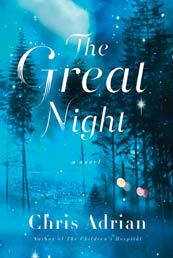 The Great Night is a modernized retelling of Shakespeare's A Midsummer Night's Dream, set in Buena Vista Park in San Francisco in 2008. A group of humans stumble into a disaster implemented by the Faery Queen, Titania, who is in the throes of deep sorrow. Following the death of their latest changeling child, Titania and Oberon had one of their marital spats -- but this time, Oberon doesn't seem to be coming back. Desperate to get the King to show himself and so absorbed with her grief that she loses all sensibility, Titania lifts the controlling enchantment off of Puck, also known as the Beast, freeing him to wreak havoc in the park. (The greater world is protected by walls of air -- nothing, mundane or fantastical, gets in our out of the park while those walls, presumably conjured by Oberon, are up). The mortals trapped within are: Molly, recovering from the suicide of her boyfriend; Will, in love with a strange woman who dumped him a year ago; Henry, who can't remember any of his life before the age of thirteen, and whose obsessive-compulsive habits drove away his boyfriend; and a group of homeless people rehearsing for a musical version of Soylent Green, led by Huff, who believes the Mayor of San Francisco is feeding the indigent population to each other in the soup kitchens. These mortals get wound up in the actions of the faeries, who are either giving over to sensual indulgence in what they presume to be their last hours, or who are seeking ways to put the Beast back under control.
There are things about this book which are really great. It's definitely at its best when the faeries are the main focus. Titania and Oberon are sweeping, dramatic figures, and Adrian describes the lesser faeries in a way that balances nicely between whimsical and grotesque. The flashback section where Titania and Oberon have to watch their changeling child die is the strongest portion of the book. Because their magic cannot work on anything they care for, they have to turn to human medicine to try and save the Boy. They're also struggling to deal with the emotional consequences of actually caring for a mortal child, as their self-absorption usually prevents such deep attachments to their changelings. Adrian does a great job showing how mortals perceive the faeries when they enter the mundane world, how the little magics affect them. He also -- through his own background as a pediatrician -- is able to evoke the tormented feelings of parents watching a child die with great sympathy and precision. The emotionality of this section is strong and compelling, and it paints a very clear picture.
As for the humans, their stories generally start off well enough -- Molly, Will, and Henry, at least, inhabit complex emotional and psychological worlds. Huff and his tribe I could have done without. They seemed extraneous, none of them besides Huff developed any real personality, and I can't figure out the purpose of the Soylent Green trope. Not having enough of a familiarity with that source material, I don't know if there's some larger theme at work there, or if the fixation is just a way to demonstrate the extent of Huff's delusions. Regardless, it seems like that subplot only exists as a tacked-on way to have an analog for the Mechanicals, so that Titania has a fool to dote on when the Beast places her under an enchantment. But the lover-analogs are fascinating, if not wholly likeable. They all enter the story in liminal states, hedging between decisions, scared to take decisive action in controlling their lives, hesitant and varying degrees of pathetic. In this way, they're precisely the opposite of Shakespeare's lovers, who take to the woods for very specific reasons, but their ambiguity serves the opening of the story, because it makes them vulnerable to ethereal interference.
The second half of the book degrades into confused chaos, though. As the humans fall deeper under the faeries' spell, the narrative quickly becomes jumbled and hazy. Molly and Will, whose stories had been compelling, get lost entirely in the enchanted shuffle. Henry's experience is only somewhat clearer. The reader does learn some more pieces of the backstory, some threads that tie these seemingly unrelated people together, but there's no real sense of a greater point to it, no driving force behind what's happening, and no ultimate goal for them to work towards.
And perhaps that's all to the author's purpose. Perhaps that chaos is precisely what Adrian is aiming for, to portray the senselessness of the whirlwind the Beast creates. Which is why I say, if that's the case, then it's extremely well-done. But even well-done, it interfered with my ability to enjoy the book. I like a good, solid story, some sense of cohesion, which The Great Night lacks. As the mortals falls deeper into the madness of the night, their experiences become clogged with symbolism. Adrian takes it a step too far, I think, laying the metaphors on a bit too thick, and the story loses both coherence and emotional engagement as a result.
The ending of the book is a problem. Abrupt and anticlimactic, it circumvents any kind of resolution for the characters. The mortals' stories, set up so well at the beginning, reach no conclusion. They don't even move along -- we don't see any indication that they've been changed by their time in the woods, that they'll go back to real life different than before, because we don't see them at the end. There's no sense of alteration or growth. No one has a dramatic arc except Titania, perhaps, and even her story ends ambiguously, with no denouement. Adrian throws the reader into a maelstrom and then never calms the seas. Again, this confusion might be intentional, but it's unsatisfying.
Tags:
book reviews,
cass has thoughts
Subscribe to:
Posts (Atom)