06 January 2012

'Richard III' Study Guide Now Available!

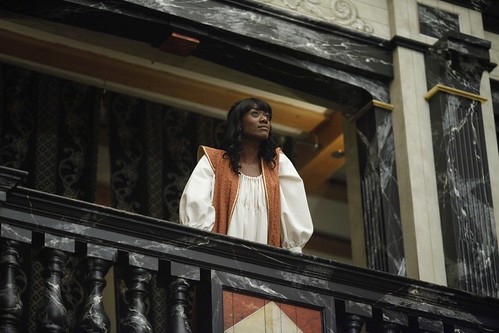
I am tremendously pleased to announce that the ASC Study Guide for Richard III is now available for purchase online! We've got lots of juicy information for you in this one, stuffed as this play is with amazing language, fascinating characters, and active staging requirements.

As usual, I have a ten-page preview for your preliminary enjoyment. This Study Guide includes the following:
  • The Basics: Getting your students on their feet, working with iambic pentameter, paraphrasing, exploring rhetoric, and turning your classroom into an early modern stage.
  • Line Assignments: A way to give your students ownership over a small section of text, which they will use in further language-based activities and staging explorations.
  • Rhetoric: Stichomythia. Quick, back-and-forth dialogue characterizes some of the play's most memorable scenes. How does Shakespeare use this device to engage the audience's affections?
  • Perspectives: Cursing -- No, not that kind of cursing. This activity goes to the heart of what power a play can invest in words. Does Margaret really bring down the House of York with her invective language, or does she merely prophesy what was already destined to occur? Your students will explore some of Shakespeare's most inventive insults and deliciously antagonistic vitriol to determine the relationship between language and fate.
  • Staging Directions: Richard III has some of Shakespeare's most explicit and detailed stage directions, uncommon for the early modern stage. Your students will explore what information those directions offer versus the information embedded in the text of the play itself.
  • Perspectives: Richard's Reputation. What was the historical reality of Richard III's reign, where did Shakespeare get his ideas about crookbacked Dick from, and how can an actor use this information in performance?
  • Staging Challenges: Haunting Richard and Helping Richmond. Your students will explore ways of bringing Richard III's supernatural elements to life.
  • Textual Variants: While the 1623 Folio is the longer text and the version more closely related to Shakespeare's sources, the earlier quartos may reflect changes made for the stage or while the company was touring the provinces. Your students will explore the transmission of text and how those alterations can change the overall impression of the play.
  • Rhetoric: Richard and the Audience. In Richard III, Shakespeare created one of his most enduringly memorable characters, and Richard's relationship with the audience is critical to his legacy. But how does Shakespeare craft that relationship?
  • A guide to producing a 1-hour version of the play in your classroom
And that completes the set! All of the Study Guides for our 2011-2012 artistic year are now complete, and you can preview any of them before purchasing your downloadable PDF. We also provide hard copies to educators who attend our Teacher Seminars -- join us next month for Much Ado about Nothing and Richard III. Teachers who bring students to matinees can receive download access by contacting Ben Ratkowski.

My next task (already in-progress) is to update last year's guides for Macbeth, The Taming of the Shrew, The Comedy of Errors, and As You Like It with the newly expanded Basics section. Once I've completed the upgrade, I'll move on to the Study Guides for the 2012-2013 artistic year. What will those be? I can tell you... next week! Artistic Director and Co-Founder Jim Warren will be announcing the 2012-2013 lineup tomorrow night, before the opening of Much Ado about Nothing, and after that, I'll be able to detail which of them will be our school matinee and Study Guide shows. Stay tuned next week for that information -- or, join us at 7pm Saturday night and hear it from Jim!

30 December 2011

2011 in Review

We're wrapping up another year in ASC Education, and 2011 has been full of excitement and surprises.
  • Our biggest event of the year was the 6th Blackfriars Conference, held in late October. With over 150 presenters in both plenary and colloquy sessions; keynotes from George T. Wright, Scott Kaiser, Tiffany Stern, and honoree Stephen Booth; ASC productions and special late-night performances; banquets; parties; and after-parties, this year’s conference was a rousing success.
  • Our summer camps were more successful than ever. At the American Shakespeare Center Theatre Camp, six troupes across two sessions performed in an hour-long version of early modern plays (in a “Greek to me Summer”, the plays were all set in Greece); participated in master classes including stage combat, dance, music, acrobatics, and maskwork; attended academic classes in theatre history, scansion/rhetoric, classics, and source study; and visited the Blackfriars Playhouse to watch the professional Resident and Touring Troupe actors rehearse and perform in our summer season of plays. This was the first summer we offered college credit for the camp. Our Midsummer Day Camp welcomed students ages 9-12 for an adventurous week of creative play, imagination, and fantasy, culminating in a final performance of Twelfth Night. Enthusiasts of all ages came to Staunton for the second year of the No Kidding Shakespeare Camp for Adults. We’re already looking forward to the 2012 camps; applications and registrations are now open: ASCTC; MSDC; NKSC.
  • We introduced a new program in 2011: ASC Family. An ASC Family membership has many benefits, including discounted tickets, free Playhouse tours, and free admission to ASC Family events, where we bring the community into the Playhouse. In September, we welcomed musicians and artists; our next ASC Family event, “Taste of Staunton” is on January 21st and will feature local restaurateurs.
  • The ASC also hosted recitation competitions for Poetry Out Loud and the English Speaking Union. At the ESU Nationals in New York in May, Ralph Alan Cohen served as a judge, and the ASC awarded a full ASCTC scholarship to second-place winner Claire Hilton.
  • Our Study Guides, already improved in 2010, underwent another round of revisions. The new guides for Julius Caesar, Hamlet, Henry V, A Midsummer Night's Dream, Much Ado about Nothing, and Richard III feature an expanded Basics section, introducing teachers to methods of classroom performance and engagement with the text, including scansion, paraphrasing, acting interpretation, rhetoric, and audience interaction. I'm currently working on bringing the Basics from last year's guides up to those standards, and then I'll start work on the 2012-2013 guides.
  • Those Study Guides form the basis for our Teacher Seminars. This year, we added a fourth seminar, a special one-day event in August. Winter, Spring, Summer, and Fall, dozens of new attendees and old friends joined us to explore methods of performance-based learning. For the second year in a row, we’ve welcomed pre-service teachers from JMU to a mini-seminar in December, we look forward to seeing them return next year.
  • We welcomed 15 Little Academes to the Playhouse over the course of the year: 2 in February, 6 in March, 2 in April, 3 in May, 1 in August, and 1 in September. That's up from 11 in 2010, and we hope that even more teachers will choose to bring their students to us for week-long intensives in 2012.
  • If the students can’t come to us, we’ll come to them! In October, we held our first On-Site Educational Residency in Shaker Heights, Ohio. I traveled with former ASC actors Kelley McKinnon and Chad Bradford for a week with the amazing young women of the Hathaway Brown School. We presented in both English and theatre classes, and Kelley and Chad provided rehearsal coaching for the school’s production of Macbeth.
  • Our educational opportunities aren’t just limited to students; this year, we expanded our professional training programs farther than ever. We continue our long relationship with the Federal Executive Institute, providing leadership seminars, and we’ve begun to develop programs focusing on law and finance as well.
  • Apart from bringing scholars to visit us during the Blackfriars Conference, we also attended a number of other conferences in 2011. We presented to teachers and students at the Texas Educational Theatre Association in January, and that month, representatives from the Education, Marketing, and Managing departments of the ASC attended the Shakespeare Theatre Association conference in Boulder, Colorado. In February, Sarah and I presented on Shakespeare as a Primary Source at the Arizona Center for Medieval and Renaissance Studies’s conference in Phoenix. And in April, Ralph traveled with ASC actors James Keegan, Rene Thornton Jr., and John Harrell to the Shakespeare Association of American conference in Seattle, where Ralph presented on Falstaff and our actors presented at a workshop on Playing Shakespeare. 2012 is shaping up to be just as full of travel for the whole team, with visits planned to Sacramento, Orlando, and Boston.
  • We’re also expanding our relationships with friends across the world. Sarah and I visited the Folger Shakespeare Library in May to discuss how both companies are expanding our online resources for students and teachers. Ryan Nelson from Shakespeare’s Globe visited us to present for the MBC MLitt/MFA program and to talk about digital opportunities for education, and the conference in October further expanded that relationship with a presentation given by new Globe Managing Director Neil Constable, and Director of Research Farah Karim-Cooper on their upcoming Indoor Theatre.
  • We moved the bulk of our archives to Washington and Lee University, where our materials can enjoy greater storage space and management than our facilities could offer (So for anyone who’s visited our archives in the past, that means no more cramming yourselves into that tiny, overstuffed closet). We retain the last five years’ worth of material in the offices, but we shipped everything about shows from 1987 to 2005 down to Lexington; more sections (from Education, Marketing, Development, the Board of Trustees, and on the building of the Blackfriars) will go down in Summer 2012.
  • The MBC MLitt/MFA Shakespeare in Performance program also had a full year: an all-male production of Romeo and Juliet, dueling versions of The Two Gentlemen of Verona, a spring thesis festival, and many other events and productions.
  • We also work with the MBC Program for the Exceptionally Gifted and Honors program each fall semester. This year’s focus word was “wisdom”, and the students explored variations of that word’s meaning through scenes from As You Like It.
  • We partnered with the Virginia School for the Deaf and Blind to bring workshops to their students, as well as arranging two sign-language interpreted nights of Macbeth in April -- one matinee, for their students, and one evening performance open to the public, thanks to the generosity of the interpreters, Kate O’Varanese and Laurie Shaffer, from UVA who gave us the gift of their services at no cost.
  • We said goodbye to Christina Sayer Grey and welcomed Ben Ratkowski to the team. Christina didn't leave the ASC, but shuffled over into Marketing; if you follow the ASC on Facebook or Twitter, she's responsible for most of that content now, as well as numerous contributions to our other promotional materials. Ben took over her job as Group Sales and Academic Relations Manager, in addition to his responsibilities as ASC Family Coordinator.
  • Education Interns always provide a bitter-sweet Hello and Goodbye. Good-bye to Natalie and Liz and David. Hello to Jane, Kyle, Brenna, Kimberly, Jennifer, Angelinne, and John. We’re so grateful for the time each of you can spend with us, and we wish you all the luck in 2012 and beyond.
You can see photos from these events on the ASC Facebook page. If you joined us in 2011, take a flip through and reawaken some memories. If you didn't make it to Staunton, then hopefully the pictures will inspire you to join us in 2012!

So what’s ahead for ASC Education in 2012? More access to more people. We hope to reach more students and educators than ever -- that means more classes coming to matinees, more young adults at ASCTC, more pre-teens at Midsummer Day Camp, more grown folks at No Kidding Shakespeare Camp, more attendees at our Teacher Seminars, more educators downloading Study Guides, more groups coming in for leadership seminars and other professional training opportunities, more podcasts featuring our actors and education artists -- more of you getting to do more with us.

I hope everyone has had a lovely and safe holiday season, and that we’ll be seeing you in the coming months. The Actors’ Renaissance Season ramps up in just a few days, providing a wonderful opportunity to witness firsthand the marriage of research and scholarship with theatrical practice -- so come see us soon!

15 December 2011

Remembering Bernice Kliman and H. Gordon Smyth -- A Special Message from Ralph Alan Cohen

Bernice Kliman and H. Gordon Smyth, two important friends to the ASC, died last week. They didn’t know each other, and they would be surprised to find themselves being remembered together in this piece. In truth, they were about as different as two good people can be. Gordon, a retired executive with Dupont, was a quiet and reserved man, the kind of upright citizen you expect to meet at the Rotary Club and have as a deacon of your church. Bernice was a retired professor from Nassau Community College, and the kind of gleefully uninhibited New Yorker you’d expect to see at a protest march with Bella Abzug.

Bernice first raised a family of four sons with her husband Merwin on Long Island and then began a remarkable career as a Shakespearean. At the Folger Shakespeare Library, she was the first reader at her desk when the library opened at 8:45 and the last one there when it closed at 4:45. After hours, she was the ringleader in getting the other scholars together for plays, concerts, lectures, and – especially – parties where there was dancing. She was a wonderful dancer and my memory of parties at the Folger Guest House and at Tom Berger’s Malone Society Dances at the Shakespeare Association of America always feature Bernice tearing up the dance floor in her colorfully patterned stockings – imagine Ruth Gordon doing a damned good Tina Turner imitation and you’ll be pretty close to what I remember.

Bernice didn’t like snobs and she was suspicious of the establishment, but she loved upstarts and underdogs – she was one – so she was immediately drawn to the work of the Shenandoah Shakespeare Express. A good show was all the credentials she needed in a Shakespeare company. At the Folger she became a vocal proponent of the SSE, and, when we offered our first teacher seminars (at the Dayton Learning Center), she was our featured visiting scholar (thanks to the Virginia Foundation for the Humanities and our first ever grant). Later she brought us up to Long Island to do shows and workshops at at her college. She was one of those people’s whose high regard for our work made me know we were on the right track, and her remarkable enthusiasm put a favoring wind in our sails. Her great work, The Three-Text Hamlet, gives a side-by-side-by-side look at the three versions of the play, and is one of the indispensible books for a Shakespearean scholar. She did me the honor of letting me use an advanced manuscript for my production of the play in 1995.

By contrast, Gordon’s support was not so much moral as financial – generously so. At his funeral, the minister talked about the story in Luke of the Good Samaritan, and pointed out that loving your neighbor meant extending the idea of “neighbor” even to strangers. In a way, that’s what Gordon did with us. I don't think he cared that much about Shakespeare, but he and Mary Beth wanted to support young minds – their foundation sends deserving young people to college – and he cared about Mary Baldwin College and knew we were important to Cynthia Tyson and then to Pamela Fox.

I remember, during board meetings, his quiet dismay at our first attempts to be a sound business. I remember his dry comments and his pointed questions. I fancy, too, that he had a glint of amusement in his eyes, the kind of glint your father had while you were explaining to him why you needed a larger allowance. Whatever his misgivings may have been about our start-up, upstart Shakespeare company, it was Gordon who agreed to assure the mortgage our late, great Bruce Campbell had arranged for the Blackfriars.

Gordon and Bernice – the businessman-philanthropist and the scholar-teacher – so unlike one another except in their devotion to the idea that learning enriches, were part of our foundation. We are saddened at losing them. We celebrate their friendship and we owe their memories the best work we can do.

14 December 2011

'Much Ado About Nothing' Study Guide Now Available!

At last! I get to share the Study Guide for my very favorite play, Much Ado about Nothing. As I noted in a previous post, I've enjoyed this one tremendously, and I'm already super-excited about getting to work through these activities with attendees at our Winter Teacher Seminar.

Shakespeare Education: Much Ado about Nothing Study GuideHere is a ten-page preview for your enjoyment. This Study Guide includes the following activities:
  • The Basics: Getting your students on their feet, working with iambic pentameter, paraphrasing, exploring rhetoric, and turning your classroom into an early modern stage.
  • Line Assignments: A way to give your students ownership over a small section of text, which they will use in further language-based activities and staging explorations.
  • Too Wise to Woo Peaceably: Benedick and Beatrice are one of Shakespeare's finest couples, witty and brilliant and endearing. Better than all of that, however, they're both fantastically smart -- and in this activity, your students will explore the rhetoric of their scenes and discover how Shakespeare uses their language to show the audience that they deserve each other and belong together.
  • Perspectives: Slanderous Tongues. Much Ado about Nothing's plot revolves around an issue that your students experience every day in high school life: rumors. Your students will examine the language of slander in Much Ado and will relate Hero's unfortunate situation to their own lives. What words hurt the most? On what basis can a girl's reputation become ruined? How is reputation different from a male perspective?
  • Dogberry: Before malapropism was malapropism, it was something else entirely. From everlasting redemptions to odorous comparisons, your students will discover the comic gold that is Dogberry's creatively mistaken vocabulary.
  • The Gulling of Benedick and Beatrice: Your students will explore the staging requirements of two of the play's best comic scenes, when Benedick and Beatrice each hear their friends conspiring against them. Where can you hide the eavesdroppers so that the audience can see their reactions -- critical to the success of the scene -- without breaking the imaginative fiction that allows Benedick and Beatrice to believe that their gullers are unaware of their presence? These scenes take advantage of early modern staging conditions in creative ways, and working through them will get your students thinking actively about thrust staging, universal lighting, and audience contact.
  • Staging Challenges: Kill Claudio. Shakespeare's plays rarely fit neatly into the categories of comedy and tragedy that we've created for them, and a key example of this in Much Ado about Nothing is the moment when Beatrice challenges Benedick to prove his worth to her by killing the man who dishonored her cousin. Through active staging, your students will explore different potential interpretations of this scene and will determine which version they feel tells the best story.
  • Textual Variants: The earliest printed versions of Much Ado about Nothing have several textual oddities -- oddities which reveal that this play may be more closely related to Shakespeare's original manuscript than any other in the canon. Activities on speech prefixes and stage directions will walk your students through an examination of the transmission of text in early modern London.
  • Production Choices: A guide to producing a 1-hour version of the play in your classroom.

If you would like to purchase a downloadable PDF of this or any other ASC Study Guide, just visit our website. I'm already well into work on the Study Guide for Richard III -- the last for this artistic year! After which, my plan is to bring the 2010 set up-to-date with the modifications we introduced for the 2011s, and then I will start work on 2012.

08 December 2011

How did I get here?

Do you ever take a look around you, and ask yourself: “Now, how did I get here?” I found myself doing that a lot during the last week of October. The question wasn’t the kind of thing that wakes you in the middle of the night in a cold sweat (though in the weeks leading up to October 25, there were plenty of those). Rather, it was a query of wonder. As I stood in the Blackfriars Playhouse October 25-30, I felt as though I had super-glued rose-colored glasses to the bridge of my nose and couldn't shake that amazing feeling that comes when one is surrounded (at home, no less) by dear friends (new and old), excellent conversation, amazing scholarship, and the joy of the work of two years coming to fruition in a beautiful way.

Ah, the Blackfriars Conference 2011.

My parents have a difficult time understanding me when I say “I won’t be really available for a few weeks, the conference is coming up.” What, exactly, could be keeping me so busy? To be fair, when we were separated by only 90 miles, as opposed to the 1300+ that divide us now, my life was pretty hectic. In my occupation as a high school Theatre teacher, teaching five classes daily, producing six shows a year, with set-building, costume construction, tech rehearsals, I was never as consumed as I am when Conference time rolls around in the odd-numbered year. It’s different, a different kind of busy – an all-consuming, all-anticipating, all-energizing, and yes, all-exhausting kind of feeling that builds for 24 months and culminates in a week of shared excitement, with faces both new and familiar. And the joy of overhearing as the answer to “How did you get here?” not “Bus, train, car,” but “I heard about it from...” or the even more gratifying “I come every time, wouldn’t miss it.”

My first conference was at its third incarnation in 2005, when I was in my first year in the Masters Program at MBC. Two months into the program, and I found myself in the same room with the authors of my textbooks and all of the articles I was looking up in Shakespeare Quarterly.

Why, hi there, Russ MacDonald (*RUSS MACDONALD?!?!?*). Oh, you’re from Texas, too? How nice to meet you!

Well, hello Tiffany Stern (*TIFFANY STERN!!!!*) I love that skirt.

And over there is Stephen Booth, George Walton Williams, Roz Knutson, Leslie Thomson, Alan Dessen. And some friends no longer with us, Bernice Kliman, Arnie Preussner, and Barbara Palmer, whose absence we have felt with sorrow since our last parting.

I knew, in that moment at my first Early Arrivers’ party, that this place was special. What other grad program gives its students the opportunity to network on their home turf? In this case, the turf of the Blackfriars playhouse, always a space of generosity and intimacy and, for one week in October on odd-numbered years, a space of enviable scholarship and flourishing ideas. How was I lucky enough to get here?

My previous conference experiences were all in my undergrad discipline, Theatre Arts. Those conferences featured more workshops than papers, more seminars than presentations, more off-the-cuff speaking than formal delivery. It was a shock to my system to see people reading from a lectern on the stage. But then, the ASC actors arrived. Their contributions linked the two worlds as no other glue or bridge could. They are proof that seeing is the quickest path to believing, whether one needs to be shown a character or helped to understand a presenter’s thesis. In the years since my first conference, it has been my privilege to work with those talented actors to improve interactions between presenters and their actors, to improve communication, to improve the general affect of the conference. We’ve come a long way, and though I know we still have some way to go toward a perfect system, the coming-together of actors and scholars in the way the Blackfriars Conference encourages makes me exclaim: how did I get here and how long can I stay?

In 2007, 2009, and again in 2011, the Conference gave me the opportunity to work along side my mentor, and, I am glad to say, my friend, Ralph Alan Cohen. When I took over from Sarah Pharis (aka Sarah #1) in 2007, I had big shoes to fill. Sarah’s organizational structure -- her daily work flow chart is still the basis for everything that happens behind the scenes -- made it possible for me to step in and to help Ralph to achieve his goals: good papers, good friends, good food, good times. It’s not as easy as it sounds. This year, I began to think of it as akin to planning a 6 day party for 250 of my dearest friends. Each hour of each of the 16 hour days just needs to be scheduled with events, food, drink, and plays. I’d just need to contact each of the 100+ presenters, the 50 grad students, the 15 actors, the 5 caterers, and the 5 venues to give them individual instructions for each minute of that time, get the invites and the publicity out, and then make sure everyone feels pampered and loved while they are here. Not so hard. It’s not, really.

Not this year, anyway. For the first time since my 2005 conference (when I was merely a volunteer), I had a full team in place and on board so early with planning and strategizing, that I actually got to watch my friends, both presenters and actors, in every session, and I watched the rest of my friends in the audience enjoying every minute.

How did I get here? Well, for that, I have loads of people to thank. Ralph, for trusting, the ASC actors and artistic staff for being so generous and sharing their talents in the highlight event of each day, Cass, Ben, Christina, Asae, Kim, Anne, bear wrangler Brian, Clara, Paul (Menzer and Rycik), the entire admin staff at ASC, the wonderful box office staff, the artistic staff and actors for making each session and evening performance memorable, the MBC students who exceeded their colleagues at past conferences in both volunteering and contribution of scholarship. They made it look (and feel) easy, and I am tremendously grateful.

Some highlights for me at the 2011 conference included:
• The delicious food at the early arrivers' party.
• Stephen Booth’s paper on Shakespeare and Audiences.
• Go Dog Go, as devised and performed by Chris Johnston, John Harrell, Jeremy West, Dan Kennedy, Greg Phelps, Miriam Donald, and James Keegan.
• Hearing about the new Indoor Theatre in London from Neil Constable (Heck, meeting Neil Constable).
• Bill Gelber’s ‘ A “Ha” in Shakespeare....”
• Ben Curns sleeping onstage (as directed) in Casey Caldwell’s paper (and then using lightening quick reflexes not to knock over the 100 champagne glasses set behind the curtain as he exited).
• Chris Barrett.
• Joe Ricke and Jemma Levy in a morning session to rival all others.
• George T. Wright and James Keegan’s mutual admiration discussion.
• Finding out “Why are there no blowjob jokes in Shakespeare” from Matt Kozusko.
• Beth Burns and the Hidden Room.
• Stuart Hall’s participation, thanks to Brett Sullivan Santry.
• Natasha Solomon and Dan Burrows acting in Bob Hornback’s Renaissance Clowns paper.
• Seeing our Conference Attendees see John Harrell’s Hamlet.
• Our late night shows (wow).
• William Proctor William’s experiment.
• Seeing ASC actors at every paper session (even the EARLY ones).
• Watching worlds come together in Scott Kaiser’s keynote.
• The bear(s).
• Talking teaching.
• Tiff.
• Colloquies.
• Insights on our space in session X.
• The Banquet.
• Doreen Bechtol in everything she did, but especially Lady M as played by Sarah Siddons (pregnant).
• Hamlet Conversation.


And so, a little over a month past the last day of the conference, I have a little time to reflect. A little time to look around at the people I work with, the place I work for, and thank heavens that, however it came to be, I landed here.

What will you remember?

02 December 2011

Too Wise to Woo Peaceably

The Much Ado about Nothing Study Guide should be ready soon (and I hope I'll have a 10-page preview for you on Monday), and I just have to say, I'm enjoying this one more than probably ought to be allowed. I'm enjoying it so much, in fact, that I couldn't wait until the release to tell you what a good time I'm having.

Much Ado about Nothing is my favorite play, and this has never been a secret to anyone who knows me. It was not the first Shakespeare play I read, but it was the first one I saw in performance, at the age of 12, in the little theatre in the basement of the Virginia Museum of Fine Arts. From that night on, it was all over for me. Much Ado had won my heart, and nothing since has had any power to tempt it away.

There's a lot that's good in this play -- the satire of courtship between Claudio and Hero, the insidious villainy of Don John, the overconfident antics of Constable Dogberry -- but for my money (and I suspect for many others' as well), this show is all about Beatrice and Benedick. They are both the head and the heart of the story, the greatest wits and also the characters who demonstrate the most tremendous emotional depth. I think theirs is the most emotionally real of all of Shakespeare's love stories, not least because it's a more mature affair than many others. Benedick and Beatrice have loved and lost and hurt before; Beatrice tells us this flat-out, though Shakespeare tantalizingly never elucidates the circumstances of their shared past:
DON PEDRO
Come, lady, come; you have lost the heart of

Signior Benedick.


BEATRICE
Indeed, my lord, he lent it me awhile; and I gave
him use for it, a double heart for his single one:
marry, once before he won it of me with false dice,
therefore your grace may well say I have lost it.
I like this glimpse of backstory not only for the magnificent potential for emotional nuance that it gives performers, but also because it provides Beatrice and Benedick with a more solid foundation on which to build a relationship. If they only fall in love with each other because their friends trick them into it, that would make them fairly shallow people, and it would not inspire a lot of hope for a successful future -- but if the love is already there and just needs to be rekindled, that paints a much brighter picture.

I've been working on an activity that I just can't wait to test out with the participants of our Teacher Seminar in February, examining the progression of their relationship through an analysis of how they use language. Shakespeare shows the audience, so clearly, that these two are meant for each other. No one else in the play uses language quite the way they do. For all the banter, quips, and Beatrice and Benedick are the only two who so consistently take each others' words, fire them back across, and set up for the next volley.

The rhetoric shows us not only how smart they are -- and these two characters are some of Shakespeare's most verbally intelligent creations -- but how well they work together. At the beginning of the play, those shared words and mimicked rhetoric are part of the battle, a game of one-up-manship they play with each other. By the end of the play, however, Beatrice and Benedick are using those same figures in a completely different way; instead of combating each other, they're working together, building off of each others' words instead of trying to tear each other down. There's still an element of challenge there -- essential, I think, to their relationship -- but it's no longer with the end goal of destruction. Beatrice and Benedick prove themselves a delightfully matched pair. From the "gay couples" of Restoration comedy to the comedies of manners in the eighteenth and nineteenth centuries, the "screwball" comedies of the 1930s and 40s, and the sitcoms of today, their legacy is certainly a magnificent one.

15 November 2011

'Henry V' Study Guide Now Available

The ASC Study Guide for Henry V is now available. I got to stretch my historical muscles and revisit my medieval studies roots for this one, which was a real treat for me.
Here is a ten-page preview for your perusing enjoyment. Activities in this guide include the following:
  • The Basics: Getting your students on their feet, working with iambic pentameter, paraphrasing, exploring rhetoric, and turning your classroom into an early modern stage.
  • Line Assignments: A way to give your students ownership over a small section of text, which they will use in further language-based activities and staging explorations.
  • Staging Challenges: Dealing with Canterbury's seemingly interminable Salic Law speech -- and turning it into an exciting exploration of language and performance opportunities. The Salic Law speech may, at first, seem to represent everything your students fear most about Shakespeare: an enormous block of text, spoken by a high-ranking official, which doesn't appear to say anything of importance. This activity will help you show your students that there is humor for the mining in Canterbury's digressions, and that the entire speech is a set-up for a grand punchline.
  • Perspectives: How does Henry craft his language in order to motivate his men? And is he really such a glorious leader, or is there some disconnect between the Henry that the Chorus celebrates and the Henry that Shakespeare shows us in action? This activity examines the examples of leadership, both positive and negative, presented in Henry V: heroic Henry, not-so-heroic Henry, the flippant Dauphin, the aging Charles VI, the brusque Fluellen, and others. Your students will relate Shakespeare's various portrayals of leadership to modern politics, and will examine Henry's methods of motivation as compared to modern military recruiting techniques.
  • Perspectives: The Battle of Agincourt stands as one of England's most famous victories, but what were the historical realities? Were the English outnumbered 6-to-1? 10-to-1? Or just 4-to-3? Your students will explore contemporary accounts, secondary sources, and modern research to cast new light on the version of events Shakespeare portrays. They will also discuss the place that Agincourt holds in the English narrative of national identity and will explore what similar moments in American history hold that same position for us.
  • Rhetoric: Henry V is one of Shakespeare's very best speakers. He fits his speech to the occasion and his listeners remarkably well, changing his tenor, his vocabulary, and his rhythms for greatest appeal. Your students will examine those conditions throughout their exploration of Henry V, but how does Henry speak when he is alone with the audience? In this activity, your students will explore how Henry uses devices of repetition and substitution in order to build a rapport with the audience.
  • A variety of scenes for alternative stagings.
  • Production Choices: A guide to producing a 1-hour version of the play in your classroom
If you would like to purchase a downloadable PDF of the Henry V Study Guide, or of any of our other Study Guides, please visit our website. I've already begun work on the next offering: Much Ado about Nothing -- It's my all-time favorite play, so I'm quite excited about it.

04 November 2011

Imprimis: Links and Tidbits -- 'Anonymous' Edition

As I'm sure you've all noticed, a movie came out last week which, despite its risible nature, seeks to ruffle feathers in the world of Shakespeare studies. Many scholars would rather not dignify the nonsensical issue with a response (not to mention our reluctance to give Emmerich more free publicity), but the matter has pressed itself sufficiently that the community has responded. If Anonymous realized its own fictional nature and were not attempting to masquerade its inventions as fact, perhaps we wouldn't have such a problem, but because Emmerich has taken to the media, smugly pronouncing himself the savior of truth, and because Sony has begun distributing supposedly "educational" packets to high schools (I've seen them; they're alarmingly misleading and ethically irresponsible) -- those conditions provoke the defense that Shakespeare deserves. The kid gloves have come off, and rather than dancing delicately around the issue, many scholars have attacked the issue head-on and free of hedging. I submit here, for your perusal, a smattering of the reviews and opinions published in response to the Anonymous absurdity.
  • James Shapiro, author of Contested Will, took to the New York Times in defense of Shakespeare: "Promoters of de Vere’s cause have a lot of evidence to explain away, including testimony of contemporary writers, court records and much else that confirms that Shakespeare wrote the works attributed to him. Meanwhile, not a shred of documentary evidence has ever been found that connects de Vere to any of the plays or poems."
  • The Times also has a piece by Stephen Marche, which not only disapproves of the attempt to portray the film as educational but also derides the conspiracy theory in general: "No argument could ever possibly sway the Oxfordian crowd. They are the prophets of truthiness. 'It couldn’t have been Shakespeare,' they say. 'How could a semiliterate country boy have composed works of such power?' Their snobbery is the surest sign of their ignorance."
  • An editorial in the Washington Post sought out opinions from James Shapiro, the Folger's Michael Witmore, and eminent period scholars Eric Rasmussen and Stephen Greenblatt.
  • Simon Schama advises, simply, "Don't buy it" in regards to Emmerich's spurious claims. "None of which would matter very much were there not something repellent at the heart of the theory, and that something is the toad, snobbery—the engine that drives the Oxfordian case against the son of the Stratford glover John Shakespeare. ... The real problem is not all this idiotic misunderstanding of history and the world of the theater but a fatal lack of imagination on the subject of the imagination. The greatness of Shakespeare is precisely that he did not conform to social type—that he was, in the words of the critic William Hazlitt, 'no one and everyone.'"
  • A public radio commentary fights the idea of privilege attached to the Oxfordian theory: "I could never stand before a class of high school students and tell them that great writing, and a deep understanding of humanity can only be achieved by the educated elite."
  • Woman About Town links the "controversy" to other conspiracy theories. "It was only as the centuries passed and Shakespeare’s work began to be seen as the pinnacle of artistic achievement that it was that ‘doubts’ emerged. And the biggest reason appears to have been plain old-fashioned snobbery and frustrated romantic yearnings."
  • Jonathan Hobratsch for the Huffington Post presents 10 reasons why Shakespeare is Shakespeare.
  • Slate.com has a movie review, complete with podcast, demonstrating that even objective reviewers with no dog in the fight find the whole premise absurd. The podcast is particularly interesting for what the reviewers have to say about the relationship of modern actors to the conspiracy. Another article on the same site asserts the need to defend Shakespeare: "To remain silent in the face of stupidity this blatant is to acquiesce to a kind of culture-destroying ugliness. ... Most of all, I hate the way they pride themselves on the vain, mendacious conceit that they’re in on a grand historical secret deception that only they have the superior intelligence to understand. It’s an insult to everyone else’s intelligence if they’re taken seriously."
  • James Ley challenges Sony's choice to promote the fictional movie as educational: "There is something pernicious about the way Anonymous is being promoted. The 'teach the controversy' strategy, beloved of those whose arguments are on the wrong side of the evidence, is now apparently so normalised that an implausible work of speculative fiction can be brazenly offered as an exercise in historical revisionism and an educational tool."
  • Skeptical Humanities also challenges the movie presenting fiction as fact: "So, no, Anonymous is NOT just a movie: it is a huge propaganda machine that wants desperately to sway viewers and students."
  • Stanley Wells and Paul Edmondson, from the Shakespeare Birthplace Trust, have written an e-book which they’ve made freely available. Shakespeare Bites Back synopsizes the argument nicely and also advocates that we stop using the term "anti-Stratfordian" and begin calling a spade a spade with the term "anti-Shakespearean". Additionally, Edmondson and Wells discuss the issue in a short podcast, Wells has a piece in the Telegraph, and a series of posts from back in June demonstrates that Shakespeare solidly wins the debate.
  • Finally, the Utah Shakespeare Festival solicited responses from a number of scholars and practitioners from Shakespeare institutions around the country. When they asked the ASC for our thoughts, Sarah was kind enough (and brave enough) to let me reply -- so if you want to know what I personally think about the issue, my argument is encapsulated there in a 500-word essay.
I'm also in the process of finally reading Shapiro's Contested Will, which Simon & Schuster sent to me for a review, so hopefully I'll be able to post that soon. It's also worth noting what several of the scholars who've weighed in have pointed out: this conspiracy is not something that dominates the field of Shakespeare studies. It is a distraction from real work. As entertaining as it sometimes is to spork a ridiculous fiction, I think we'll all be quite pleased when the movie flops (as it's reportedly doing), the hype dies down, and we can go back to arguing about the finer nuances of scansion, pedagogical technique, and the merits of Q1 Hamlet.

30 October 2011

Blackfriars Conference 2011 - Hamlet Conversations

Christina Sayer Grey here for the last presentation of the 2011 Blackfriars Conference. It's been a lot of fun to live-blog for you all this week. Enjoy!

Ralph announces that this panel was suggested by Rene Thornton, Jr.

Moderator: Matt Davies

Hamlets: Khris Lewin (2005 at the Blackfriars), Benjamin Curns (2007 at the Blackfriars, Actors' Renaissance Season, Q1), James Ricks (2001 at the Blackfriars), John Harrell (2011 at the Blackfriars), and Thadd McQuade (1995 with SSE, also played Hamlet in the German MFA project)

Matt says that the purpose of this panel is to talk about what it means to play Hamlet here versus playing him elsewhere. This panel will be in the format of an extended talkback.

Contest: Best Collective Noun for a Group of Hamlets (the best one I've heard, A Sulk of Hamlets)

Q: Why do you think that Hamlet chose you?
T.M.: I think that's a question for the directors.
J.H.: I think I'm a Polonius, but I never saw Hamlet on my path. It was always something for other actors to do, so I never paid much attention to it. I never thought I would play it and I never thought I wanted to. The Hamlet you see now is what I, personally, see the play to be from a very virginal perspective.
B.C.: It was my 2nd Renaissance Season. I had had really terrific parts in the first season, but I wasn't carrying any of the plays. When I heard they were planning to do the Q1, but I didn't know what that meant. I just asked to have my mind floated along in the pool of names, just to consider me. My understanding of Hamlet is that its unique in that the lead character has a scene with every other member of the company.
M.D.: Hamlet is interesting because Hamlet is the only character who really knows what's going through the whole play.
K.L.: First gig out of college. I was 21 and I was the understudy for Hamlet. I remember sitting at the first rehearsal, and the guy playing Hamlet seemed too old to play Hamlet to me. That's when I felt that Hamlet chose me. And then when I finally played him for real, at 33, that miraculously felt like the perfect age.
J.R.: That sense of being chosen - "why is this happening to me?" and using that. You get to have a relationship with everyone else onstage with you.

Q: Why is this role considered the testing ground for actors? What is with the prestige? Does it deserve its reputation?
B.C.: Of course it does. It demands of the actor a lot of different things. You have to build relationships with every other in the play and, in this space, build a relationship with the audience. And, you're in 90% of the play. That, in a way, makes it easier. You don't have time backstage to get nervous.
J.H.: Shakespeare as a cultural figure seems to get lucky sometimes, but the thing about Hamlet as a great part makes me, as an actor, way more self-conscious about performance than I've been in any other part. And that's a big factor in the part, too. The role and the actor ramify in that part. It doubles the experience.

Q: Which is the character that you, as your Hamlet, most connected with?
J.H.: Horatio, which surprised me.
K.L.: It's amazing - I really felt a special connection with all of the characters at different times.
B.C.: For me, it was the ghost, hands down. Shakespeare writes this amazing scene - "I know you have a million lines before and after this scene, but in this moment "'list.'" The ghost gives the best pieces of advice to the actor playing the role in this speech. The ghost has so much to say, and Hamlet is required, in that moment, to listen.
J.R.: The ghost, as well. We really played with tenderness in that scene. The audience, though, was the relationship I paid the most attention to. I tried to befriend them as much as I could.
T.M.: It's much more for me about the actors playing the roles than a particular character on paper. Horatio, though, is an enormous challenge. What is he doing there except to act as a witness and a fellow audience member. The room can alter it quite a bit, of course.

Q: Hamlet's Theatricality - for Hamlet the audience becomes a major character that he has to deal with. How much did the audience become a mirror for you, playing at the Blackfriars?
B.C.: It made the role way easier. If I had to do it in the dark, I'd find the role much more challenging. "To be or not to be" - the inclusivity of the pronouns.
J.R.: I found it liberating and very comforting. We miss a huge opportunity when we put up that 4th wall. To that extent, the role becomes the actor.

Q: Hamlet can, in some ways, be an isolating part, but in this space, he's never alone in a very obvious way.
J.H.: I'll buy that.

K.L.: To the other Hamlets, how did you use the house for soliloquizing? Stagecraft-wise?
J.H.: I started by doing the "too, too solid flesh" speech in the DSR corner. That first speech is nerve-wracking and that acted like a security blanket almost.
K.L.: From center stage, that first speech made me feel like an insect under a microscope.
B.C.: That speech is a place where you feel like you're being judged as an actor as well as the character.

Q: How have Original Practices affect your develop of the role? What was the relationship of O.P. to your Hamlets?
B.C.: OP version of special effects. How can we use "magic doors" and sound cues for the ghost? Ostensibly, the scene calls for five people, but it's really an all-call for the supernatural elements.
K.L.: I did Hamlet two years later in a traditional theatre, we had lights and fog, etc. Was there a precedent for using mist?
Lauren Shell (from the gallery): Yes.
J.H.: I like how this kind of space...the advice to the players - making this really advice to Hamlet from himself. It made for a very interesting little puzzle when relating to the role and this space.

Q: Hamlet wasn't a Blackfriars play, it was a Globe play. Hamlet ribs the groundlings and some scholars have said that it make him an elitist. Are there groundlings in this space?
J.H.: You are being ruthlessly upstaged by the players. There are always people who are WAY more interested in the dumbshow than in anything Hamlet says.
T.M.: In this space, the groundlings are above in the gallery. It's very tangible, that split and it's very exciting. Different communities/audiences on different levels.

Q: In this space, does Hamlet then throw the "groundling" lines up rather than down?
J.H.: I always pick the one person on the stools who isn't paying attention because there is one, inevitably.

Q: A show of hands for who has or is about to play Hamlet - What's the experience watching someone play Hamlet in this space?
A (Justin): It seems like such a wonderfully intimate venue. It's enclosed and you can feel like the audience is always so close.
Q: And you did your Hamlet in a graveyard?
A (Justin): We started in a 19th-century opera house and I felt it was harder to reach the audience in that space than it was outdoors.
A (Daniel): This space is quite similar to the Winedale space. It's surrounded by audience on three sides. You can touch/get in the face of someone in the front row. It allows you to connect very personally with the audience members, convince them that they're the person about who you're talking.
A (Bob): Outside in central Texas. It's very hot. The challenge of the role is less about the lines than just the physical exercise involved in performing the role. At Winedale, audiences are constantly fanning themselves and shifting around. It makes it impossible for the actor to stay still the whole time. Added to the manicness of the character.

Q: In "all occasions," there is a passage - "will and strength and means..." 26 consecutive monosyllabic words, begins and ends with a caesura. So, basically - pause, 26 monosyllables, pause. Have you thought about what that's all about?
J.H.: The leaden ratio - that speech happens at the moment the audience most palpably wants Hamlet to shut up. And, you are out there saying something that doesn't make a whole lot of sense.
Q: Act - motive, intention, and performance. If you apply that concept to what Hamlet is saying -
J.H.: If he just changed to the past-tense "If I HAD cause and will..." it would make so much more sense.
T.M.: I think that the thing is what Mamet called the 'Kitten monologue' - someone grinding the play to a halt with a jarring, nostalgic moment. It's like a play-sized caesura. It's a different flavor for Hamlet. He can misrepresent himself to himself, self- deception. I think it's an interesting moment that, if you're looking for fluidity, continuity, and rationality, it's clear why it gets cut, but it can be a moment where Hamlet and Fortinbras can suss out the differences in their characters.
K.L.: I didn't do it here, but I did it elsewhere. And it's interesting - it's the last big speech, it's the only one not at the castle. And it's the turning point after which he acts - he deals with R&G, he gets involved with pirates, he gets his revenge. He becomes this sort of action hero-y character offstage.
J.H.: And, I found it incredibly easy to memorize.

Q: Offstage - why do you think Hamlet goes to Ophelia's closet and what it he trying to do there?
J.H. [laughs]: What are they generally trying to do there?
B.C.: If you believe that he goes there directly after the ghost scene, he goes there to tell the person he trusts the most, but when he gets there, he remembers he's sworn to secrecy and so stands there in silence. He hopes to find a support system, but can't.
K.L.: It's one of those near misses. Like, if only that servant could read and didn't have to ask Romeo...
J.R.: Jim had us rehearse that scene to get a reference point.

Q. In this particular theatre, we're willing to join you on an imaginative journey, do you think it matters how old Hamlet is?
J.R.: Modern audiences certainly relate to college Hamlet and his buddy Horatio. I think it assists their understanding.
K.L.: It is such a wonderful role, and I want to see all kinds of different Hamlets. I want to see Hamlets of all kinds.

Q (Maxim): If you could give yourself advice as you were playing Hamlet, what advice would you give?
B.C.: Ask for help. In a season with no director, I was really fortunate to have Rene as Horatio and he set aside time to sit with me as I worked the soliloquys. Rather than feeling like you have to carry the show, take in as much information and feedback as possible.
J.R.: I would tell myself...give myself permission to fail. I came in with a lot of preconceived notions and couldn't allow myself to let them go.
M.D.: It brings up the thought - is this the sort of role you should really play twice?
J.H.: I wish I could have been able to relax about it.

Q: Is it difficult, as Hamlet, to be directed? Since it's such a dominating part?
T.M.: Not at all. I think I would have been a lot more at sea if I hadn't had Ralph as the director. The director can be a very useful pressure to create a clear form. Otherwise, the part could just spill everywhere.
J.H.: The best directors at least give you the illusion of ownership. I feel that I can answer for everything I'm doing on the stage.
J.R.: I felt that Jim was an ally and really helped in fleshing out each of those relationships, one by one.
B.C.: It's great to be asked a lot of questions. As to ownership, the answer is yours. A good director won't tell you the answer but encourage you to ask the question.

Q (Paul Menzer): To Ben, could you talk about doing the Q1, a Hamlet that is familiar and so different.
B.C.: I always thought that "there's the point" would get a giggle because it's jarring. But, the Q1 feels like the difference between an action film to an arthouse film.
K.L.: It's just so exciting to have that feeling.
T.M.: The German translation version is structured differently even from Q1, but there are still recognizable bits. And those were the moments where the audience could get onboard with something familiar before something strange and jarring happened. Hamlet is in our cultural consciousness and there are a lot of people who may not know the play well enough to be jarred greatly by the differences.

Q (Casey Caldwell): On the subject of Folio and Q1, what is it like working with a play that has different, somewhat competing versions?
B.C.: Simply, I ignored all the other versions.
K.L.: I had a fifty email exchange with the director that was like a bargain - bartering lines. I did miss some stuff that wasn't there, but how long do you want to make the evening? Every line can help you as an actor.
J.H.: We worked from the Oxford and Jim had done the cut. And, usually I'm a bargainer, but in this case, I just went with it. I only asked for one line back. And then, trying to learn the Q1 sequence was very confusing. I had learned Hamlet's path one way and that was Hamlet. So, learning that different version of the character was cool.

Q (Rene): Is there a part of Hamlet that you don't like?
J.H.: Osric. I don't understand why he's there and I don't think I ever will.

Q (Tom Berger): When you offer a conflated version of Hamlet, that doesn't exist. It's a 19th century play.
J.H.: It's really a 21st-century play. We've taken these pieces and played with them more.
T.M.: But, it only matters if you're trying to authorize it in some way. In the playing of it, does it really matter?
K.L.: It adds to the mystery of what is this Hamlet.

Collective nouns: A Procrastination, A Prevarication, A Bedlam

Blackfriars Conference 2011 – Plenary Session XI

Hi! I'm Julia, I'll be liveblogging Paper Session XI from 9:00 a.m. to 10:15 a.m.

Moderator: Tom Berger, Saint Lawrence University

"Lyke unto a right weather woman":
Prophecy and Performance in William Percy's Mahomet and His Heaven

Daniel Keegan, University of California, Irvine

Keegan's main purpose in discussing Mahomet and His Heaven was to show that the play is worth studying by students of Renaissance drama, although perhaps not worth performing. He showed that the Weather Woman element is an important key to the theme of hybridization in the play, a theme that is important to understanding characters within the play, and also to understanding Islam.

The Canonical Bard:
Ninagawa Yukio's Attempt to Dismantle the Altar of Shakespeare in Japan

Sara Boland-Taylor, University of Illinois

Boland-Taylor presented Ninagawa as an interesting Japanese director who struggled against the way his countrymen viewed and performed Shakespeare as a pageant of Western culture. In his work, he made great strides in owning Shakespeare, using such creative tactics as setting The Tempest in a rehearsal at a prison, which eliminated the need for extraneous elements (such as blond wigs) that otherwise were considered necessary for performance of Shakespeare plays. Ninagawa crossed the ancient with the avaunt-garde in an attempt to embrace Shakespeare, and encouraged his audiences to do the same.

Rousing the Audience in the Sleep-Walking Scene:
Lady Macbeth as Faustus Figure

Anne Gossage, Eastern Kentucky University

Gossage posited the idea that instead of a crazy or asleep Lady Macbeth, she should wake up during the sleepwalking scene, so that her hysteria and anxiety are not from false visions but from the realization that the reality she fears is her reality; she has not dreamed it. Gossage also showed Lady Macbeth as a vice character, descending through the pit at the end of the scene while the Doctor and the Gentlewoman watch as the good and bad angels from above.

"I Have Given Suck:"
The Maternal Body in Sarah Siddons' Lady Macbeth

Chelsea Phillips, Ohio State University

Phillips discussed the career of Sarah Siddons, who in the 18th century performed many of Shakespeare's female roles while pregnant with her various children. Phillips focused on Siddons' portrayal of a pregnant Lady Macbeth, because this choice in particular highlighted and transformed many of the references in Macbeth to children and motherhood, and also brought the subject of Banquo's children's succession to the throne to an interesting question.

"Dearer than a friend":
The Satire of Relationship Dynamics in The Two Gentlemen of Verona

Cass Morris, American Shakespeare Center

While many productions try to rush past the awkward ending of The Two Gentlemen of Verona, or somehow correct for its strangeness, Morris suggests leaving the troubling moment as it is. She believes that Shakespeare was deliberately bringing to light the problems with the classical model of a divinely inspired male friendship, and she showed in her paper that Proteus and Valentine are following that model perfectly. Morris suggests that Sylvia's silence after the attempted rape and after Valentine's offer of her to Proteus is so far out of character that she could only be doing it on purpose to draw attention to the strangeness of the situation.